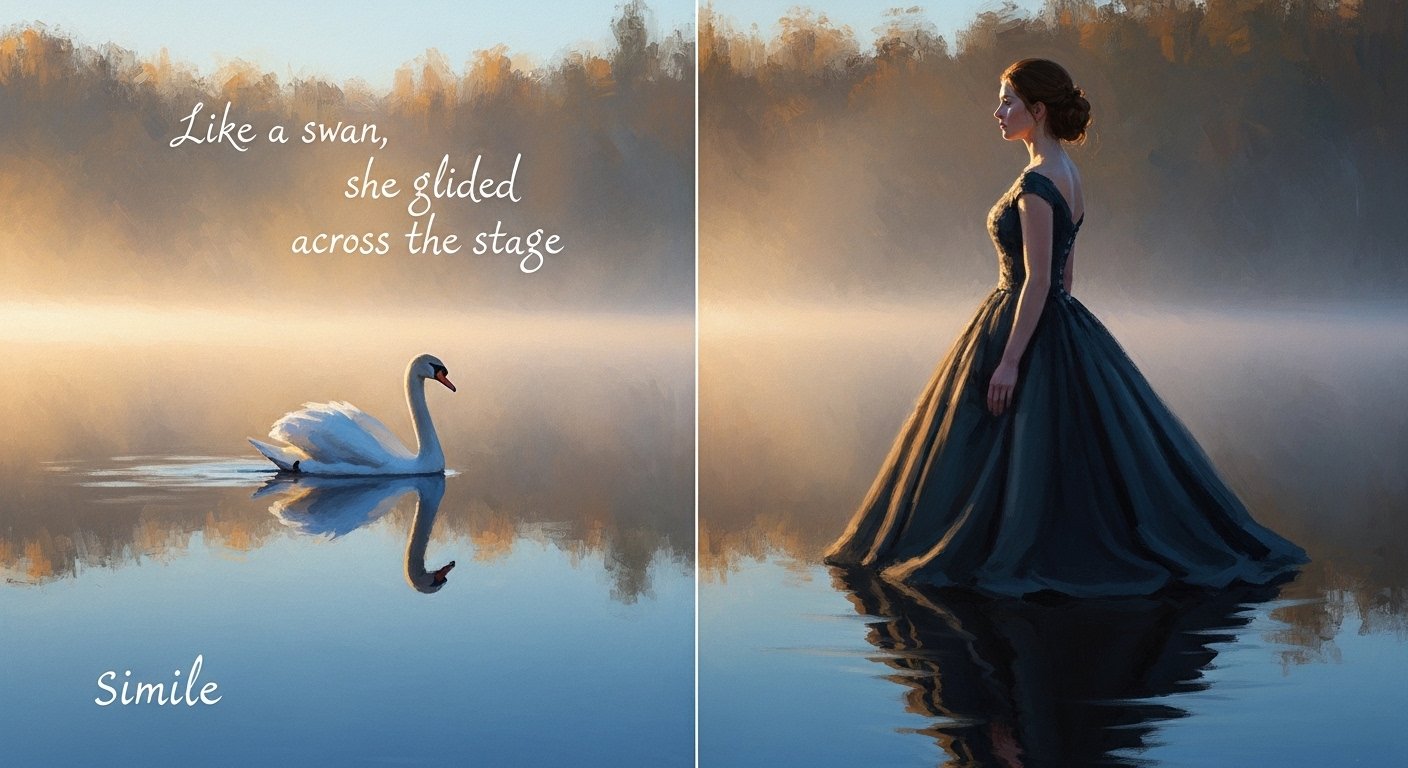
In a small classroom, a teacher asked her students to describe the rain outside. One child said, “The rain is like silver threads.” Another said, “The rain is silver threads.” Both sentences painted a picture. Yet they were not the same. This is the heart of the Difference Between Simile and Metaphor.
The Difference Between Simile and Metaphor may look small, but it changes meaning and style. Many learners mix them up. Still, knowing the Difference Between Simile and Metaphor helps you write with power and beauty. When you understand the Difference Between Simile and Metaphor, your words become clearer and stronger.
Let us explore this word journey together.
Key Difference Between the Both
A simile compares two things using the words like or as.
A metaphor compares two things directly without using like or as.
That is the core line between them.
Why Is Their Difference Necessary to Know for Learners and Experts?
Language builds society. Writers shape ideas. Teachers guide minds. Leaders inspire people.
If learners know the right figure of speech, they can express feelings well. Experts use them to write speeches, poems, and research with style. Clear use avoids confusion. Good use builds strong communication.
Knowing the difference helps in exams, creative writing, public speaking, and media work. Words can move hearts or mislead minds. So this knowledge matters.
Pronunciation
Simile
US: /ˈsɪməli/
UK: /ˈsɪmɪli/
Metaphor
US: /ˈmɛtəfɔːr/
UK: /ˈmɛtəfə/
Now that we know the basics, let us step into the main comparison.
Difference Between Simile and Metaphor
Here are 10 clear points. Each point has two examples.
1. Use of Comparing Words
Simile: Uses like or as.
- Her smile is like sunshine.
- He runs as fast as lightning.
Metaphor: No like or as.
- Her smile is sunshine.
- He is lightning on the track.
2. Directness
Simile: Makes a soft comparison.
- The baby slept like a kitten.
- The sky is blue as the ocean.
Metaphor: Makes a bold statement.
- The baby is a kitten.
- The sky is an ocean.
3. Strength of Image
Simile: Gentle image.
- His voice is like music.
- The water shines like glass.
Metaphor: Strong image.
- His voice is music.
- The water is glass.
4. Emotional Effect
Simile: Feels light.
- She is as brave as a lion.
- He fought like a warrior.
Metaphor: Feels powerful.
- She is a lion.
- He is a warrior.
5. Length of Expression
Simile: Often longer.
- The road was like a snake in the hills.
- Her eyes were like stars in the dark.
Metaphor: Short and sharp.
- The road was a snake.
- Her eyes were stars.
6. Common in Speech
Simile: Used in daily talk.
- I am as busy as a bee.
- He eats like a horse.
Metaphor: More common in poetry and speeches.
- Time is money.
- The classroom was a zoo.
7. Clarity
Simile: Easy to understand.
- The pillow is soft like cotton.
- He stood firm as a rock.
Metaphor: Needs deeper thought.
- The pillow is cotton.
- He is a rock.
8. Teaching Level
Simile: Taught early in school.
- She sings like a bird.
- The snow fell like feathers.
Metaphor: Taught with more detail.
- She is a bird on stage.
- The snow was feathers from the sky.
9. Literal Risk
Simile: Safer. It shows it is a comparison.
- The boy is like a monkey.
- The cloud is like cotton.
Metaphor: Can confuse if taken literally.
- The boy is a monkey.
- The cloud is cotton.
10. Use in Literature
Simile: Adds beauty softly.
- Her face shone like the moon.
- The wind cried like a child.
Metaphor: Builds deep meaning.
- Her face was the moon.
- The wind was a crying child.
Nature and Behaviour of Both
A simile behaves like a bridge. It connects two ideas gently. It signals the reader clearly.
A metaphor behaves like a mask. It replaces one idea with another. It asks the reader to think deeper.
Why People Get Confused About Simile and Metaphor
Both compare things, create images and are figures of speech.
The small difference of like or as often goes unnoticed. Many metaphors also sound poetic like similes. So learners mix them.
Table: Difference and Similarity
| Feature | Simile | Metaphor | Similarity |
|---|---|---|---|
| Comparison | Uses like/as | Direct comparison | Both compare |
| Strength | Gentle | Strong | Both create images |
| Clarity | Clear signal | May need thought | Both add style |
| Use | Common in speech | Common in poetry | Both used in writing |
| Purpose | Explain clearly | Express deeply | Both improve language |
Which Is Better in What Situation?
A simile is better when you want clarity. It helps young learners and fits simple essays and daily speech. Similw makes ideas easy to understand. It is safe and friendly.
A metaphor is better when you want power. It suits poetry, speeches, and stories and gives deep meaning in fewer words. A metaphor creates drama and emotion. It leaves a strong mark on the reader’s mind.
How Simile and Metaphor Are Used in Language
Similes use words such as like and as to compare.
Metaphors replace one thing with another. They create symbolic meaning.
Both are used in poems, novels, speeches, and even ads.
Connotative Meaning
Simile: Neutral to positive. It suggests beauty and clarity.
Example: She is as calm as the sea.
Metaphor: Can be positive or negative.
Positive: He is a shining star.
Negative: That place is a jungle.
Idioms and Proverbs Related
- “As busy as a bee.” (Simile)
Example: She is as busy as a bee before exams. - “Time is money.” (Metaphor)
Example: He works fast because time is money. - “The world is a stage.” (Metaphor, from As You Like It)
Example: We all act because the world is a stage.
Works in Literature
- Romeo and Juliet – Tragedy, William Shakespeare, 1597
- The Road Not Taken – Poetry, Robert Frost, 1916
- Paradise Lost – Epic Poetry, John Milton, 1667
Movies Related to Metaphorical Themes
- The Lion King – 1994, USA
- Life of Pi – 2012, USA/UK
Five Frequently Asked Questions
1. Is every simile a metaphor?
No. A simile uses like or as.
2. Can a metaphor be one word?
Yes. Example: He is a snake.
3. Which is older in literature?
Both are ancient. They appear in early poetry.
4. Are they used in academic writing?
Yes, but carefully.
5. Are similes easier for children?
Yes. They are clearer.
How Both Are Useful ?
Similes make teaching easy. They help explain science, nature, and feelings.
Metaphors inspire society. Leaders use them in speeches. Writers use them to shape culture. They color daily language. They make life less dull.
Final Words for Both
Simile is gentle light.
Metaphor is deep fire.
Both are tools of beauty. Both give life to language.
Conclusion
The Difference Between Simile and Metaphor is simple but important. A simile uses like or as. A metaphor makes a direct claim. Yet both help us see the world in new ways. They add color to speech and writing. They help learners grow and experts shine. When you understand their nature, you control the power of comparison. Words then become paint, and language becomes art. Learn more…
Hi All! I’m Imran Abbas. I’m a Ph.D (scholar) in Structural Chemistry and I work in a number of domains like Bioinformatics, Literature, politics, sports and I’m a polyglot as well. I respect all irrespective of their ethnicity, locality and color. I’m always ready to learn new ideas and travel to different parts of the world.