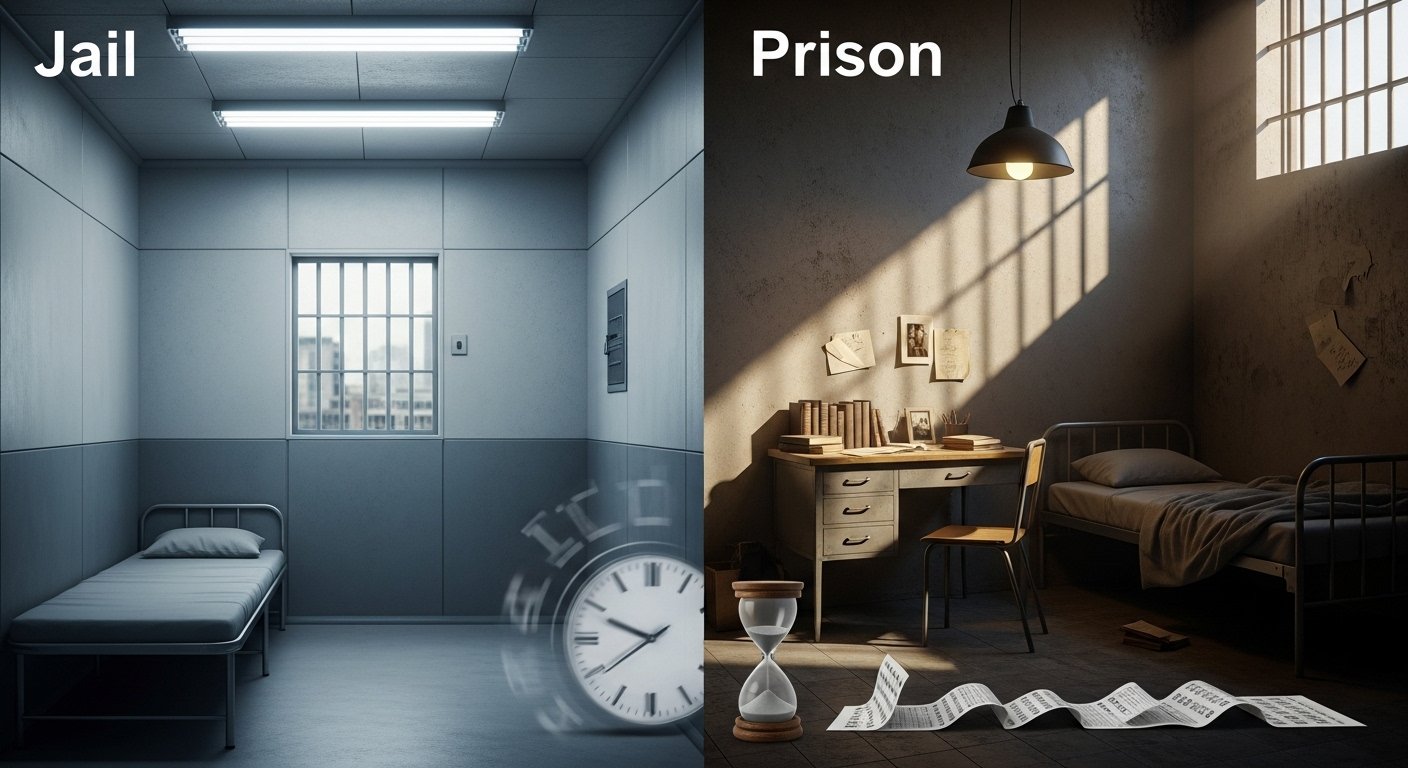
One night, a man was arrested after a street fight. First, he was taken to jail. He waited there for his court date. Months later, after the judge gave a long sentence, he was sent to prison. This simple story shows the difference between prison and jail.
Many people mix up these words. Yet the difference between prison and jail is clear and important. Jail is for short stays. Prison is for long punishment. Knowing the difference between prison and jail helps us understand crime, law, and justice. In daily talk, news reports, and legal study, the difference between prison and jail matters more than we think.
Key Difference Between the Both
The main difference is time and purpose.
- Jail is for short-term holding.
- Prison is for long-term punishment.
Now let us explore this in detail.
Why Their Difference Is Important in Society
Understanding the difference helps:
- Students learn legal terms clearly.
- Journalists report crime correctly.
- Lawyers use exact language in court.
- Citizens understand justice news better.
It builds legal awareness in society. Clear words create clear thinking.
Pronunciation
Prison
- US: /ˈprɪzən/
- UK: /ˈprɪzən/
Jail
- US: /dʒeɪl/
- UK: /dʒeɪl/
Language shapes meaning. So now, let us move to the full comparison.
More About Difference Between Prison and Jail
1. Length of Stay
Jail: Short stay, usually less than one year.
Example 1: A man waits 3 months in jail for trial.
Example 2: A driver stays in jail for 10 days for drunk driving.
Prison: Long stay, usually more than one year.
Example 1: A robber serves 10 years in prison.
Example 2: A murderer gets life in prison.
2. Type of Offense
Jail: Minor crimes.
Example 1: Shoplifting leads to jail time.
Example 2: Small fights may end in jail.
Prison: Serious crimes.
Example 1: Armed robbery leads to prison.
Example 2: Kidnapping leads to prison.
3. Who Runs It
Jail: Local government or county.
Example 1: A city manages its jail.
Example 2: A county sheriff runs the jail.
Prison: State or federal government.
Example 1: A state prison holds state criminals.
Example 2: A federal prison holds federal offenders.
4. Purpose
Jail: Hold people before trial or short punishment.
Example 1: A suspect waits for court.
Example 2: A person cannot pay bail and stays in jail.
Prison: Long-term punishment after conviction.
Example 1: A criminal serves a 15-year sentence.
Example 2: A gang leader serves life.
5. Facilities
Jail: Basic facilities.
Example 1: Small cells.
Example 2: Limited programs.
Prison: Larger facilities.
Example 1: Work programs.
Example 2: Education classes.
6. Population Size
Jail: Smaller groups.
Example 1: 100 inmates in a local jail.
Example 2: People move in and out daily.
Prison: Large population.
Example 1: 1,500 inmates in one prison.
Example 2: Stable long-term population.
7. Security Level
Jail: Lower security.
Example 1: Few armed guards.
Example 2: Less strict movement rules.
Prison: Different security levels.
Example 1: Maximum security prison for violent criminals.
Example 2: Minimum security for low-risk inmates.
8. Daily Routine
Jail: Short routine, less structure.
Example 1: Inmates wait most of the day.
Example 2: Few activities.
Prison: Strict routine.
Example 1: Work assignments.
Example 2: Scheduled programs.
9. Legal Status
Jail: Many inmates are not yet convicted.
Example 1: A suspect waits for trial.
Example 2: A person waits for bail hearing.
Prison: All inmates are convicted.
Example 1: A court gives final sentence.
Example 2: Appeal is in process but sentence continues.
10. Emotional Impact
Jail: Stress of waiting.
Example 1: Fear of unknown court result.
Example 2: Anxiety about bail.
Prison: Long-term mental effect.
Example 1: Missing family for years.
Example 2: Adapting to prison culture.
Nature and Behaviour of the Both

Jail: Fast-changing place. People come and go daily. The mood feels uncertain.
Prison: Stable but strict. Inmates follow rules for years. The system feels heavy and controlled.
Why People Confuse Prison and Jail
People confuse them because both lock people behind bars. Movies often use the words as the same. In daily speech, people do not think about legal details.
Table: Difference and Similarity Between Prison and Jail
| Feature | Jail | Prison | Similarity |
|---|---|---|---|
| Length | Short-term | Long-term | Both involve custody |
| Crime Type | Minor | Serious | Both deal with crime |
| Control | Local | State/Federal | Government run |
| Purpose | Holding | Punishment | Legal system part |
| Population | Smaller | Larger | Inmates live inside |
Which Is Better in What Situation?
Jail is better when a person needs temporary holding before trial. It is designed for short stays and It keeps suspects safe while the court decides. It also handles small crimes quickly.
Prison is better when society needs long-term punishment. Serious criminals require strict control. Prison offers structured programs. It can also give training and education for reform.
How the Words Appear in Metaphors and Similes
People use these words beyond law.
- “My office feels like a jail.”
- “He lives in a prison of fear.”
Here, jail means restriction. Prison means deep emotional trap. Learn more….
Connotative Meaning
Jail – Negative or neutral
Example: “He spent a night in jail.”
Prison – Strong negative
Example: “She feels trapped in a prison of guilt.”
Idioms and Proverbs
- “Out of jail free card”
Example: He used money as an out of jail free card. - “Prison of your own making”
Example: His lies became a prison of his own making.
Works in Literature
- “The Count of Monte Cristo” – Adventure novel by Alexandre Dumas (1844)
- “The Ballad of Reading Gaol” – Poem by Oscar Wilde (1898)
Movies
- The Shawshank Redemption (1994, USA)
- Escape Plan (2013, USA)
Five Frequently Asked Questions
1. Is jail the same as prison?
No. Jail is short-term. Prison is long-term.
2. Can someone go to jail before trial?
Yes. Many people wait in jail for court.
3. Do all criminals go to prison?
No. Minor crimes may lead to jail only.
4. Who controls prisons?
State or federal government.
5. Are prisons more secure than jails?
Yes. Most prisons have higher security.
How Both Are Useful for Surroundings

Jail protects the community from sudden threats. It keeps suspects safe until court.
Prison protects society from serious criminals for a long time. It also offers reform programs. Both help maintain order.
Final Words for the Both
Jail is short and temporary. Prison is long and serious. Each has its role in justice.
Conclusion
The difference between prison and jail is simple but important. Jail is for short stays and minor crimes. Prison is for long sentences and serious crimes. They serve different purposes in the justice system. When we understand this difference, we speak more clearly and think more wisely. Clear language supports fair law. So next time you hear crime news, you will know exactly which word fits.

Hi All! I’m Imran Abbas. I’m a Ph.D (scholar) in Structural Chemistry and I work in a number of domains like Bioinformatics, Literature, politics, sports and I’m a polyglot as well. I respect all irrespective of their ethnicity, locality and color. I’m always ready to learn new ideas and travel to different parts of the world.