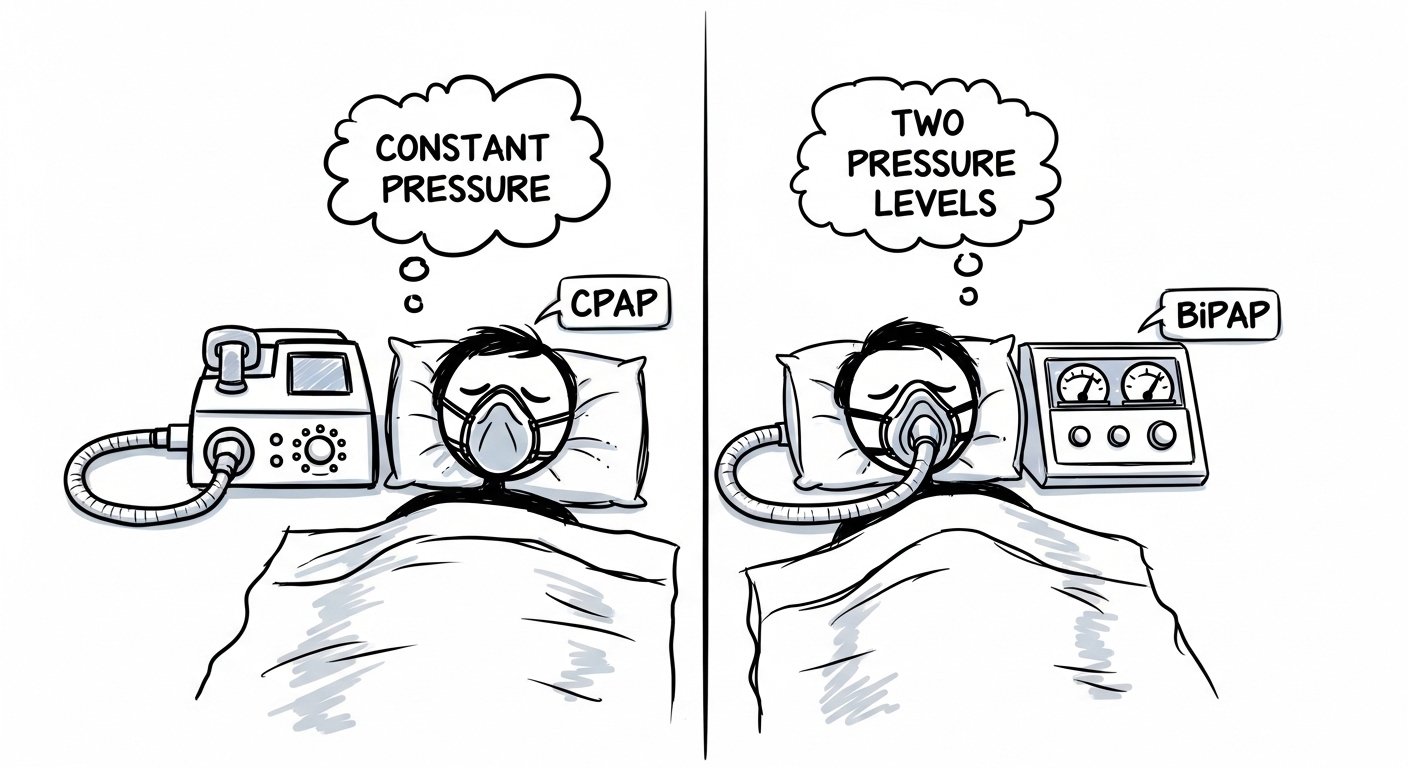
Let’s understand the difference between CPAP and BiPAP by thinkng of a man with sleep apnea once said, “My doctor gave me a CPAP, but my friend uses a BiPAP. Are they the same?” The doctor replied, “They both help you breathe, but they do it in different ways.” That simple answer captures the story behind CPAP and BiPAP.
When people hear CPAP and BiPAP, they often think of masks, air pressure, and sleep machines. Both devices support breathing and are used at night. These are used to treat sleep apnea and other lung problems. Yet CPAP and BiPAP work differently inside. Understanding the difference between CPAP and BiPAP helps patients, caregivers, and medical students choose the right therapy.
Pronunciation
CPAP
US: /ˈsiːˌpæp/
UK: /ˈsiːˌpæp/
BiPAP
US: /ˈbaɪˌpæp/
UK: /ˈbaɪˌpæp/
Now let us look at how these machines truly differ.
Key Difference Between the Both
CPAP gives one steady air pressure.
BiPAP gives two different pressures, one for breathing in and one for breathing out.
Difference Between CPAP and BiPAP
1. Full Form
CPAP means Continuous Positive Airway Pressure.
BiPAP means Bilevel Positive Airway Pressure.
Examples:
- CPAP for mild sleep apnea
- BiPAP for severe breathing issues
2. Air Pressure Type
CPAP gives one constant pressure.
BiPAP gives higher pressure when inhaling and lower pressure when exhaling.
Examples:
- CPAP: Fixed 10 cm H₂O
- BiPAP: 14 cm H₂O inhale, 8 cm H₂O exhale
3. Comfort Level
CPAP may feel hard when breathing out.
BiPAP feels easier because pressure drops during exhale.
Examples:
- Patient struggles with CPAP exhale
- Patient feels relief on BiPAP
4. Medical Use
CPAP treats obstructive sleep apnea.
BiPAP treats sleep apnea and lung diseases like COPD.
Examples:
- CPAP for snoring and apnea
- BiPAP for COPD patient
5. Complexity
CPAP is simpler.
BiPAP has more settings.
Examples:
- Basic home CPAP machine
- Hospital-grade BiPAP machine
6. Cost
CPAP is usually less expensive.
BiPAP costs more.
Examples:
- Entry-level CPAP
- Advanced BiPAP system
7. Pressure Adjustment
CPAP pressure stays steady all night.
BiPAP adjusts between inhale and exhale.
Examples:
- CPAP fixed mode
- BiPAP spontaneous mode
8. Use in Hospitals
CPAP is common at home.
BiPAP is often used in hospitals for respiratory distress.
Examples:
- CPAP for home sleep therapy
- BiPAP in ICU care
9. Suitability
CPAP suits mild to moderate cases.
BiPAP suits severe cases or patients with weak breathing muscles.
Examples:
- Mild apnea patient
- Neuromuscular disorder patient
10. Insurance Coverage
CPAP is widely covered.
BiPAP may need special approval.
Examples:
- CPAP prescription coverage
- BiPAP prior authorization
Nature and Behaviour
CPAP is steady and simple. It keeps airways open with constant force.
BiPAP is flexible and adaptive. It responds to breathing cycles.
Why Are People Confused About Their Use?
Both machines look similar due to masks and tubes and both treat apnea. Many patients think BiPAP is just a stronger CPAP, but the difference lies in pressure delivery.
Difference and Similarity Table
| Feature | CPAP | BiPAP |
|---|---|---|
| Pressure | One level | Two levels |
| Use | Sleep apnea | Apnea + lung disease |
| Comfort | May feel harder | Easier exhale |
| Cost | Lower | Higher |
| Similarity | Both provide positive airway pressure therapy |
Which Is Better in What Situation?
CPAP is better for simple obstructive sleep apnea. It is easy to use and affordable. Many patients adjust well after short practice. It works well when constant pressure is enough to keep airways open.
BiPAP is better for patients who struggle to exhale against pressure or who have serious lung problems. It supports weak breathing muscles and reduces effort. In hospital settings, BiPAP offers more advanced control.
How Are the Keywords Used in Metaphors and Similes?
CPAP can symbolize steady support.
Example: “She was his CPAP in hard times, always steady.”
BiPAP can symbolize flexibility.
Example: “He handled stress like a BiPAP, adjusting with every breath.”
Connotative Meaning
CPAP
Positive: Stability, routine care
Negative: Discomfort at first
Neutral: Medical device
BiPAP
Positive: Advanced support
Negative: Serious illness association
Neutral: Respiratory therapy machine
Works in Literature
Medical textbooks often discuss CPAP and BiPAP in sleep medicine and respiratory therapy chapters.
Movies Related to the Keywords
CPAP and BiPAP appear in medical dramas such as:
- Grey’s Anatomy
- House
Five Frequently Asked Questions
1. Is BiPAP better than CPAP?
Not always. It depends on medical need.
2. Can I switch from CPAP to BiPAP?
Only with doctor advice.
3. Is BiPAP used only in hospitals?
No. It can be used at home too.
4. Which is more comfortable?
Many find BiPAP easier to exhale with.
5. Do both treat sleep apnea?
Yes, but BiPAP treats more severe conditions too.
How Are Both Useful for Surroundings?
Both devices improve sleep, reduce health risks, and lower hospital visits. They help patients live normal lives. Families benefit from better sleep and fewer emergencies.

Final Words for the Both
CPAP is steady air support.
BiPAP is adaptive breathing help.
Conclusion
CPAP and BiPAP both support breathing, yet they work in different ways but CPAP gives one constant pressure, while BiPAP provides two levels for inhale and exhale. CPAP suits common sleep apnea cases. BiPAP fits more complex breathing problems. Understanding their difference helps patients make informed choices and follow proper medical care. Both machines play vital roles in respiratory health and improve quality of life. Know more….

Hi All! I’m Imran Abbas. I’m a Ph.D (scholar) in Structural Chemistry and I work in a number of domains like Bioinformatics, Literature, politics, sports and I’m a polyglot as well. I respect all irrespective of their ethnicity, locality and color. I’m always ready to learn new ideas and travel to different parts of the world.