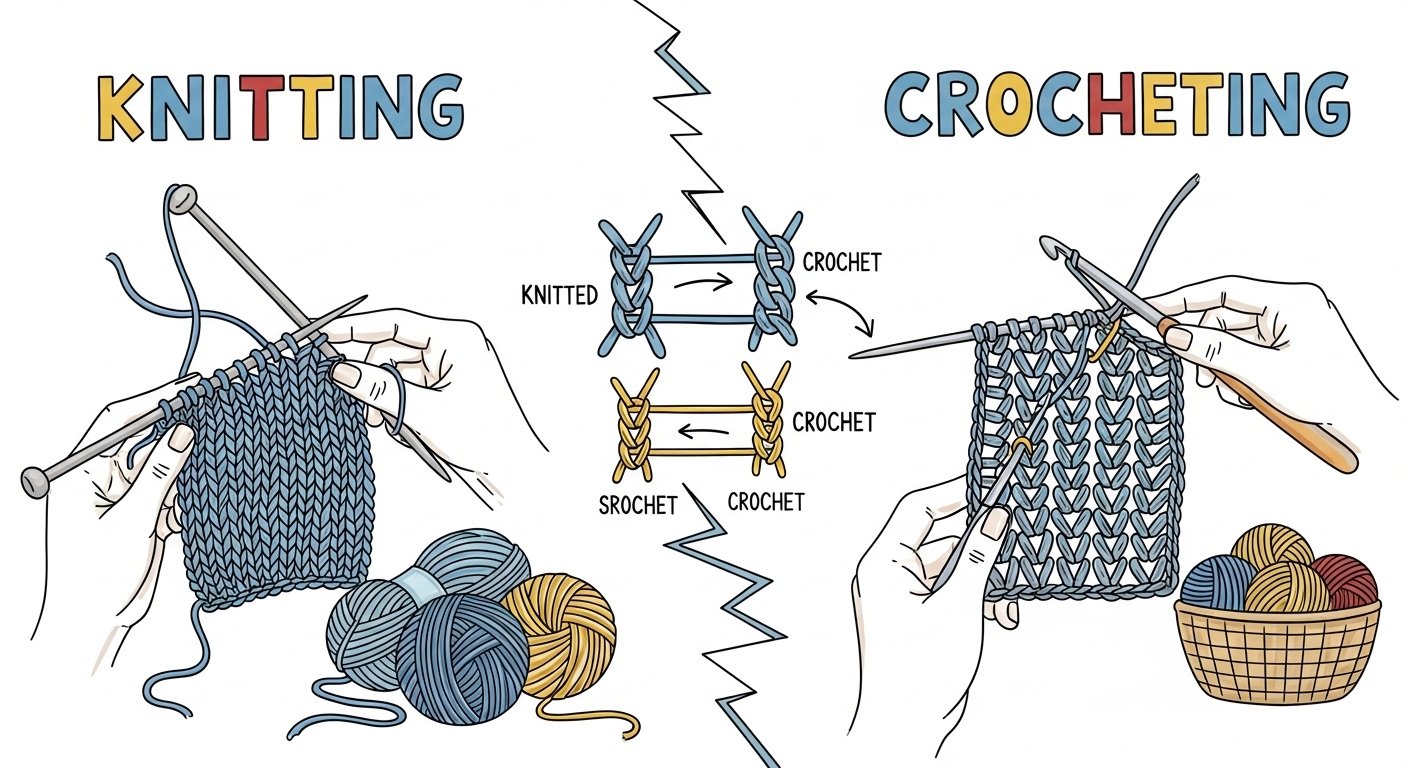
Understanding the difference between knitting and crocheting is important for anyone interested in yarn crafts. Knitting and crocheting both involve creating fabric from yarn, but they differ in tools, techniques, and finished textures. Imagine a grandmother sitting by the fireplace, her hands moving swiftly, creating a soft scarf. She uses knitting needles for one scarf and a crochet hook for another. This simple scene highlights how knowing the difference between knitting and crocheting can affect the outcome of your project. Both skills are timeless, used for making clothing, gifts, and decorative items. For learners, recognizing the difference between knitting and crocheting can save time and help in choosing the right craft for their goals.
Pronunciation:
- Knitting: UK /ˈnɪt.ɪŋ/, US /ˈnɪt̬.ɪŋ/
- Crocheting: UK /ˈkrəʊ.ʃeɪ.ɪŋ/, US /ˈkroʊ.ʃeɪ.ɪŋ/
Knitting and crocheting may seem similar, but subtle differences affect technique, appearance, and use. Let’s dive deeper.
Key Differences
Knitting uses two needles to create loops that interlock, forming a fabric with a smooth texture. Crocheting uses a single hook to pull loops through other loops, resulting in more textured patterns. The differences are visible in flexibility, speed, and design possibilities.
Why Is It Necessary to Know for Learners and Experts?
Knowing their helps learners select the right method for their project. Experts rely on these distinctions to teach efficiently, design patterns, and innovate in textile crafts. Society benefits as these crafts preserve cultural heritage, provide sustainable clothing solutions, and even support mental wellness through creative expression.
Key Differences
- Tools Used
- Knitting uses two needles; crocheting uses a single hook.
- Example (Knitting): Making a long scarf with needles.
- Example (Crocheting): Crafting a granny square with a hook.
- Knitting uses two needles; crocheting uses a single hook.
- Basic Technique
- Knitting involves looping yarn on needles; crocheting pulls yarn through loops using a hook.
- Example (Knitting): Stockinette stitch for sweaters.
- Example (Crocheting): Single crochet stitch for blankets.
- Knitting involves looping yarn on needles; crocheting pulls yarn through loops using a hook.
- Speed of Work
- Crocheting is often faster due to fewer tools.
- Example (Knitting): Knitting a sweater can take weeks.
- Example (Crocheting): A small blanket can be completed in days.
- Crocheting is often faster due to fewer tools.
- Fabric Texture
- Knitting produces softer, stretchier fabrics; crocheting creates thicker, textured fabrics.
- Example (Knitting): Socks for flexibility.
- Example (Crocheting): Coasters for sturdiness.
- Knitting produces softer, stretchier fabrics; crocheting creates thicker, textured fabrics.
- Complexity of Patterns
- Knitting allows delicate lace patterns; crocheting makes intricate 3D designs.
- Example (Knitting): Lace shawls.
- Example (Crocheting): Amigurumi toys.
- Knitting allows delicate lace patterns; crocheting makes intricate 3D designs.
- Durability
- Crocheted items are generally stronger for edges; knitted items are more elastic.
- Example (Knitting): Stretchy hat.
- Example (Crocheting): Durable table mat.
- Crocheted items are generally stronger for edges; knitted items are more elastic.
- Ease for Beginners
- Crochet is easier for beginners; knitting needs practice to manage two needles.
- Example (Knitting): Sweater beginners may drop stitches.
- Example (Crocheting): Simple scarf starts easily.
- Crochet is easier for beginners; knitting needs practice to manage two needles.
- Versatility
- Crocheting can create small items quickly; knitting is better for clothing.
- Example (Knitting): Cardigans.
- Example (Crocheting): Hats or bags.
- Crocheting can create small items quickly; knitting is better for clothing.
- Error Correction
- Crocheting mistakes are easier to fix; knitting requires careful unraveling.
- Example (Knitting): Dropped stitch in a sweater.
- Example (Crocheting): Removed one row of granny squares.
- Crocheting mistakes are easier to fix; knitting requires careful unraveling.
- Weight of Finished Fabric
- Knitted fabric is lighter; crocheted fabric is heavier.
- Example (Knitting): Light summer top.
- Example (Crocheting): Thick winter blanket.
- Knitted fabric is lighter; crocheted fabric is heavier.
Nature and Behaviour of Knitting and Crocheting
- Knitting: Soft, flexible, elastic, good for wearable items.
- Crocheting: Strong, textured, decorative, ideal for home crafts and accessories.
Why Are People Confused About Their Use?
Many beginners confuse knitting and crocheting because both use yarn and form loops. Visual similarity hides differences in techniques, tools, and finished texture.
Comparison Table of Knitting and Crocheting
| Feature | Knitting | Crocheting | Similarity |
| Tools | Two needles | Single hook | Both use yarn |
| Fabric | Soft, elastic | Thick, textured | Create patterns |
| Speed | Slower | Faster | Can make clothing and decor |
| Ease | Moderate | Easier | Skill improves with practice |
| Patterns | Lace, smooth | 3D, textured | Can combine in projects |
| Error correction | Harder | Easier | Both correct mistakes |
| Best use | Clothing | Home decor | Handmade items |
| Durability | Moderate | Strong edges | Long-lasting if done well |
Which Is Better in What Situation?
- Knitting is better for stretchy clothing like socks, hats, or sweaters because it gives a soft and flexible fabric.
- Crocheting is better for decorative items, blankets, and quick projects due to its strength, texture, and faster completion time.
How Are Knitting and Crocheting Used in Metaphors and Similes?
- Knitting often symbolizes patience and connection.
- Crocheting represents creativity and intricacy.
- Example metaphor: “Life is like knitting, one loop at a time.”
- Example simile: “Her ideas were crocheted together like a colorful blanket.”
Connotation:
- Knitting: Positive – patience, warmth.
- Crocheting: Positive – creativity, detail-oriented.
Idioms and Proverbs
- “Knit together” – to unite.
- “Crochet one’s way out” – creatively solving a problem.
- Learn more about metaphors and simlies…
Works in Literature
- “Knitting Adventures” – Children’s fiction, Jane Doe, 2018
- “Crochet Dreams” – DIY Craft guide, Mark Smith, 2020
Movies on Knitting and Crocheting
- “The Knitting Club” – 2015, USA
- “Crochet Stories” – 2019, UK
FAQs About Knitting and Crocheting
- Which is easier for beginners?
Crochet is usually easier because it uses one hook. - Can I make clothing with crochet?
Yes, but knitted fabric is more elastic and wearable. - Which is faster?
Crochet projects are often faster. - Are the tools expensive?
Both are affordable; crochet hooks are cheaper. - Can I combine both techniques?
Yes, many designers blend knitting and crochet patterns.
How Are Both Useful for Surroundings?
Knitting and crocheting promote sustainability by repurposing yarn, making reusable items, and reducing textile waste. Handmade items reduce dependence on mass-produced goods, helping the environment.
Final Words
Both knitting and crocheting are valuable crafts. Knitting gives comfort and flexibility, while crocheting adds texture and creativity. Learning this helps you choose the right technique and appreciate both arts fully.
Conclusion
Understanding this difference is essential for beginners and experts. Both skills support creativity, cultural preservation, and mental wellness. Knitting is ideal for flexible clothing, while crocheting excels in decorative and strong fabric projects. Choosing the right technique ensures satisfaction, efficiency, and beautiful results, making yarn crafts a timeless hobby for everyone.
Hi All! I’m Imran Abbas. I’m a Ph.D (scholar) in Structural Chemistry and I work in a number of domains like Bioinformatics, Literature, politics, sports and I’m a polyglot as well. I respect all irrespective of their ethnicity, locality and color. I’m always ready to learn new ideas and travel to different parts of the world.
3 thoughts on “The Difference Between Knitting and Crocheting: A Complete Guide”