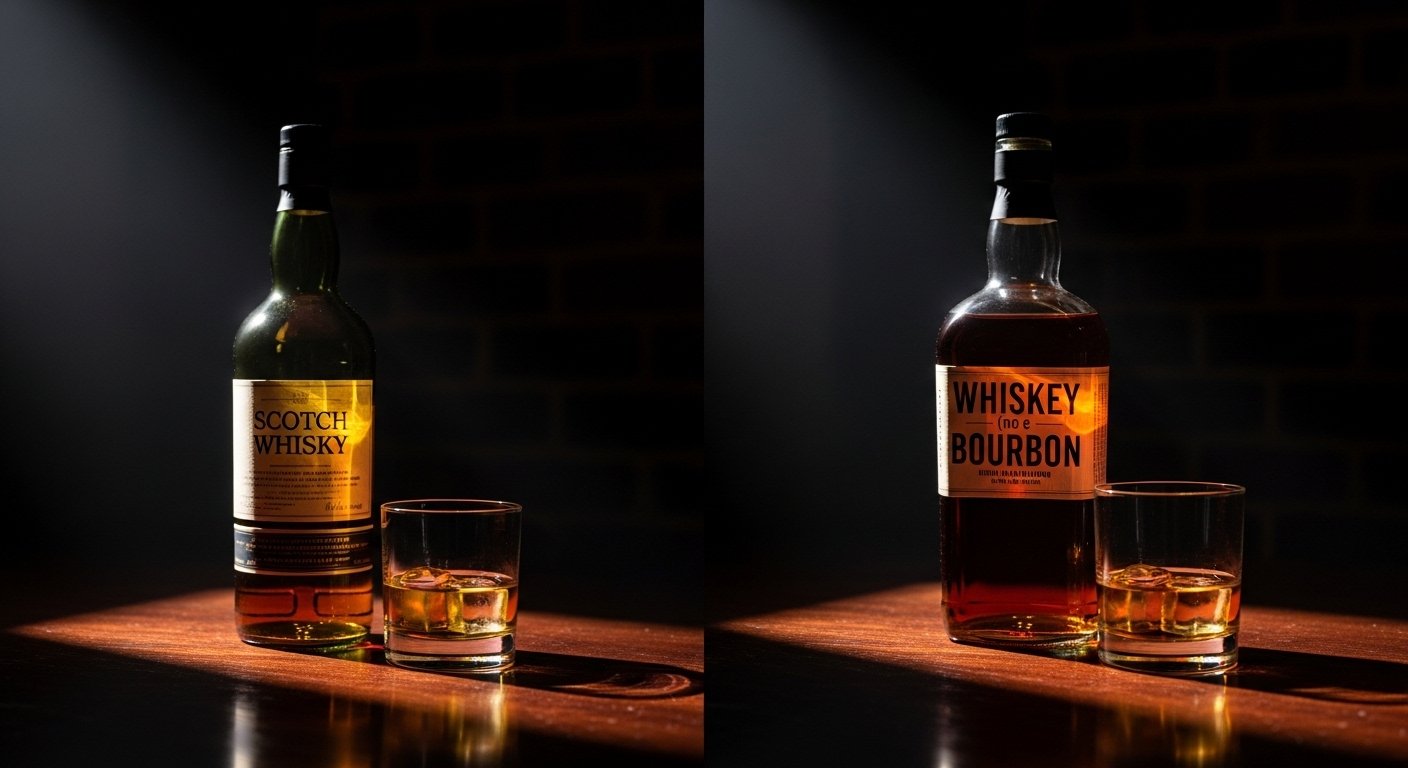
In order to understand the difference between Scothc and Whisky just imagine that the last winter, a traveler walked into a small shop in Edinburgh and asked for whisky. The shopkeeper smiled and handed him a bottle of Scotch. The traveler paused and said, “I asked for whisky, not Scotch.” The shopkeeper replied, “Scotch is whisky.” That short exchange shows why many people are confused about Scotch and Whisky.
When we talk about Scotch and Whisky, we are speaking about strong distilled drinks made from grain. But the words are not always used in the same way. Scotch and Whisky may look similar, taste close, and even share history, yet there are rules behind their names. Knowing the difference between Scotch and Whisky helps you choose wisely, speak correctly, and understand culture better.
Pronunciation
Scotch
US: /skɑːtʃ/
UK: /skɒtʃ/
Whisky
US: /ˈwɪski/
UK: /ˈwɪski/
Now that we know how to say the words, let us see how they truly differ.
Key Difference Between the Both
Scotch is a type of whisky made only in Scotland. Whisky is a general name for distilled grain spirits made in many countries.
Difference Between Scotch and Whisky
1. Place of Origin
Scotch must be made in Scotland.
Whisky can be made in Scotland, Ireland, USA, Japan, and more.
Examples:
- Scotch: The Macallan
- Scotch: Laphroaig
- Whisky: Jameson
- Whisky: Jim Beam
2. Spelling
Scotch uses “whisky.”
Irish and American use “whiskey.”
Examples:
- Scotch label: “Scotch Whisky”
- Irish label: “Irish Whiskey”
3. Ingredients
Scotch often uses malted barley.
Other whisky may use corn, rye, or wheat.
Examples:
- Scotch: Single malt barley
- Bourbon: Mostly corn
4. Aging Rules
Scotch must age at least 3 years in oak barrels.
Other whisky may have different rules.
Examples:
- Scotch: 12-year-old single malt
- Bourbon: Minimum 2 years
5. Flavor
Scotch can taste smoky or peaty.
Other whisky may taste sweet or spicy.
Examples:
- Islay Scotch: Smoky
- Kentucky Bourbon: Sweet
6. Law Protection
Scotch is protected by UK law.
Whisky rules depend on country.
Examples:
- Scotch must follow Scotch Whisky Regulations 2009
- Bourbon must follow US standards
7. Distillation Style
Scotch often uses pot stills.
Some whisky uses column stills.
Examples:
- Single malt Scotch: Pot still
- Grain whisky: Column still
8. Water Source
Scotch uses Scottish water.
Other whisky uses local water.
Examples:
- Highland Scotch: Mountain water
- Japanese whisky: Spring water
9. Climate
Scotland’s cool climate slows aging.
Warmer places age whisky faster.
Examples:
- Scotland: Slow aging
- Kentucky: Faster aging
10. Cultural Identity
Scotch is part of Scottish heritage.
Whisky represents many cultures.
Examples:
- Scottish festivals
- Irish pubs worldwide
Nature and Behaviour
Scotch is strict in rules and identity. It is proud of its land.
Whisky is flexible and global. It adapts to many grains and climates.
Why Are People Confused About Their Use?
People see similar bottles and hear similar words. Some countries spell it differently. Many think Scotch and whisky are two separate drinks, but Scotch is a type of whisky.
Difference and Similarity Table
| Feature | Scotch | Whisky |
|---|---|---|
| Origin | Scotland only | Many countries |
| Spelling | Whisky | Whisky/Whiskey |
| Main Grain | Barley | Corn, rye, wheat |
| Aging | 3+ years | Depends on country |
| Flavor | Smoky, earthy | Sweet, spicy, varied |
| Similarity | Both are distilled grain spirits aged in wood barrels |
Which Is Better in What Situation?
Scotch is better when you want a deep, smoky taste. It suits quiet evenings and slow sipping. It fits formal dinners and tasting events.
Whisky from other countries may be better for cocktails or sweet flavors. Bourbon works well in mixed drinks. Irish whiskey feels smooth and light. The best choice depends on taste and mood.
How Are the Keywords Used in Metaphors and Similes?
Scotch often stands for strength and tradition.
Example: “His voice was as strong as Scotch.”
Whisky can mean warmth or comfort.
Example: “Her words felt like warm whisky on a cold night.”
Connotative Meaning
Scotch
Positive: Tradition, depth, class
Negative: Expensive, strong
Neutral: Alcoholic drink
Whisky
Positive: Warmth, celebration
Negative: Overindulgence
Neutral: Distilled spirit
Idioms and Proverbs
- “Old as Scotch” – very old
Example: This house is old as Scotch. - “Whisky in the jar” – from the Irish song
Example: He sang “Whisky in the Jar” at the party.
Works in Literature
- Kidnapped (Adventure, Robert Louis Stevenson, 1886)
- Under the Volcano (Novel, Malcolm Lowry, 1947)
Movies Related to the Keywords
- Scotch! The Golden Dram (2009, UK)
- The Angels’ Share (2012, UK)
Five Frequently Asked Questions
1. Is Scotch the same as whisky?
No. Scotch is a type of whisky from Scotland.
2. Why does spelling change?
Countries follow their own traditions.
3. Is bourbon Scotch?
No. Bourbon is American whisky.
4. Is Scotch always smoky?
No. Some are light and fruity.
5. Which is stronger?
Both usually have similar alcohol levels.
How Are Both Useful for Surroundings?
Both drinks support farming, tourism, and exports. Distilleries create jobs. Barley and corn farmers earn income. Cultural festivals grow around them. Learn more……
Final Words for the Both
Scotch is focused and rooted in Scotland.
Whisky is global and diverse.
Conclusion
Scotch and Whisky share the same family, yet they are not identical twins. Scotch must come from Scotland and follow strict rules. Whisky is the wider category, made across the world with different grains and styles. Their flavors, laws, and cultures shape their identity. Understanding Scotch and Whisky helps buyers choose better and speak correctly. In the end, the choice is personal. Some prefer smoky depth. Others enjoy sweet warmth. Both carry history in every sip.
Hi All! I’m Imran Abbas. I’m a Ph.D (scholar) in Structural Chemistry and I work in a number of domains like Bioinformatics, Literature, politics, sports and I’m a polyglot as well. I respect all irrespective of their ethnicity, locality and color. I’m always ready to learn new ideas and travel to different parts of the world.
4 thoughts on “Difference Between Scotch and Whisky: The Decisive Difference”