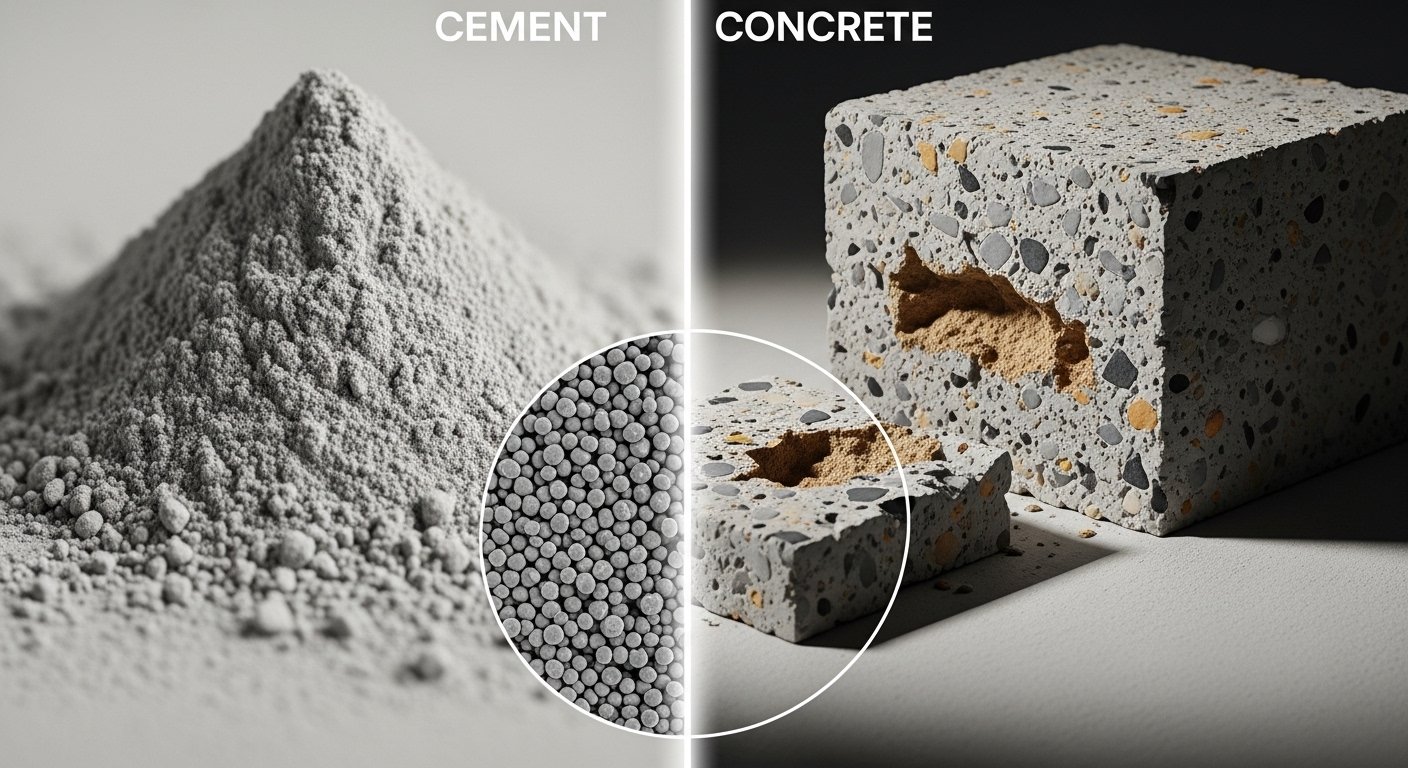
A man once told a builder, “The cement on my driveway is cracking.” The builder smiled and said, “That is not cement. That is concrete.” This small mix-up happens every day. Many people confuse Cement and Concrete because they look similar and are used together. But Cement and Concrete are not the same thing.
When we talk about Cement and Concrete, we are speaking about building materials. Cement is a fine gray powder. Concrete is a hard material made by mixing cement with sand, stone, and water. Understanding Cement and Concrete helps in construction, design, and daily conversation. If you know the difference between Cement and Concrete, you speak clearly and build wisely.
Pronunciation

Cement
US: /sɪˈmɛnt/
UK: /sɪˈment/
Concrete
US (noun): /ˈkɑːnkriːt/
UK (noun): /ˈkɒŋkriːt/
Now let us move from sound to substance.
Key Difference Between the Both
Cement is an ingredient.
Concrete is the finished product made from cement.

Difference Between Cement and Concrete
1. Basic Meaning
Cement is a powder that acts like glue.
Concrete is a solid material formed after mixing cement with other materials.
Examples:
- Cement: Portland cement
- Cement: White cement used for tiles
- Concrete: Concrete road
- Concrete: Concrete bridge
2. Composition
Cement is made from limestone, clay, and minerals.
Concrete contains cement, sand, gravel, and water.
Examples:
- Cement factory product
- Ready-mix concrete truck
3. Function
Cement binds materials together.
Concrete forms buildings and structures.
Examples:
- Cement in mortar
- Concrete in foundations
4. Strength
Cement alone cracks easily.
Concrete becomes very strong after curing.
Examples:
- Dry cement powder breaks easily
- Concrete pillars support buildings
5. Use in Construction
Cement is used in small amounts.
Concrete is used in large volumes.
Examples:
- Cement for plaster
- Concrete for dams
6. Cost
Cement is cheaper per bag.
Concrete costs more due to materials and mixing.
Examples:
- One bag of cement
- Truckload of concrete
7. Setting Process
Cement reacts with water.
Concrete hardens over time after mixing.
Examples:
- Cement hydration
- Concrete curing for 28 days
8. Appearance
Cement is a fine gray powder.
Concrete is hard and stone-like.
Examples:
- Cement bag in store
- Concrete sidewalk
9. Durability
Cement alone is not durable.
Concrete lasts for decades.
Examples:
- Cement cracks
- Concrete buildings stand for years
10. Cultural Use of Words
People often say “cement road.”
Technically, it is a concrete road.
Examples:
- “Cement house”
- Correct term: concrete house
Nature and Behaviour

Cement is reactive. It changes when mixed with water.
Concrete is stable. It becomes solid and strong over time.
Why Are People Confused About Their Use?
People see gray surfaces and assume it is cement. In daily speech, the word cement is used loosely. Since cement is inside concrete, people mix the terms. Media and advertisements also use the words casually.
Difference and Similarity Table
| Feature | Cement | Concrete |
|---|---|---|
| Type | Powder | Solid material |
| Role | Binder | Final structure |
| Ingredients | Limestone, clay | Cement, sand, gravel, water |
| Strength Alone | Weak | Strong |
| Similarity | Both used in construction |
Which Is Better in What Situation?
Cement is better when you need binding material. It works well for plaster, mortar, and small repairs. It is useful for tile fixing and brick joining. Cement acts like glue in construction.
Concrete is better for heavy work. It is used in buildings, bridges, roads, and dams. It handles weight and pressure. When strength and durability are needed, concrete is the right choice.
How Are the Keywords Used in Metaphors and Similes?
Cement often means “to strengthen a relationship.”
Example: “They cemented their friendship.”
Concrete means “clear and real.”
Example: “Give me concrete proof.”
Connotative Meaning
Cement
Positive: Strengthen, bond
Negative: Rigid thinking
Neutral: Construction material
Concrete
Positive: Solid, dependable
Negative: Cold, hard
Neutral: Building material
Idioms and Expressions
- “Set in cement” – fixed and unchangeable
Example: His opinion is set in cement. - “Concrete evidence” – strong proof
Example: The lawyer gave concrete evidence.
Works in Literature
- Concrete Island (Novel, J. G. Ballard, 1974, dystopian fiction)
- The Cement Garden (Novel, Ian McEwan, 1978, psychological fiction)
Movies Related to the Keywords
- Concrete Cowboy (2020, USA)
- The Cement Garden (1993, UK)
Five Frequently Asked Questions
1. Is cement stronger than concrete?
No. Concrete is stronger.
2. Can we build a house with only cement?
No. We need concrete.
3. Why do people say cement road?
It is common speech. The correct term is concrete road.
4. How long does concrete take to cure?
About 28 days for full strength.
5. Is concrete waterproof?
It resists water but is not fully waterproof.
How Are Both Useful for Surroundings?
Both materials support housing, roads, bridges, and dams. They create schools, hospitals, and homes. Cement factories and concrete plants provide jobs. Modern cities stand on these materials.
Final Words for the Both
Cement is the quiet binder.
Concrete is the strong builder.
Conclusion
Cement and Concrete work together but are not the same. Cement is the powder that binds. Concrete is the strong material formed after mixing cement with sand, gravel, and water. People often confuse the terms, yet knowing the difference is important in construction and daily speech. Cement acts like glue. Concrete carries weight and builds cities. When we understand Cement and Concrete, we speak clearly and build safely. Learn more…..

Hi All! I’m Imran Abbas. I’m a Ph.D (scholar) in Structural Chemistry and I work in a number of domains like Bioinformatics, Literature, politics, sports and I’m a polyglot as well. I respect all irrespective of their ethnicity, locality and color. I’m always ready to learn new ideas and travel to different parts of the world.