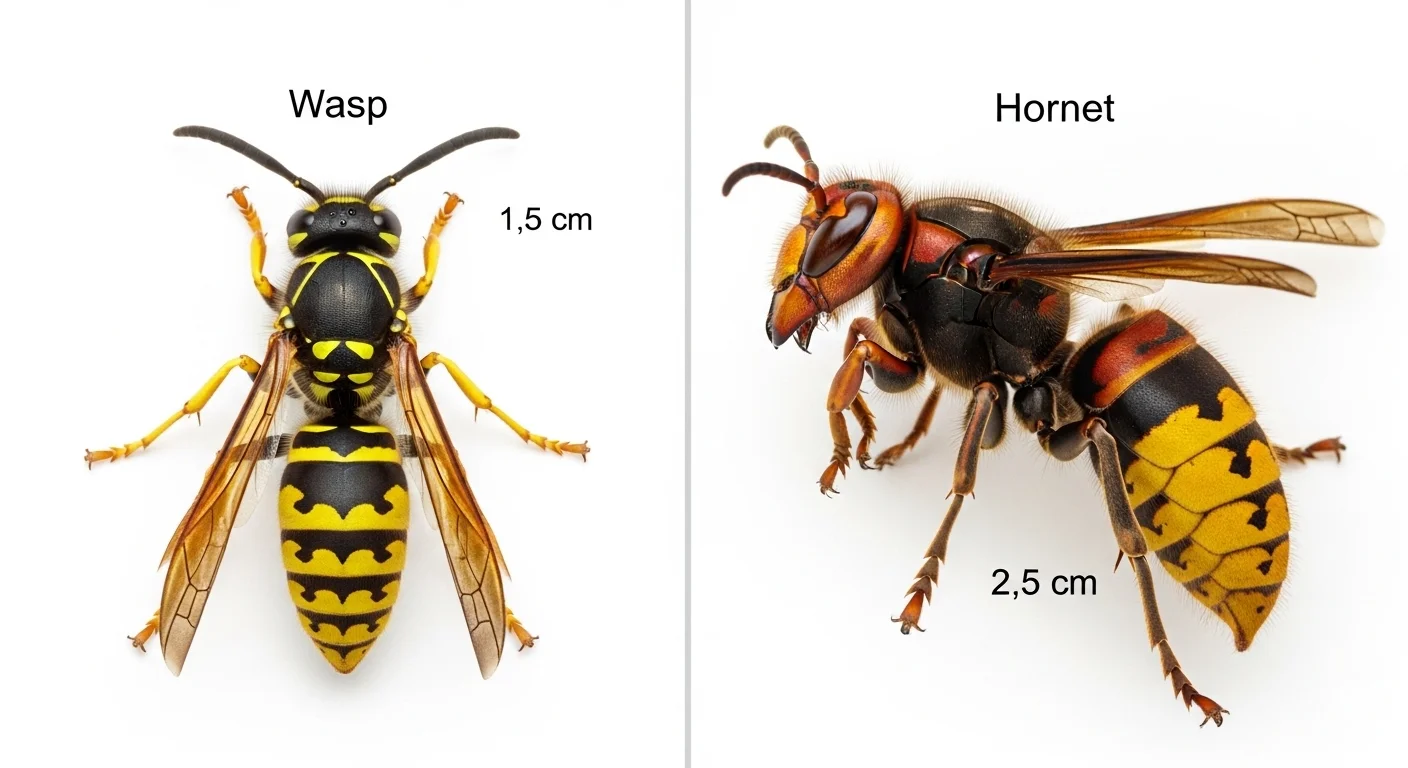
Difference between wasp and hornet is an important topic for anyone interested in insects, gardening, or outdoor safety. Many people mistakenly think these insects are the same, but the difference between wasp and hornet becomes clear when we look at their size, behavior, and nesting habits. Wasps belong to a broad group of stinging insects known for their slim bodies and narrow waists, while hornets are actually a larger and more powerful subgroup of wasps. Because of these distinctions, the difference between wasp and hornet is more significant than most people realize.
Understanding the difference between wasp and hornet can help people identify these insects correctly and avoid unnecessary fear. Hornets usually build larger paper nests and tend to have stronger colony defense, while many wasp species vary widely in appearance and behavior. From their body structure to their nesting style, the difference between wasp and hornet reflects unique evolutionary traits within the insect world. Once you recognize the difference between wasp and hornet, identifying them in gardens, forests, or homes becomes much easier.
You were at a summer barbecue. A buzzing insect dive-bombed your potato salad. Someone shouted “Wasp!” Someone else yelled “Hornet!” Panic ensued. But here’s the truth that would have calmed the table: All hornets are wasps, but not all wasps are hornets.
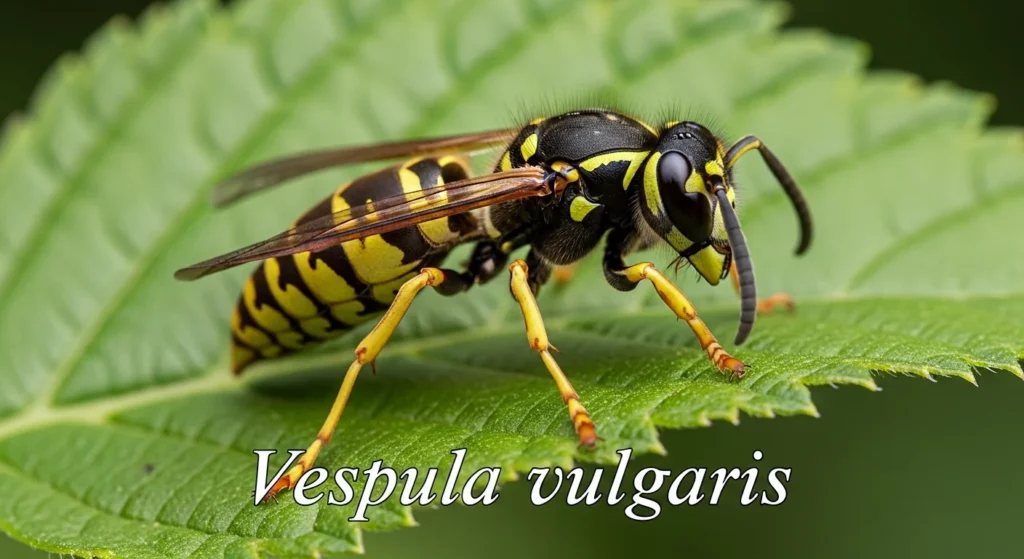
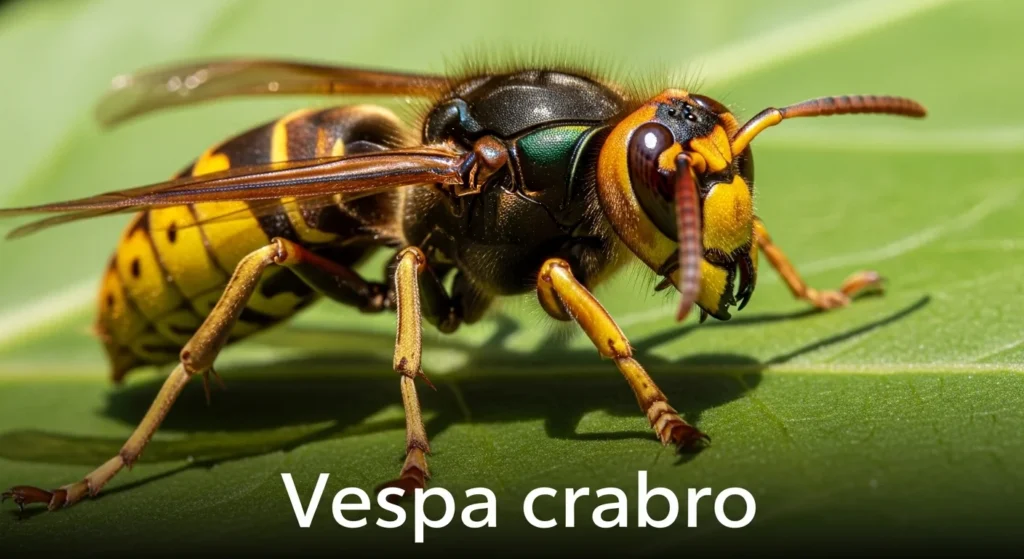
Part 1: The Taxonomic Truth – All Hornets Are Wasps
The Vespidae Family Tree
The confusion begins with imprecise language. In everyday conversation, “wasp” and “hornet” are used interchangeably. Biologically, this is like using “dog” and “German Shepherd” as synonyms.
The Scientific Hierarchy:
| Rank | Classification | Members |
|---|---|---|
| Order | Hymenoptera | Bees, wasps, ants, sawflies |
| Family | Vespidae | Social wasps, hornets, yellowjackets, paper wasps |
| Subfamily | Vespinae | Hornets (Vespa), yellowjackets (Vespula, Dolichovespula) |
| Genus | Vespa | True hornets (22 species worldwide) |
| Species | Vespa crabro | European hornet (only true hornet in North America) |
The Critical Distinction: Hornets are a specific genus (Vespa) within the wasp family (Vespidae). There are over 100,000 wasp species globally, but only 22 true hornet species.
“In short: hornets are wasps, but not all wasps are hornets.” — Britannica
Part 2: The Visual Identification Guide – Spot the Difference
Size: The First Clue
| Feature | Typical Wasps (Yellowjackets, Paper Wasps) | Hornets (Vespa species) |
|---|---|---|
| Length | ½–1 inch (12–25 mm) | ¾–1.5 inches (20–40 mm) |
| Queen size | Slightly larger than workers | Significantly larger, up to 2 inches |
| Body mass | Slender, lightweight | Robust, heavy-bodied |
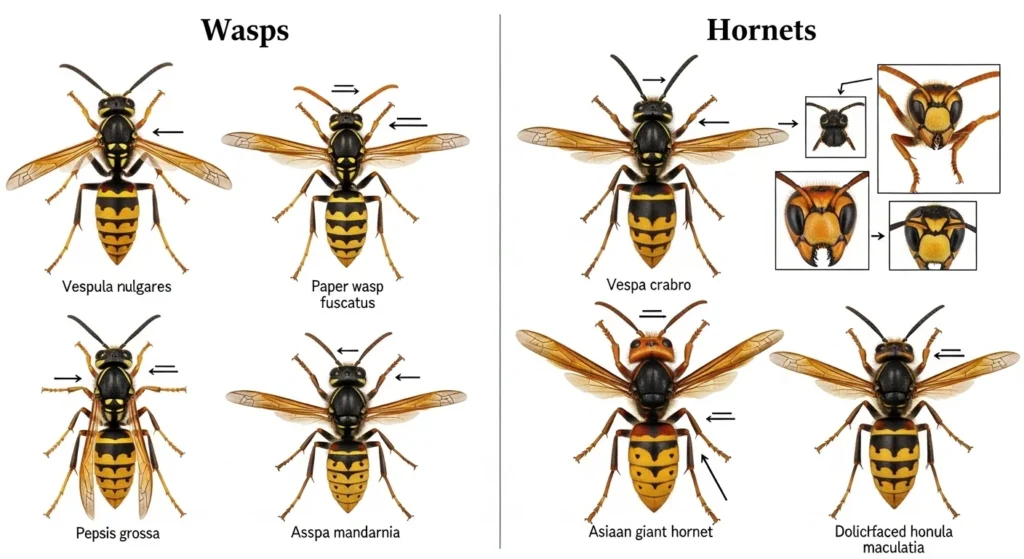
The European Hornet (Vespa crabro): The only true hornet established in North America, introduced in the 1840s, measures ¾ to 1⅜ inches with distinctive brick-red and yellow coloration.
The Northern Giant Hornet (Vespa mandarinia): Dubbed the “murder hornet” by media, reaches 2+ inches—the largest wasp species in the world.
Coloration & Markings
| Species | Color Pattern | Distinguishing Features |
|---|---|---|
| European hornet | Brick-red/brown with yellow abdomen, black thorax markings | Teardrop-shaped abdominal marks, golden face |
| Bald-faced hornet (actually a yellowjacket) | Black with white face, white markings | White face, aerial nest builder |
| Yellowjackets | Bright yellow and black stripes | Angular body, ground or cavity nester |
| Paper wasps | Reddish-brown or dark red with yellow markings | Long dangling legs, umbrella-shaped nest |
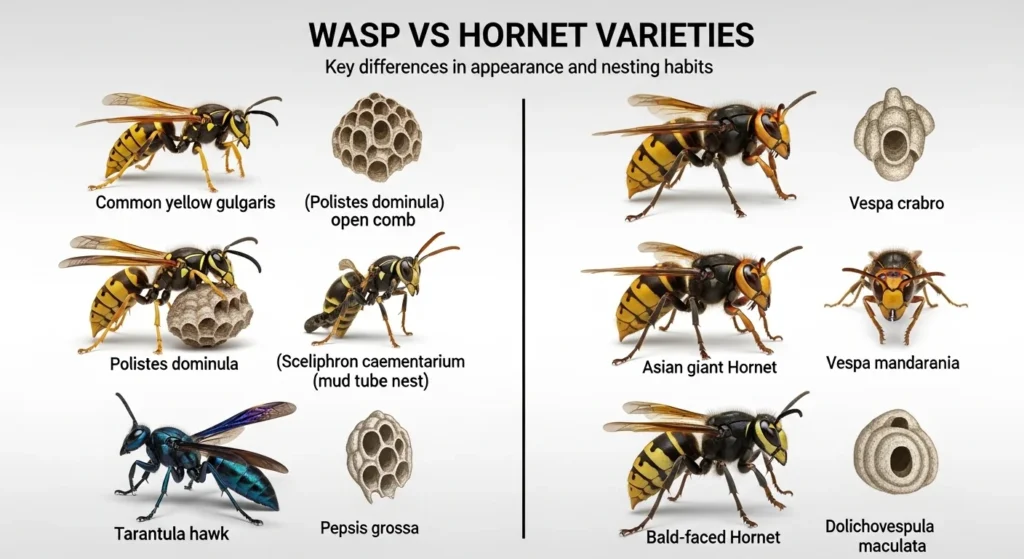
The “Bald-Faced Hornet” Deception: Despite its name, Dolichovespula maculata is not a true hornet. It’s a yellowjacket species—a perfect example of common names misleading scientific reality.
Part 3: Architectural Differences – Nest Construction
The Paper Engineers
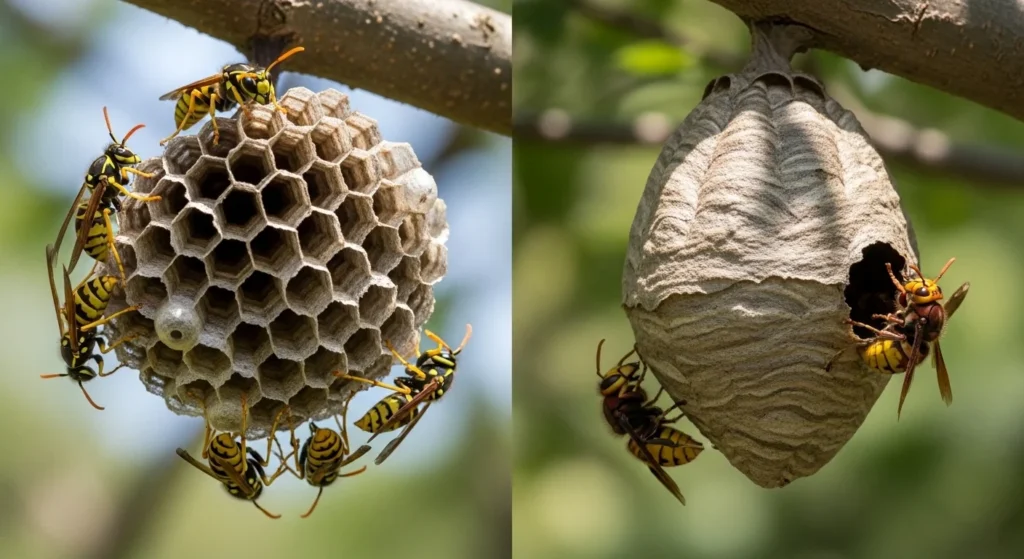
Both wasps and hornets construct nests from wood pulp and saliva, creating a paper-like material. But their architectural styles diverge significantly:
| Feature | Wasp Nests (Yellowjackets, Paper Wasps) | Hornet Nests |
|---|---|---|
| Shape | Irregular, umbrella-shaped (paper wasps); enclosed football-shaped (yellowjackets) | Large, rounded, football-shaped with single entrance |
| Location | Underground, wall voids, eaves, open branches (paper wasps) | High in trees, hollow trees, building cavities, exposed branches |
| Size | Few inches to 12+ inches (yellowjacket nests) | Up to basketball-size or larger, multiple combs |
| Covering | Exposed comb (paper wasps); paper envelope (yellowjackets/hornets) | Thick paper envelope, often striped gray and brown |
| Entrance | Multiple openings | Single, prominent entrance at bottom |
European Hornet Nest Traits:
- Tan-brown color, relatively fragile appearance
- Located in hollow trees, barns, attics, wall voids, abandoned beehives
- Peak population: 200–400 workers, larger nests exceed 1,000
Bald-Faced Hornet (Yellowjacket) Nest Traits:
- Light gray with possible brown stripes
- Exposed, hanging from trees or building overhangs (3–60+ feet high)
- Peak population: 100–400 workers
Part 4: Behavioral Ecology – Aggression, Diet, and Defense
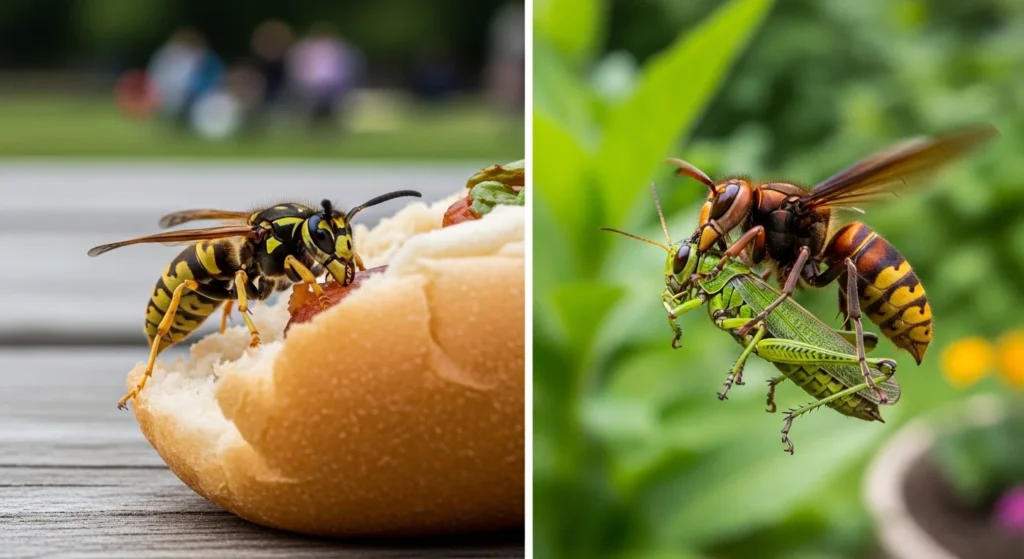
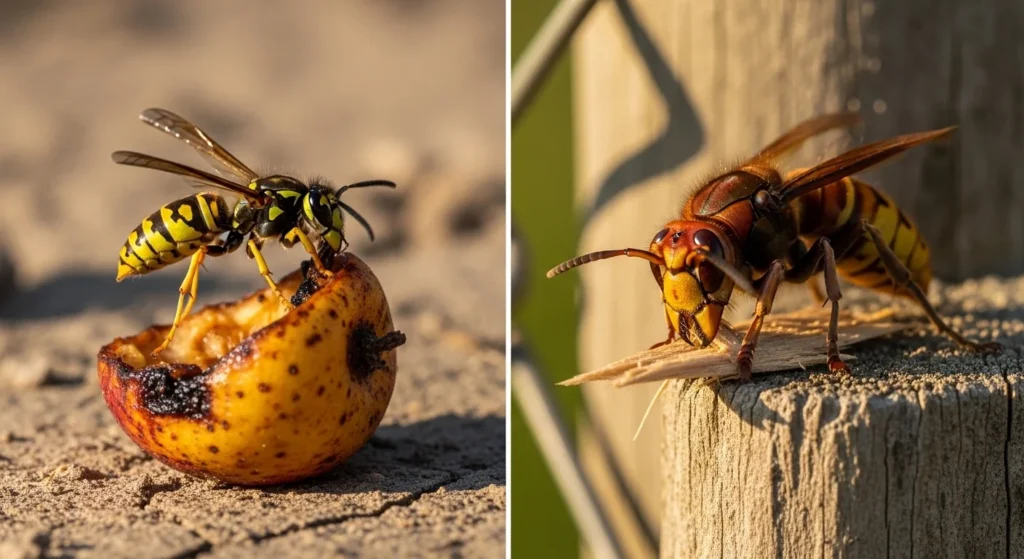
The Aggression Spectrum
| Behavior | Wasps (General) | Hornets (Vespa) |
|---|---|---|
| Defensive radius | Nest vicinity only | Larger territory, more persistent defense |
| Sting multiple times? | Yes (smooth stinger) | Yes (smooth stinger) |
| Venom potency | Painful, localized | More potent, greater pain |
| Night activity | Rare | European hornets fly day AND night |
| Provoked response | Variable by species | Highly territorial, coordinated defense |
The European Hornet’s Unique Behavior:
- Nocturnal flight capability—attracted to lights, may collide with windows
- Bark stripping—damages lilac, viburnum, rhododendron, birch to collect wood pulp and access sap
- Predatory generalists—hunt grasshoppers, flies, bees, other wasps
Dietary Differences
| Species | Primary Diet | Ecological Role |
|---|---|---|
| Yellowjackets | Scavengers: sugary foods, proteins, human garbage | Pest controllers, but nuisance at picnics |
| Paper wasps | Caterpillars, nectar; less aggressive | Beneficial garden predators |
| European hornets | Large insects, tree sap, fruit | Apex predators, pollinators |
| Northern giant hornet | Honeybee colony extermination | Ecological threat (invasive) |
Part 5: The Sting Comparison – What Hurts and Why
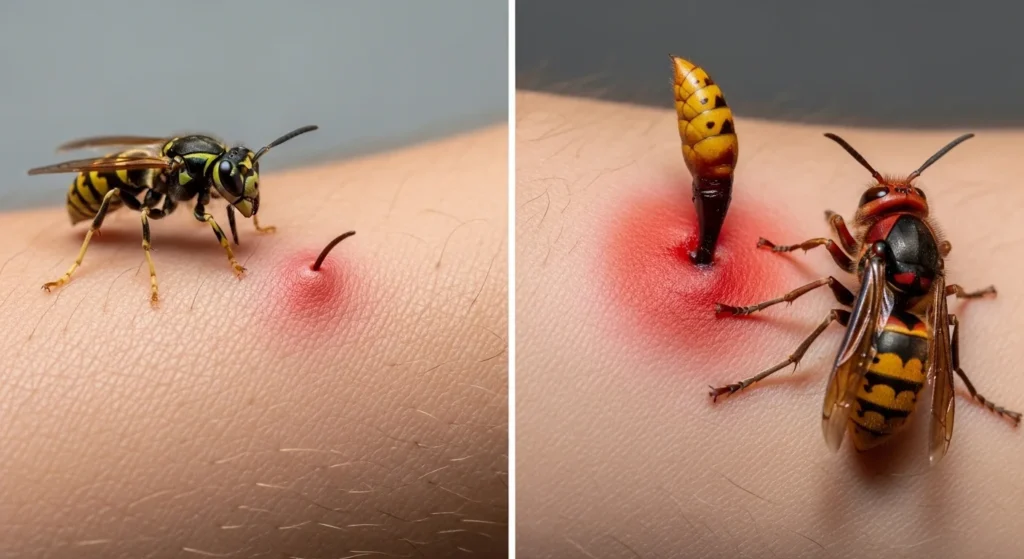
Venom and Medical Risk
| Factor | Wasp Stings | Hornet Stings |
|---|---|---|
| Pain level | Moderate to severe | Severe to extreme (due to larger venom load) |
| Venom composition | Similar peptides, histamines | More acetylcholine, larger volume injected |
| Multiple stings | Common, especially yellowjackets | Less frequent but more dangerous per sting |
| Allergic reaction risk | 3% of population (anaphylaxis) | Similar percentage, potentially more severe |
| Emergency signs | Difficulty breathing, facial swelling, dizziness | Same; seek immediate medical attention |
Critical Safety Note: Both wasps and hornets can sting multiple times (unlike honeybees, which die after one sting). Yellowjackets are responsible for most human stings due to their aggressive colony defense and ground-nesting habits.
Part 6: The Complete Identification Matrix
Quick Reference Guide
| Feature | Paper Wasps | Yellowjackets | Bald-Faced Hornet | European Hornet |
|---|---|---|---|---|
| True hornet? | No | No | No (yellowjacket) | Yes |
| Size | ⅝–1 inch | ½–1 inch | ⅝–¾ inch | ¾–1⅜ inch |
| Color | Reddish-brown, dark red | Yellow/black stripes | Black/white | Brick-red/yellow |
| Nest shape | Umbrella, exposed comb | Enclosed, football | Enclosed, football, aerial | Enclosed, fragile, hidden |
| Nest location | Eaves, branches, door frames | Ground, wall voids, cavities | Trees, building overhangs | Hollow trees, buildings, voids |
| Aggression | Low to moderate | High | High | Moderate to high |
| Nocturnal? | No | No | No | Yes |
Part 7: Seasonal Behavior and Control Strategies
The Annual Cycle
| Season | Wasp/Hornet Activity | Prevention Strategy |
|---|---|---|
| Spring | Queens emerge, establish nests | Seal entry points, early trap placement |
| Summer | Colony growth, peak foraging | Monitor for nest construction, maintain barriers |
| Late Summer/Fall | Maximum aggression, food scarcity | Avoid outdoor eating, secure trash |
| Winter | Only fertilized queens survive; nests abandoned | Remove old nests, seal structures |
DIY Removal Warning: Both wasps and hornets defend nests aggressively. Professional removal is strongly recommended for:
- Nests larger than a softball
- Aerial nests (bald-faced hornets)
- Wall void or ground nests (yellowjackets)
- Multiple nest locations
Part 8: Ecological Value – Beyond the Sting
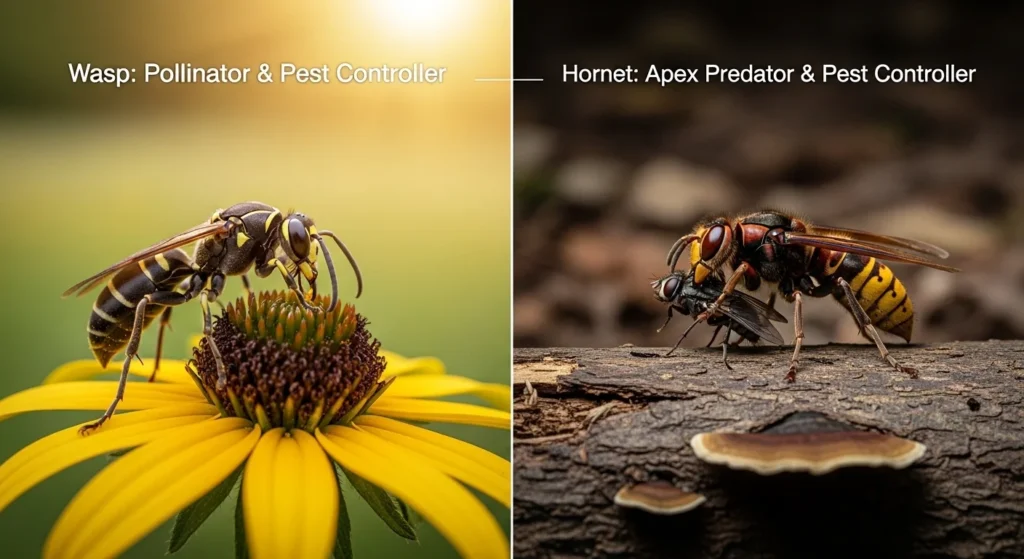
The Unsung Benefits
Despite their fearsome reputation, wasps and hornets are critical ecosystem engineers:
| Service | Contribution |
|---|---|
| Pest control | Hornets and yellowjackets consume tons of caterpillars, flies, and agricultural pests annually |
| Pollination | While less efficient than bees, they visit flowers and transfer pollen |
| Food web support | Prey for birds, spiders, and other insects |
| Carrion removal | Yellowjackets accelerate decomposition of dead animals |
“Wasps can be helpful because they hunt pests like caterpillars and spiders, helping to control insect populations. They can also pollinate flowers.”
The Conservation Context: Indiscriminate destruction of wasp/hornet colonies disrupts local ecosystems. Targeted, professional management balances human safety with ecological function.
Part 9: The Global Perspective – Hornets Worldwide
True Hornets (Vespa genus)
| Species | Distribution | Notable Characteristics |
|---|---|---|
| Vespa crabro | Europe, Asia, introduced to eastern North America | Only true hornet in US/Canada |
| Vespa mandarinia | East Asia, South Asia; invasive in Pacific Northwest | “Northern giant hornet,” largest wasp species |
| Vespa velutina | Asia; invasive in Europe | “Asian hornet,” threatens honeybees |
| Vespa orientalis | Mediterranean, Middle East, Africa | Heat-adapted, urban specialist |
Invasive Species Alert: The northern giant hornet (Vespa mandarinia) gained media attention in 2019–2020 after detection in Washington State. Despite “murder hornet” sensationalism, established populations remain limited, and eradication efforts continue.
Conclusion: From Fear to Understanding
The difference between wasp and hornet is not merely academic—it is practical knowledge that informs safety, conservation, and coexistence.
Remember:
- All hornets are wasps (genus Vespa within family Vespidae)
- Most “hornets” in North America are actually yellowjackets (the bald-faced hornet deception)
- European hornets are the only true hornets established in North America
- Size, nest location, and coloration distinguish species more reliably than common names
- Both wasps and hornets provide essential ecosystem services despite defensive behaviors
The next time a buzzing insect interrupts your picnic, you won’t just panic. You’ll observe, identify, and respond appropriately—armed with the taxonomic truth that transforms fear into informed respect.
FAQ: Wasp vs. Hornet Mastery
Q: Are hornets more dangerous than wasps?
A: Hornets are larger with more potent venom, but yellowjackets (wasps) cause more stings due to aggressive colony defense and ground-nesting habits. Context matters: a single hornet sting hurts more, but yellowjackets attack in greater numbers.
Q: Can I tell a wasp from a hornet by color alone?
A: No. Color is unreliable. European hornets are reddish-brown; bald-faced “hornets” (yellowjackets) are black and white. Use size, nest structure, and location instead.
Q: Do hornets sting multiple times?
A: Yes. Like most wasps, hornets have smooth, barbless stingers allowing repeated stings. Only honeybees (barbed stingers) die after one sting.
Q: Why do European hornets fly at night?
A: Unique adaptation. European hornets are among few social wasps with nocturnal capability, attracted to lights and capable of navigating in darkness.
Q: Should I destroy every wasp or hornet nest I find?
A: Not necessarily. Consider location, size, and risk. Nests away from human activity provide pest control benefits. Professional assessment balances safety with ecological value.
Conclusion
The difference between wasp and hornet primarily lies in classification, body size, and nesting behavior. Hornets are technically a type of wasp, but they are usually larger and more defensive when protecting their colonies.
Learning the difference between wasp and hornet not only improves insect identification but also helps people respond safely when encountering them. Despite their intimidating reputation, both insects contribute to ecological balance by controlling pests and supporting natural ecosystems. Learn more at….

Hi All! I’m Imran Abbas. I’m a Ph.D (scholar) in Structural Chemistry and I work in a number of domains like Bioinformatics, Literature, politics, sports and I’m a polyglot as well. I respect all irrespective of their ethnicity, locality and color. I’m always ready to learn new ideas and travel to different parts of the world.