
In the architecture of rest, no decision seems simpler yet carries more hidden consequence than choosing between a queen and full bed. Walk into any furniture showroom, and you’ll see them side by side—similar enough to confuse, different enough to transform your experience. The full bed (also called “double”) whispers of efficiency and closeness. The queen bed promises luxury and liberty. Yet most shoppers make this decision based on assumptions rather than strategy, on square footage rather than lifestyle fit.
This isn’t merely about mattress dimensions. The difference between queen and full ripples through your spatial psychology, your relationship dynamics, your room’s visual balance, and even your property value. Whether you’re furnishing your first apartment, upgrading a guest room, or optimizing a boutique hotel, understanding these distinctions transforms a purchase into an investment.

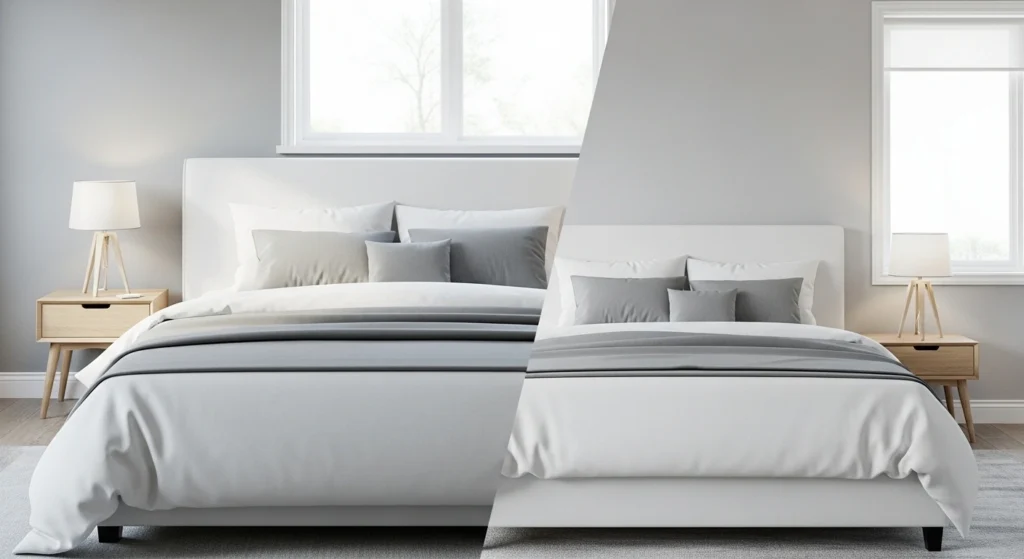
Discover the critical differences between queen and full beds—from dimensions to design psychology.
One offers intimacy. The other offers expanse. Between these two dimensions lies the difference between a cozy nest and a sprawling retreat—a choice that shapes your sleep quality, your room’s aesthetic, and your daily life in ways you might never have considered.
Let’s explore every dimension of this decision—from the mathematical to the emotional, from the practical to the philosophical.
The Dimensional Reality: Numbers That Matter
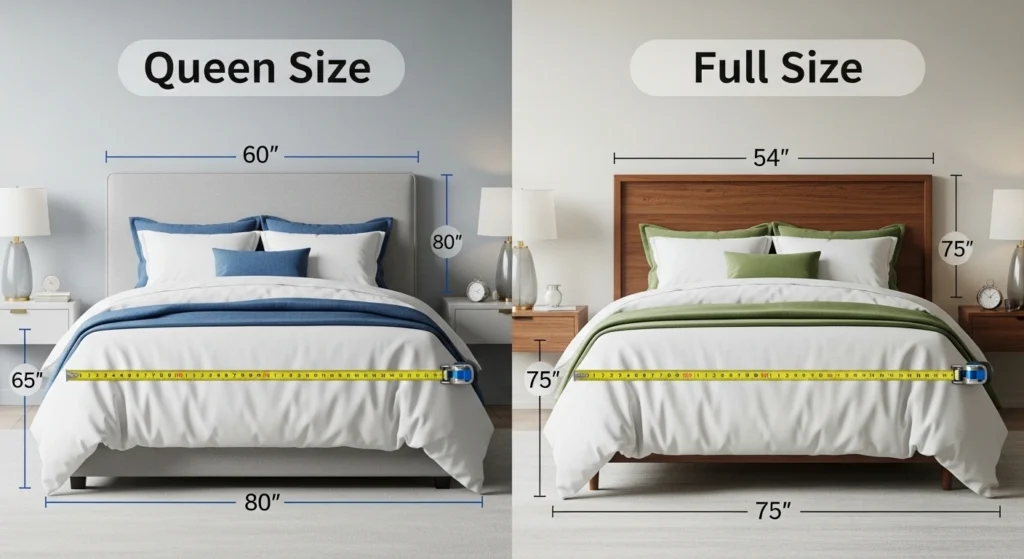
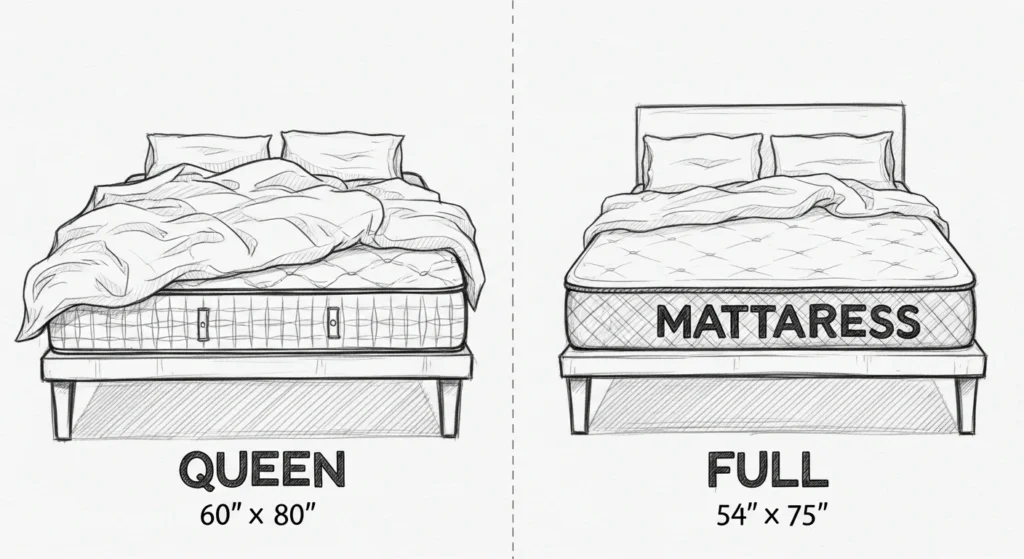
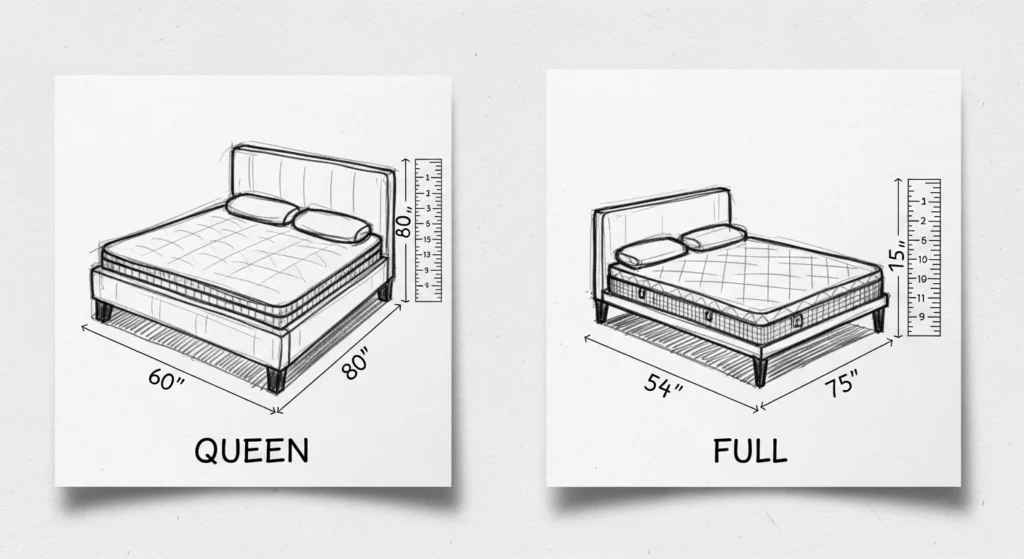
At the foundation lies pure geometry. Understanding the difference between queen and full begins with precise measurements:
| Dimension | Full (Double) | Queen | Difference |
|---|---|---|---|
| Width | 54 inches (137 cm) | 60 inches (152 cm) | +6 inches (+15 cm) |
| Length | 75 inches (191 cm) | 80 inches (203 cm) | +5 inches (+13 cm) |
| Surface Area | 4,050 sq in (26.1 sq ft) | 4,800 sq in (33.3 sq ft) | +750 sq in (+7.2 sq ft) |
| Width per Person (Shared) | 27 inches | 30 inches | +3 inches each |
The critical insight: Queen beds aren’t just bigger—they’re proportioned differently. That additional 5 inches in length accommodates taller sleepers (6’2″ and above) who find their feet dangling off full beds. The 6-inch width expansion transforms shared sleeping from tolerable to comfortable.
Visualizing the Space
Imagine standing at the foot of each bed:
- Full bed: You could almost touch both sides simultaneously. It feels contained, efficient, purposeful.
- Queen bed: You’d need to stretch to reach both edges. It feels generous, established, permanent.
This spatial perception shapes how you feel in your bedroom—whether nestled in a cozy cocoon or anchored in a substantial sanctuary.
The Sleep Experience: Intimacy vs. Liberty
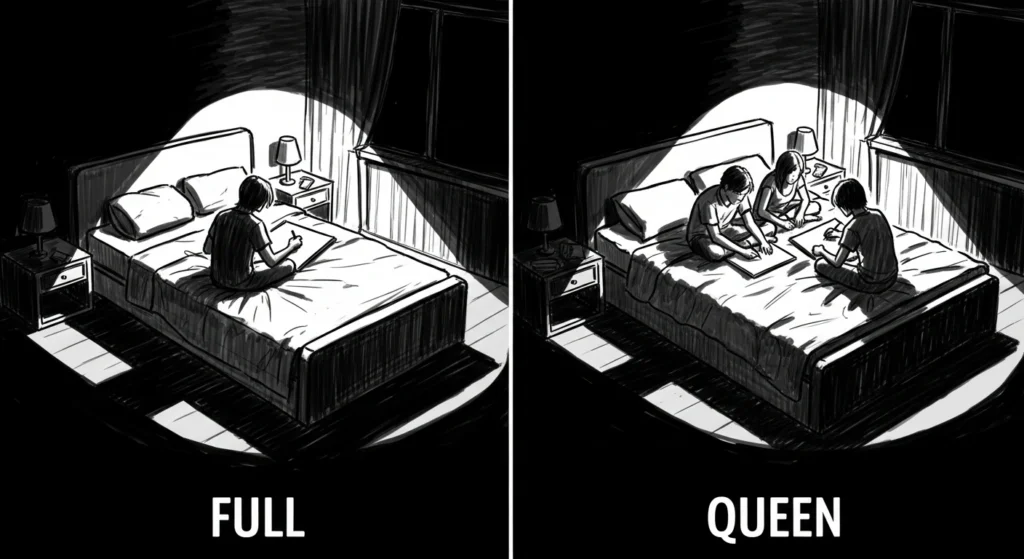
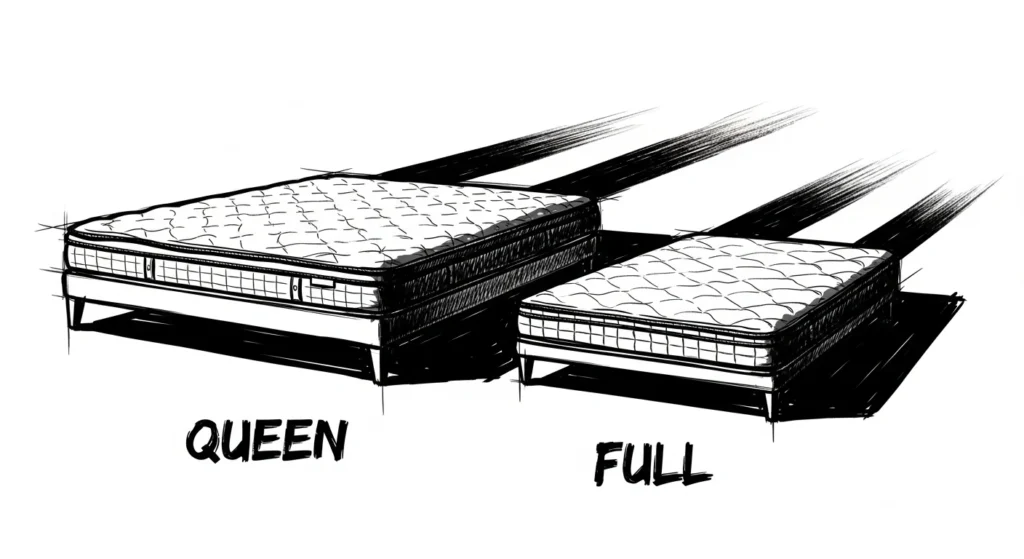
The difference between queen and full manifests most profoundly in how you actually sleep.
The Full Bed Experience: Closeness as Virtue
Best for:
- Single sleepers who sprawl or curl
- Couples who prioritize physical closeness
- Guest rooms with occasional dual occupancy
- Spaces where bedroom intimacy is the design goal
The sensation: Sleeping in a full bed as a couple means shoulders touch, movements synchronize, warmth radiates between bodies. It’s the architectural equivalent of spooning—designed for connection rather than separation. Many couples report feeling more emotionally bonded when sleeping in closer quarters, though this depends entirely on sleep style compatibility.
The compromise: Each person gets 27 inches of width—equivalent to a crib mattress. If one partner is a starfish sleeper or runs hot, this proximity becomes conflict rather than connection.
The Queen Bed Experience: Room to Breathe
Best for:
- Couples with different sleep schedules or preferences
- Individuals who value sprawling space
- Taller sleepers (6’0″ and above)
- Those who share beds with pets or children
- Master bedrooms designed as retreats
The sensation: A queen bed offers genuine personal territory. You can roll, stretch, read, or work on a laptop without disturbing your partner. The 30 inches per person matches what a twin bed offers a single sleeper—sufficient for genuine independence within shared space.
The paradox: Paradoxically, many couples report better intimacy in queen beds because the space allows for choice—closeness becomes voluntary rather than obligatory, making it more meaningful.
Spatial Psychology: How Bed Size Shapes Room Perception
The difference between queen and full extends beyond the mattress to transform your entire bedroom’s psychological impact.
The Full Bed Advantage: Proportion and Flow
A full bed occupies approximately 26.1 square feet of floor space, requiring roughly 9×10 feet of room minimum for comfortable circulation. This efficiency creates:
- Visual breathing room: More floor space for movement, storage, and secondary functions
- Furniture flexibility: Room for nightstands, dressers, or seating without crowding
- Intimacy at scale: Smaller bedrooms feel appropriately scaled rather than overwhelmed
- Multi-functionality: Guest rooms that double as offices or workout spaces
Design principle: In rooms under 120 square feet, a full bed often creates better proportion than a queen. The space feels designed rather than stuffed.
The Queen Bed Statement: Presence and Permanence
A queen bed demands approximately 33.3 square feet, requiring 10×10 feet minimum for comfortable use. This presence delivers:
- Anchoring authority: The bed becomes the room’s undeniable focal point
- Luxury signaling: Larger beds subconsciously communicate established lifestyle
- Future-proofing: Accommodates life changes—partners, pets, children, recovery from illness
- Resale value: Master bedrooms with queen (or king) fittings appeal more to buyers
Design principle: In rooms over 140 square feet, a queen bed provides the visual weight needed to balance the space. A full bed risks appearing lost or temporary.
The Lifestyle Matrix: Matching Bed to Life Stage
The optimal choice depends on your current trajectory, not just your present circumstances:
| Life Stage | Recommended Size | Rationale |
|---|---|---|
| College/Early 20s | Full | Mobility, smaller spaces, budget consciousness |
| Single Professional | Full or Queen | Depends on space and sprawling tendency |
| New Couples | Full | Tests compatibility; forces communication about space |
| Established Couples | Queen | Respects individual sleep needs; long-term investment |
| Parents (young children) | Queen | accommodates occasional family bed situations |
| Empty Nesters | Queen or King | Prioritizing comfort after years of compromise |
| Guest Rooms | Full | Sufficient for occasional couples; better space efficiency |
| Boutique Hotels | Queen | Guest expectation of comfort; perceived value |
| Vacation Rentals | Queen | Higher nightly rates; better reviews for comfort |
The Economics: Price, Longevity, and Value
The difference between queen and full carries financial implications beyond the initial purchase:
Initial Investment
- Mattress: Queen mattresses typically cost 15-25% more than full equivalents
- Bedding: Sheets, comforters, and duvets run 10-20% higher for queen size
- Frame/Foundation: Minimal difference; most frames accommodate both or scale similarly
- Total first-year cost: Approximately $200-500 more for queen setup
Long-term Value
- Lifespan: Identical (7-10 years for quality mattresses)
- Versatility: Queen offers better adaptability to life changes
- Resale/Donation: Queen bedding has higher secondary market value
- Property appeal: Homes with queen-capable master bedrooms command slight premiums
The Hidden Cost of Wrong-Sizing
Choosing incorrectly carries penalties:
- Too small: Replacement costs within 2-3 years, plus sleep quality degradation
- Too large: Room dysfunction, circulation problems, regret without easy remedy
Design Integration: Aesthetic Implications
The difference between queen and full influences your bedroom’s entire design language:
Full Bed Aesthetics: Minimalist and European
- Visual lightness: Less visual mass creates airy, Scandinavian-inspired spaces
- Symmetry options: Easier to achieve perfect balance with nightstands and lighting
- Bedding drama: Smaller beds can carry more elaborate bedding without overwhelming
- Multi-functional rooms: Allows desk, seating, or exercise areas in modest spaces
Queen Bed Aesthetics: Traditional and Luxurious
- Statement headboard: Substantial beds support architectural headboard designs
- Layered bedding: Space for multiple pillows, throws, and decorative layers
- Hotel inspiration: Replicates the luxury hospitality experience at home
- Furniture proportion: Requires appropriately scaled nightstands (24+ inches wide) to avoid visual mismatch
Special Considerations: Beyond Standard Advice
The Pet Factor
If pets sleep on your bed, the difference between queen and full becomes critical:
- Full bed + two adults + medium dog: Crowded, disruptive sleep
- Queen bed + two adults + medium dog: Manageable with designated pet zones
- Large dogs (50+ lbs): Queen minimum; king preferred
The Temperature Variable
Bed size affects thermal regulation:
- Full beds: Trap more body heat; beneficial for cold sleepers, problematic for hot sleepers
- Queen beds: Allow heat dissipation; better for temperature regulation
The Aging Consideration
As mobility decreases, bed height and perimeter access matter more than size. However, queen beds offer more positioning options for those with injuries or chronic conditions.
Regional and Cultural Variations
The difference between queen and full carries geographic nuance:
- North America: Queen is the dominant master bedroom standard; full is common for guest rooms and children’s transitions
- Europe: “Double” (similar to full) remains standard; larger beds are gaining popularity but require spacious modern housing
- Asia: Space constraints favor full or smaller; queen is luxury tier
- Hospitality Industry: Queen has become the minimum expectation for “standard” rooms in North American hotels
The Decision Framework: Your Optimal Choice
Answer these questions to determine your ideal size:
1. Who sleeps in this bed?
- Just me, and I’m under 6’0″ → Full sufficient
- Just me, and I’m over 6’0″ → Queen for length
- Two people → Queen strongly preferred
- Two people + pets/children → Queen minimum
2. What’s my room size?
- Under 10×10 feet → Full (queen crowds circulation)
- 10×10 to 12×12 feet → Queen ideal
- Over 12×12 feet → Queen or King
3. What’s my sleep style?
- Curl tightly, minimal movement → Full adequate
- Sprawl, starfish, frequent position changes → Queen liberating
4. What’s my relationship to space?
- I find comfort in coziness → Full nurtures
- I need personal territory to relax → Queen respects
5. What’s my timeline?
- Transitional housing, 1-2 years → Full pragmatic
- Long-term home, 5+ years → Queen invests
Conclusion: The Architecture of Rest
The difference between queen and full is ultimately the difference between adequacy and abundance, between managing space and mastering it. Neither is objectively superior—each serves distinct lifestyles, spatial constraints, and psychological needs.
The full bed honors efficiency, intimacy, and the European tradition of sufficient comfort without excess. It’s the choice of urban minimalists, budget-conscious pragmatists, and those who find security in coziness.
The queen bed embraces expansiveness, longevity, and the American ideal of personal space as birthright. It’s the choice of established households, tall individuals, couples prioritizing sleep quality, and those who view their bedroom as sanctuary rather than merely functional space.
Your bed is where you spend one-third of your life. Choose not based on showroom comparison or standard advice, but on honest assessment of how you live, how you sleep, and how you want to feel when you close your eyes each night. The right size doesn’t just fit your room—it fits your life.
Conclusion
In conclusion, the difference between queen and full primarily comes down to size and sleeping comfort. While a queen bed offers more room and flexibility, a full bed provides a more space-efficient option for smaller areas.
Moreover, knowing the difference between queen and full allows buyers to choose a mattress that fits both their lifestyle and room dimensions. Ultimately, selecting the right size leads to better sleep quality and a more comfortable living environment.
Ready to decide? Measure your room, height or your partner’s sprawling radius. Then choose not between better and worse, but between different visions of what rest should be. Learn more at…

Hi All! I’m Imran Abbas. I’m a Ph.D (scholar) in Structural Chemistry and I work in a number of domains like Bioinformatics, Literature, politics, sports and I’m a polyglot as well. I respect all irrespective of their ethnicity, locality and color. I’m always ready to learn new ideas and travel to different parts of the world.