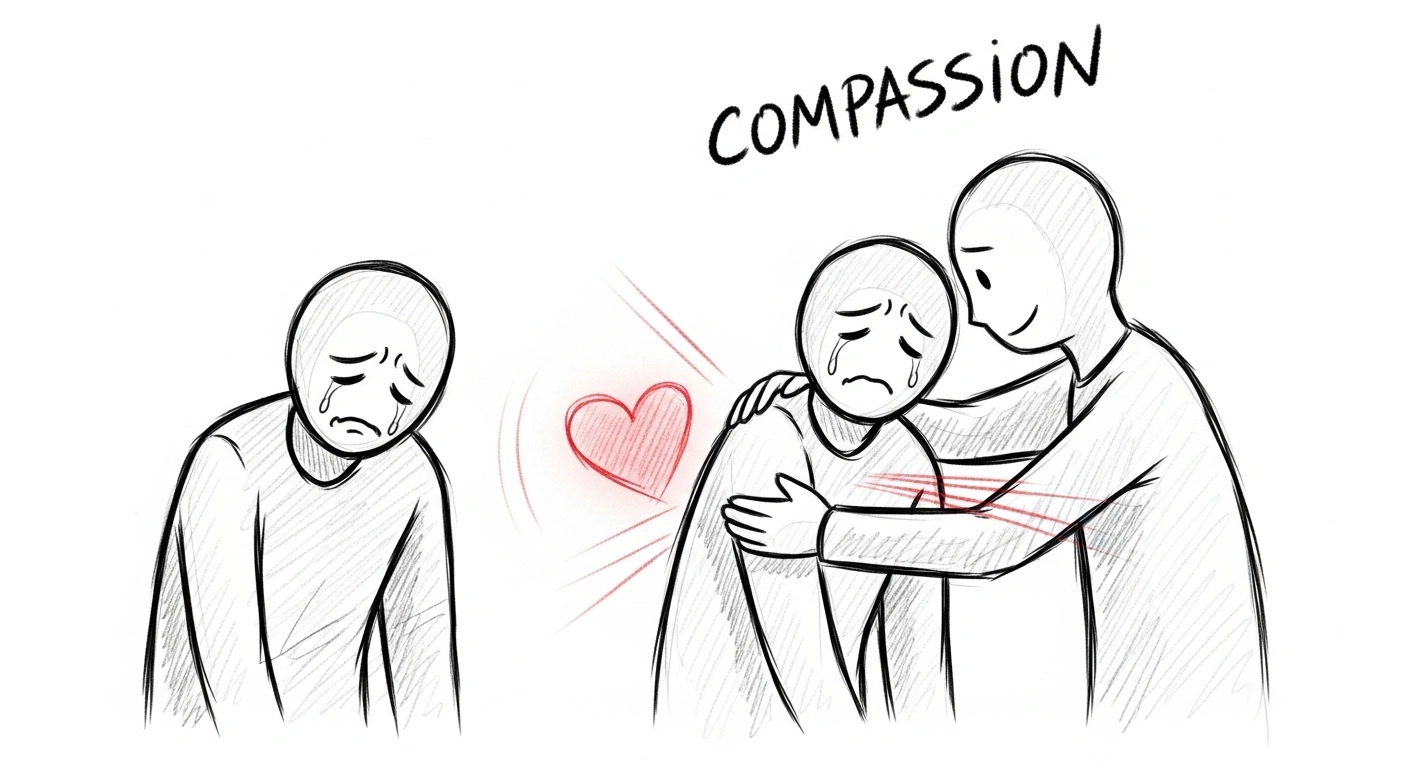
Difference between compassion and empathy and difference between compassion and empathy is an important topic in understanding human emotions and relationships. Although these terms are often used interchangeably, they carry distinct meanings that shape how we respond to others’ feelings and experiences.
To clarify, the difference between compassion and empathy lies in both emotional depth and action. Empathy involves the ability to understand and share another person’s feelings, almost as if stepping into their emotional world. In contrast, compassion goes a step further by combining that understanding with a genuine desire to help or relieve suffering. Therefore, recognizing the difference between compassion and empathy allows individuals to build stronger connections while also responding more thoughtfully and effectively in emotional situations.
Read More Below
One shares the feeling. The other transforms the suffering. Between these two capacities lies the difference between emotional contagion that depletes and altruistic action that sustains—a distinction that determines whether helping others nourishes or destroys you.
In the landscape of human connection, two words are often spoken as twins: compassion and empathy. We use them interchangeably, assuming that to feel with someone is the same as to help them. Yet emerging research from neuroscience, psychology, and contemplative science reveals a profound and practical distinction—one that explains why some caregivers thrive while others collapse, why some relationships deepen while others drown in shared pain, and why the most sensitive among us often become the most overwhelmed.
This is not semantic pedantry. Understanding the difference between compassion and empathy is essential for anyone in a helping profession, anyone raising children, anyone navigating intimate relationships, or anyone who has ever felt emotionally exhausted by caring too much. It is the difference between resonance and response, between feeling and doing, between burnout and sustainable care.
Let us explore this distinction across neural pathways, emotional experiences, and practical applications—so you can care more effectively and survive the caring.
The Foundational Distinction: Feeling With vs. Acting For
At the most fundamental level, the difference between compassion and empathy is directional and operational:
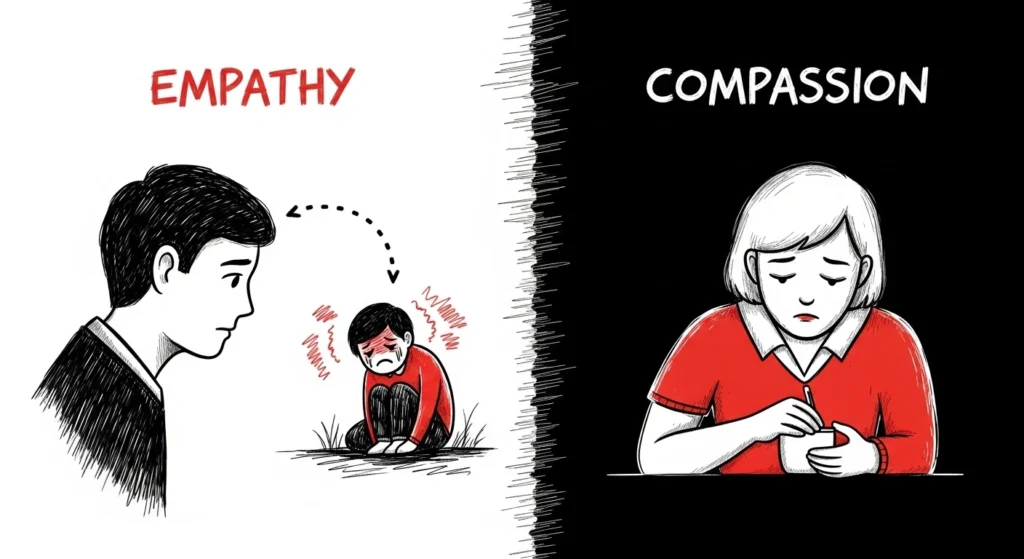
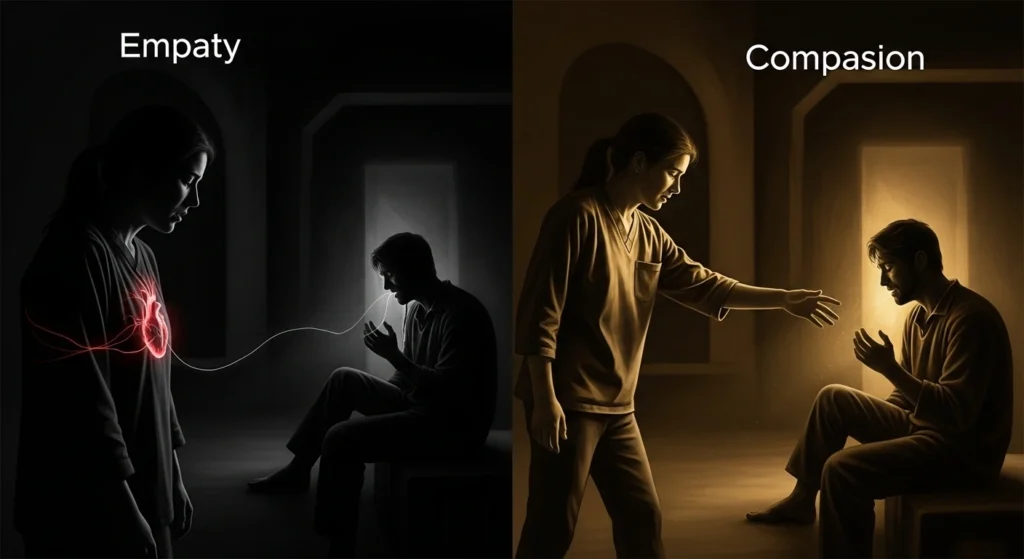
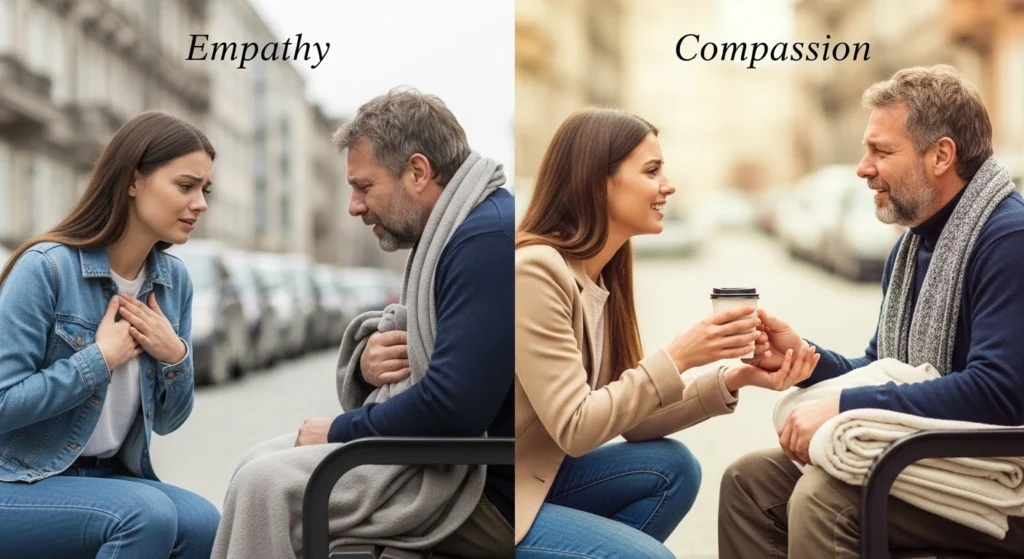
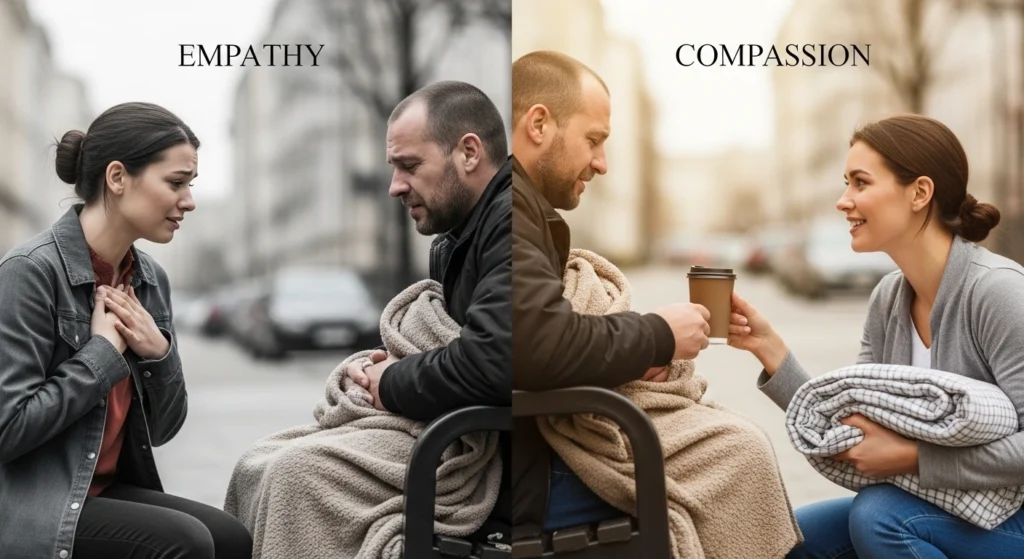
Empathy is the capacity to understand and share the feelings of another—to psychologically inhabit their experience, to feel what they feel, to see through their eyes . It is a receptive state, a form of emotional resonance that bridges self and other.
Compassion is the awareness of another’s suffering coupled with the desire and motivation to alleviate it—to feel for rather than simply with, to act rather than merely absorb . It is an active state, a virtuous response that seeks to transform suffering through understanding and action.
As one palliative care patient articulated this distinction: “Empathy is more of a feeling thing where you’re aware of somebody’s suffering, and compassion is when you act on that knowledge” . Another captured it even more vividly: “Sympathy are words and you know, ‘jeez I hope you feel better’ and ‘it’s terrible you got this’ and compassion is running over and getting a barf bag” .
This is the essential architecture: empathy provides the information; compassion provides the response.
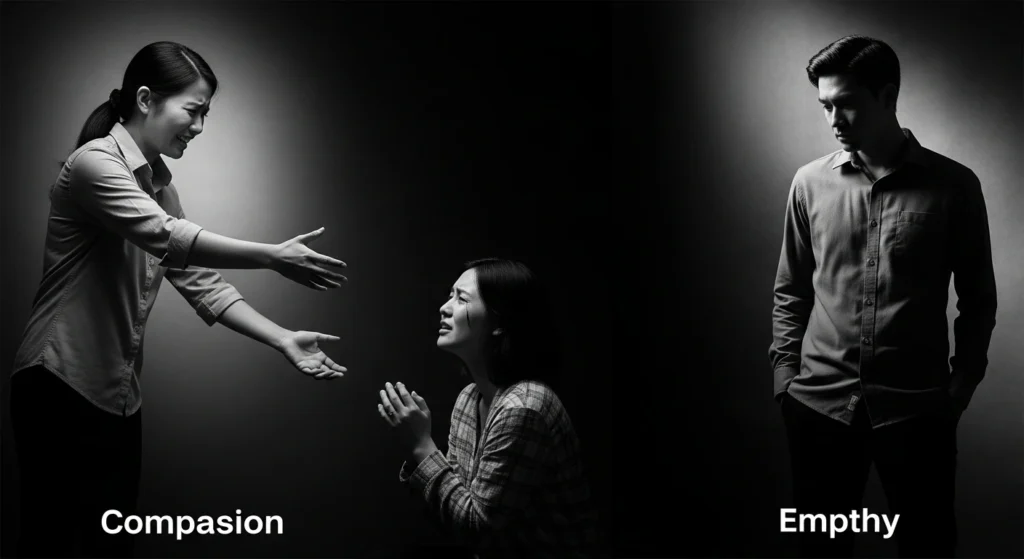
The Neurobiological Divide: Brain Pathways That Determine Destiny
Recent neuroscience research has revealed that empathy and compassion activate fundamentally different neural circuits, with dramatically different emotional and physiological consequences.
The Empathy Circuit: Shared Pain and Emotional Contagion
When you empathize with someone’s suffering, your brain activates neural pain pathways—the same regions that would fire if you were experiencing that suffering yourself . This is emotional empathy in its purest form: a literal sharing of another’s distress.
Dr. Tania Singer’s research at the Max Planck Institute demonstrates that empathy training—focused on resonating with another’s suffering—produces negative affect and activates brain regions associated with aversion . The empathizer doesn’t just understand the suffering; they embody it. This explains why empathy, while connecting, can also be overwhelming.
The components of emotional empathy include :
- Feeling the same emotion as another person
- Personal distress—feelings of discomfort in response to perceiving another’s plight
- Feeling with another person—the most commonly studied aspect of empathy
While this resonance creates connection, it also creates vulnerability. The empathizer’s emotional state becomes contingent on the sufferer’s state, leading to what researchers call empathic distress—a self-oriented response to suffering that can result in withdrawal, shutdown, or burnout .
The Compassion Circuit: Warmth, Reward, and Renewal
Compassion, by contrast, activates brain regions associated with dopaminergic reward, oxytocin-related affiliation, and positive affect . When you cultivate compassion—feeling warmth and concern for a sufferer while maintaining the intention to help—your brain responds with pleasure rather than pain, with approach rather than avoidance.
Research demonstrates that compassion training “produced a positive effect, activating regions of the brain associated with reward, love, and affiliation” . Unlike the dopamine depletion that accompanies empathic engagement with suffering, compassion generates its own neurochemical nourishment.
This is the critical discovery: compassion does not fatigue—it is neurologically rejuvenating . While empathy can lead to emotional exhaustion, compassion creates emotional resources. The helper who acts from compassion experiences positive emotions that counterbalance the sadness of witnessing suffering; the helper who merely empathizes absorbs that sadness without transformation.
The Empathy-to-Compassion Spectrum: Three Distinct Responses
To fully grasp the difference between compassion and empathy, we must position them within a spectrum of prosocial responses, each with distinct characteristics:
| Response | Definition | Emotional Quality | Motivation | Risk Level |
|---|---|---|---|---|
| Sympathy | Acknowledgment of another’s hardship from a distance; “feeling for” without deep engagement | Pity, concern (often condescending) | Social obligation, ego preservation | Low connection, potential paternalism |
| Empathy | Understanding and sharing another’s emotional experience; “feeling with” | Emotional resonance, shared affect | Desire to connect, understand | High risk of empathic distress, burnout |
| Compassion | Awareness of suffering + active desire to alleviate it; “feeling for” + acting | Warmth, care, concern, positive motivation | Altruistic love, virtuous response | Sustainable, self-reinforcing |
Sympathy: The Distant Cousin
Sympathy involves recognizing another’s suffering without fully engaging with it—an “unwanted pity-based response” that patients often experience as superficial . It maintains emotional distance through pity, which inherently positions the sufferer as unfortunate and the observer as fortunate. While better than indifference, sympathy lacks the transformative potential of deeper engagement.
Empathy: The Double-Edged Sword
Empathy creates genuine connection through shared emotional experience. It is essential for social bonding, parental care, and relationship formation . However, when focused on suffering, empathy becomes emotional contagion—you catch the pain without possessing the remedy.
Research confirms that empathy is associated with “more negative emotions like stress, burnout, or sadness,” while compassion correlates with “positive emotions like self-expansion and warmth” . Empathy without compassion leads to helplessness; empathy channeled through compassion leads to helpfulness.
Compassion: The Sustainable Response
Compassion builds upon empathy but adds crucial elements: unconditional acceptance, altruistic motivation, and action orientation . Where empathy asks “What is it like to be you?” compassion asks “How can I help you?” and then moves to answer that question.
Patients distinguish compassion by its virtuous motivators—particularly unconditional love—and its instrumental role in ameliorating suffering . The compassionate responder functions as an instrument of relief, using themselves to transform the other’s condition rather than simply mirroring it.
The Practical Divide: When Empathy Helps and When It Harms
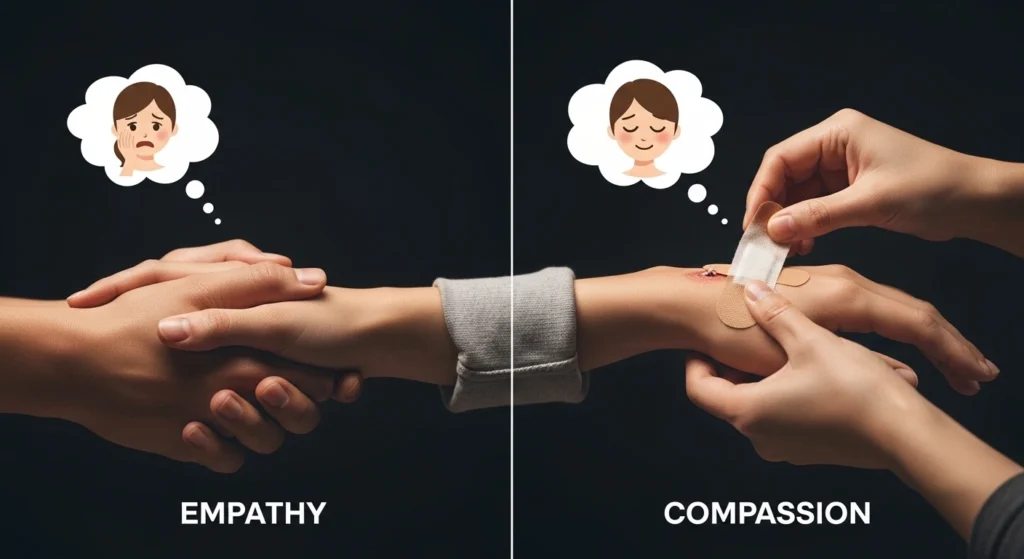
Understanding the difference between compassion and empathy is not merely theoretical—it has immediate practical implications for how we care for others and ourselves.
When Empathy Is Essential
Empathy serves crucial functions that compassion cannot replace:
Cognitive Empathy (Perspective-Taking): Understanding another’s viewpoint without necessarily sharing their emotions . This is essential for negotiation, conflict resolution, and design thinking. It allows us to comprehend without becoming overwhelmed.
Positive Empathy: Sharing others’ joy, excitement, and success . Unlike empathy for suffering, positive empathy generates positive emotions and strengthens social bonds without depletion.
Early-Stage Connection: Empathy creates the initial bridge to another’s experience. Without it, compassion risks becoming paternalistic or presumptuous—you cannot effectively help someone you do not understand.
When Empathy Becomes Problematic
Empathy becomes counterproductive when:
It creates empathic distress: You become so consumed by another’s pain that you withdraw, avoid, or shut down to protect yourself . This is the “bystander” response—paradoxically, too much feeling leads to inaction.
It leads to pathological altruism: You help others primarily to escape your own discomfort rather than to genuinely serve their needs . This creates enabling relationships and martyrdom dynamics.
It causes burnout: Healthcare workers, therapists, and caregivers who rely solely on empathy experience higher rates of emotional exhaustion because they absorb suffering without transforming it .
When Compassion Is the Answer
Compassion becomes essential when:
Sustained care is required: Long-term caregiving, therapeutic relationships, and social justice work require the resilience that only compassion provides .
Action is possible: When there are concrete steps to alleviate suffering, compassion channels emotional awareness into effective intervention .
Self-care is necessary: Self-compassion—treating oneself with the same kindness one would offer a good friend—provides emotional resources without self-pity .
The Transformation: Moving from Empathy to Compassion
The good news is that empathy and compassion are not fixed traits but trainable capacities. Research demonstrates that compassion can be cultivated, and that doing so protects against the negative effects of empathy .
The Neuroplasticity Evidence
In Tania Singer’s studies, participants who underwent empathy training showed increased negative affect. When the same participants subsequently received compassion training, they demonstrated “decreased negative affect and increased positive affect” . The brain can be rewired to respond to suffering with warmth rather than distress.
Practical Cultivation Strategies
1. Mindful Presence and Inquiry
The Compassionate Presence and Inquiry Practice, developed at Stanford’s CCARE program, teaches helpers to meet suffering directly without analysis or judgment . Key qualities include:
- Presence: Staying with experience without judgment
- Curiosity: Approaching with open-minded discovery
- Intimacy: Getting close to experience as with a loved one
- Humility: Accepting not knowing the answers
- Acceptance: Meeting whatever arises with warmth
- Self-Compassion: Bringing care to suffering parts of oneself
2. Self-Compassion as Foundation
Kristin Neff’s research demonstrates that self-compassion—treating oneself with kindness, recognizing common humanity, and maintaining mindful awareness—is prerequisite for sustainable compassion for others . We cannot give what we do not possess; we cannot remain present with others’ suffering if we abandon ourselves in the process.
Self-compassion differs from self-empathy: self-empathy involves observing one’s own experience with suspended judgment , while self-compassion adds active kindness and care .
3. Common Humanity Recognition
Compassion is distinguished from empathy by its foundation in common humanity—the recognition that suffering is universal and that we are not alone in our struggles . This perspective prevents the isolation that exacerbates empathic distress.
4. Action Orientation
The final step in transforming empathy into compassion is identifying concrete actions to alleviate suffering . This might mean:
- Offering practical assistance (helping with tasks)
- Providing emotional support (listening without judgment)
- Advocating for systemic change (addressing root causes)
- Simply being present (offering companionship in suffering)
Professional Applications: Healthcare, Therapy, and Beyond
The difference between compassion and empathy has particular relevance for helping professions, where burnout rates are high and emotional demands are constant.
Healthcare: Reframing “Compassion Fatigue”
The term “compassion fatigue” is itself a misnomer. Research demonstrates that what healthcare workers experience is actually empathy fatigue or empathic distress—the depletion that comes from resonating with suffering without the transformative action of compassion .
True compassion, with its activation of reward pathways and positive affect, does not fatigue; it sustains . Healthcare systems that train staff in compassion cultivation rather than mere empathy development may reduce burnout while improving patient care.
Therapy and Counseling
Therapists must balance empathy (understanding the client’s experience) with compassion (maintaining the emotional resources to help). Over-empathizing leads to countertransference and burnout; under-empathizing leads to coldness and ineffectiveness. The skill lies in empathic accuracy (cognitive empathy) combined with compassionate action (intervention) .
Education and Parenting
Teachers and parents who rely solely on empathy risk becoming overwhelmed by children’s distress. Those who cultivate compassion can remain emotionally present while maintaining boundaries and effectiveness. Self-compassion is particularly crucial for parents, preventing the self-criticism that undermines caregiving capacity .
The Philosophical Depth: Ancient Wisdom and Modern Science
The difference between compassion and empathy has been recognized across contemplative traditions for millennia, even as modern neuroscience now validates these distinctions.
Buddhist Psychology
Thich Nhat Hanh defines compassion as “the intention and capacity to relieve and transform suffering and lighten sorrows”—a practice requiring mindfulness, deep listening, and deep looking . This is not passive feeling but active engagement.
The Buddhist tradition distinguishes:
- Karuna (compassion): The active wish to relieve suffering
- Mudita (sympathetic joy): Delight in others’ happiness
- Upekkha (equanimity): Balanced concern without attachment
These practices cultivate sustainable care without the burnout that unskilled empathy produces.
Western Philosophy
The Stoics emphasized oikeiosis (appropriation)—extending concern to others while maintaining rational judgment and emotional equilibrium. This parallels the modern distinction between empathy (emotional sharing) and compassion (concerned action).
Integration
Modern research integrates these traditions, demonstrating that compassion training—combining mindfulness, loving-kindness meditation, and action orientation—produces measurable changes in brain structure and function that protect against empathic distress .
Conclusion: The Wise Heart
The difference between compassion and empathy is ultimately the difference between a mirror and a lamp. Empathy reflects the suffering of others, creating connection through shared experience. Compassion illuminates a path forward, creating transformation through concerned action.
Both are necessary. Empathy without compassion leads to burnout, withdrawal, and helplessness. Compassion without empathy leads to paternalism, presumption, and ineffective help. The wise heart holds both—feeling deeply enough to understand, caring broadly enough to act, and cultivating the inner resources to sustain that care over time.
In a world of increasing suffering and decreasing attention spans, we need helpers who can remain present without being consumed, who can care without being destroyed, who can feel without being flooded. This is the promise of compassion: not the elimination of empathy, but its transformation into something sustainable, nourishing, and effective. For more insights visit….
Conclusion
In conclusion, the difference between compassion and empathy highlights the distinction between feeling and action. While empathy enables us to connect deeply with others’ emotions, compassion motivates us to take supportive and meaningful steps.
Moreover, understanding the difference between compassion and empathy helps improve communication, emotional intelligence, and interpersonal relationships. Ultimately, both qualities are essential, but together they create a more caring and responsive human experience.
Your move: Notice your own patterns. When you encounter suffering, do you absorb it (empathy) or act on it (compassion)? Do you burn out or renew? The capacity to care wisely is not fixed—it can be cultivated, trained, and strengthened. Begin with self-compassion, extend to others, and discover that the more sustainably you care, the more effectively you help.
The most profound gift we can offer others is not our shared pain, but our present, compassionate, effective presence in the face of it.

Hi All! I’m Imran Abbas. I’m a Ph.D (scholar) in Structural Chemistry and I work in a number of domains like Bioinformatics, Literature, politics, sports and I’m a polyglot as well. I respect all irrespective of their ethnicity, locality and color. I’m always ready to learn new ideas and travel to different parts of the world.