Understanding the difference between lease and finance is essential for anyone looking to acquire a car, equipment, or property without paying the full price upfront. Whether you’re a first-time buyer or a seasoned business owner, knowing how these two acquisition methods work can save you thousands of dollars and countless headaches. The difference between lease and finance extends far beyond monthly payments—it affects ownership rights, tax implications, maintenance responsibilities, and your long-term financial flexibility. In this comprehensive guide, we’ll break down everything you need to know about leasing versus financing, helping you make an informed decision that aligns with your lifestyle, budget, and future goals.
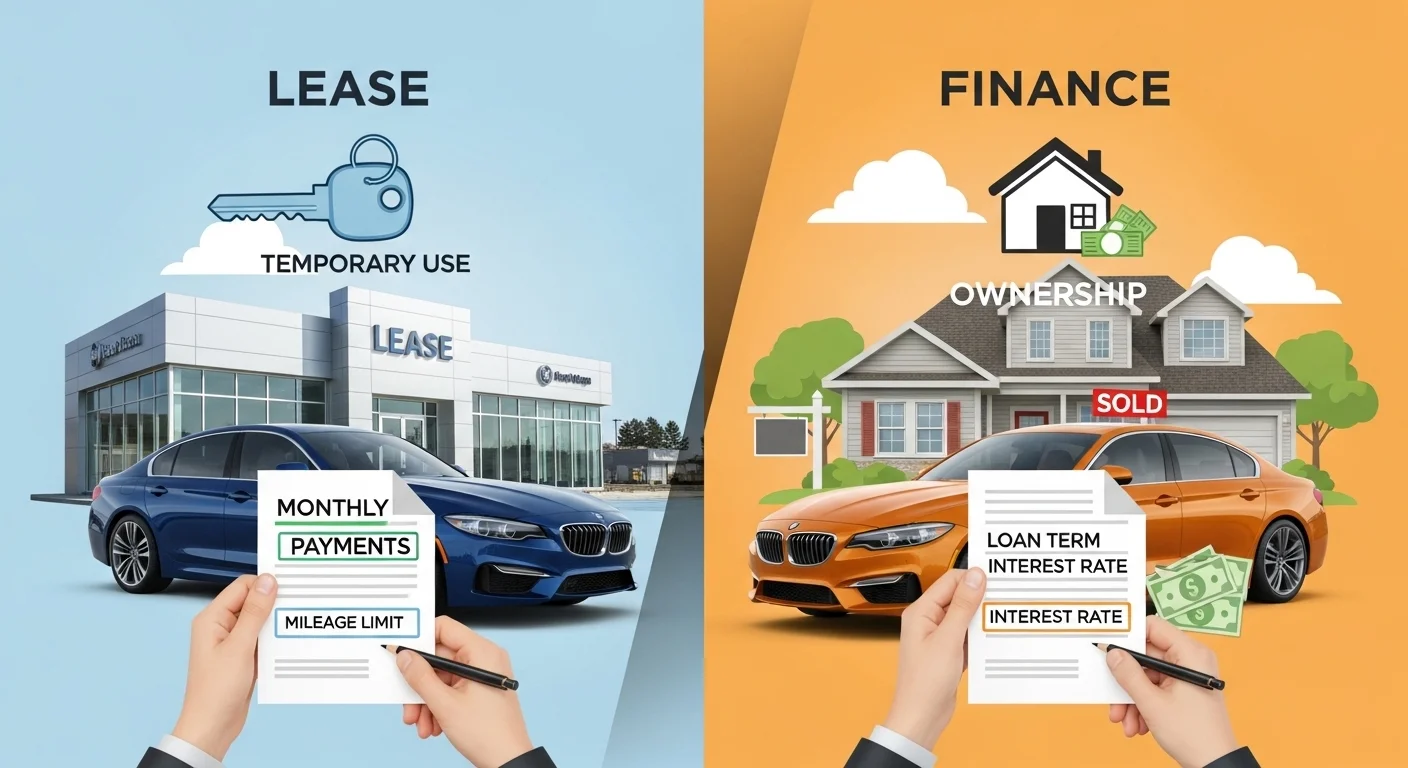
The fundamental difference between lease and finance lies in ownership. When you finance a purchase, you’re taking out a loan to buy an asset outright, with the goal of eventually owning it free and clear. When you lease, you’re essentially renting the asset for a predetermined period, paying for its depreciation during that time without ever building equity. Let’s have a deep dive in understanding the difference between lease and finance.
Key Distinctions at a Glance
| Aspect | Leasing | Financing |
|---|---|---|
| Ownership | Lender owns the asset | You own the asset after loan payoff |
| Monthly Payments | Typically lower | Typically higher |
| Upfront Costs | Lower down payment | Higher down payment often required |
| Mileage Limits | Yes (usually 10,000-15,000/year) | No limits |
| Customization | Generally prohibited | Unlimited freedom |
| End of Term | Return, buyout, or lease new | Asset is yours |
| Equity Building | None | Yes |
How Leasing Works: The Complete Breakdown
Leasing operates on a simple principle: you pay for what you use. When you lease a vehicle or equipment, the leasing company purchases the asset and allows you to use it for a fixed term, typically 24 to 48 months.
The Mathematics Behind Leasing
Your monthly lease payment is calculated based on several factors:
- Capitalized Cost: The negotiated price of the asset
- Residual Value: The estimated worth at lease end (determined by depreciation rates)
- Money Factor: The interest rate equivalent (multiply by 2,400 to get APR)
- Lease Term: Duration of the agreement
- Sales Tax: Applied to monthly payments in most states
Formula: Monthly Payment = (Capitalized Cost – Residual Value) ÷ Lease Term + (Capitalized Cost + Residual Value) × Money Factor
Types of Leases
Closed-End Lease (Most Common)
- Most popular for consumer vehicles
- Residual value is set at signing
- You can walk away at term end regardless of actual market value
- Lessee not responsible for depreciation beyond predicted amount
Open-End Lease
- Common in commercial equipment leasing
- Lessee may owe difference if actual value falls short of residual estimate
- Higher risk but potentially lower monthly payments
Single-Payment Lease
- Pay entire lease obligation upfront
- Eliminates interest charges
- Often results in significant savings versus monthly payments
Advantages of Leasing
Financial Benefits:
- Lower monthly payments free up cash flow for other investments
- Minimal or no down payment requirements
- Sales tax typically paid only on monthly payments, not full value
- Gap insurance often included, protecting against total loss scenarios
Practical Benefits:
- Drive a new vehicle every 2-3 years with latest technology
- Manufacturer warranty typically covers entire lease term
- No trade-in hassles or negotiation at term end
- Perfect for businesses needing current-model equipment
Disadvantages of Leasing
Financial Drawbacks:
- No equity accumulation—you’re building no ownership stake
- Early termination penalties can be severe (often thousands of dollars)
- Excess mileage charges (typically $0.15-$0.30 per mile over limit)
- Wear-and-tear fees for damage beyond “normal” use
Practical Limitations:
- Mileage restrictions constrain long-distance drivers
- Prohibitions against modifications or customizations
- Continuous payment obligation if you keep leasing
- Credit requirements often stricter than financing
How Financing Works: Building Your Asset Portfolio
Financing represents the traditional path to ownership. You borrow money from a lender—banks, credit unions, or manufacturer financing arms—to purchase an asset outright, then repay the loan over time with interest.
The Anatomy of an Auto or Equipment Loan
Principal: The amount borrowed to purchase the asset
Interest Rate (APR): Annual cost of borrowing, determined by credit score, loan term, and market conditions
Loan Term: Duration of repayment, typically 36-72 months for vehicles, longer for real estate
Down Payment: Upfront cash reducing principal and demonstrating commitment
Monthly Payment: Fixed amount covering principal and interest amortization
Types of Financing Arrangements
Simple Interest Loans
- Most common for vehicle purchases
- Interest calculated daily on remaining balance
- Early payoff reduces total interest paid
- No prepayment penalties in most cases
Precomputed Interest Loans
- Interest calculated upfront and added to principal
- Early payoff doesn’t save interest costs
- Less favorable for borrowers planning early repayment
Balloon Financing
- Lower monthly payments with large final “balloon” payment
- Requires refinancing or cash payment at term end
- Higher risk but improves short-term cash flow
Chattel Mortgage (Business Equipment)
- Lender holds lien on asset until paid
- Immediate ownership with security interest
- Tax advantages for business depreciation
Advantages of Financing
Ownership Benefits:
- Complete equity once loan is satisfied
- Asset becomes a balance sheet item increasing net worth
- Unlimited mileage and usage freedom
- Freedom to modify, customize, or improve the asset
Financial Advantages:
- No end-of-term obligations or return conditions
- Potential for positive equity if asset appreciates or holds value well
- Refinancing options if rates drop or credit improves
- Asset can be sold anytime to pay off remaining balance
Long-term Economics:
- After loan payoff, years of payment-free ownership
- Lower total cost over extended ownership periods (7+ years)
- No continuous payment cycles
Disadvantages of Financing
Financial Challenges:
- Higher monthly payments strain cash flow
- Depreciation risk—you may owe more than asset is worth (negative equity)
- Repair costs post-warranty fall entirely on owner
- Sales tax due on full purchase price upfront
Practical Considerations:
- Trade-in complexity requiring negotiation and timing
- Longer commitment to aging technology
- Full responsibility for resale or disposal
- Credit impact of higher debt-to-income ratio

Comparative Analysis: Real-World Scenarios
Scenario 1: The Tech-Forward Driver
Profile: Sarah, 32, marketing executive, drives 12,000 miles annually, loves new technology, prefers predictable costs.
Leasing Advantage: Sarah leases a new electric vehicle every three years, always having cutting-edge autonomous features, battery technology, and infotainment systems. Her $450 monthly payment fits her budget, and she never worries about battery degradation or outdated tech.
Financing Disadvantage: If Sarah financed the same $45,000 vehicle over five years at 5% APR, her payment would be $850 monthly. After five years, she’d own a technologically obsolete car with potentially degraded battery performance.
Scenario 2: The High-Mileage Road Warrior
Profile: Mike, 45, sales representative, drives 25,000 miles annually, travels interstate regularly, keeps vehicles 8+ years.
Financing Advantage: Mike finances a reliable sedan, paying $600 monthly for five years. His high mileage would trigger $3,000+ annual excess mileage charges if leased. After payoff, he drives payment-free for three years, saving $21,600 compared to continued leasing.
Leasing Disadvantage: A lease with sufficient mileage allowance would require a low residual value, resulting in payments nearly matching financing costs while building zero equity.
Scenario 3: The Business Owner
Profile: Jennifer, 38, owns landscaping company, needs three trucks for crew transportation, prioritizes cash flow.
Leasing Strategy: Jennifer leases trucks under commercial leases, deducting 100% of payments as business expenses. She replaces trucks every four years, ensuring reliability and professional appearance without maintenance surprises. The lower payments preserve capital for equipment that actually generates revenue.
Financing Alternative: Financing would require larger capital outlay, and while depreciation deductions exist, they don’t match the immediate cash-flow benefits of leasing for her growing business.
Tax Implications: The Financial Professional’s Perspective
For Individual Consumers
Leasing Tax Treatment:
- Sales tax paid monthly on lease payments (in most states)
- No depreciation deductions for personal use
- Potential luxury tax implications on high-value leases
- Use tax considerations if moving between states
Financing Tax Treatment:
- Sales tax paid upfront on full purchase price
- No tax benefits for personal vehicle ownership
- Interest not deductible for personal use (post-2017 Tax Cuts and Jobs Act)
For Business Use
Leasing Business Deductions:
- 100% of lease payments deductible as operating expense
- No depreciation recapture complications
- Simplified accounting treatment
- Potential Section 179 limitations on luxury vehicles
Financing Business Deductions:
- Interest expense deductible
- Depreciation deductions under MACRS
- Section 179 expensing up to limits ($1,160,000 for 2023)
- Bonus depreciation availability (phasing down post-2022)
Critical Consideration: The “lease inclusion amount” for luxury vehicles reduces deductions for high-value leased business vehicles, potentially negating some advantages.
Credit Requirements and Qualification Standards
Leasing Credit Standards
Leasing companies typically require:
- Credit Score: 700+ for best rates, 620+ minimum for most programs
- Debt-to-Income Ratio: Below 40% including new lease payment
- Income Verification: Proof of stable employment or business income
- Housing Payment History: No recent late payments
Subprime Leasing: Emerging options for 600-650 scores exist but with higher money factors and larger down payment requirements.
Financing Credit Standards
Auto lenders show more flexibility:
- Prime Financing: 720+ scores receive best rates (0-3% APR currently)
- Non-Prime: 660-719 scores, rates 4-8%
- Subprime: 600-659 scores, rates 9-15%
- Deep Subprime: Below 600, rates 16%+ or denial
Credit Union Advantage: Member-owned credit unions often offer more favorable terms than manufacturer financing, especially for used vehicles.
The Hidden Costs: What Salespeople Don’t Emphasize
Leasing Hidden Costs
Acquisition Fee: $595-$995 charged by lessor, rarely negotiable
Disposition Fee: $350-$500 charged at lease end if not purchasing
Excess Wear and Tear: Subjectively assessed charges for dents, scratches, tire wear
Mileage Overage: $0.15-$0.30 per mile compounds quickly (3,000 extra miles = $450-$900)
Early Termination: Remaining payments plus penalties often exceed $5,000
Insurance Requirements: Higher liability limits mandated ($100,000/$300,000 typical)
Financing Hidden Costs
Prepayment Penalties: Rare but exist in some subprime loans
Gap Insurance Need: Essential if down payment under 20%, costs $20-40 monthly
Extended Warranty Pressure: Dealer add-ons increasing principal
Negative Equity Rollover: Trading underwater vehicles compounds debt
Documentation Fees: $300-$800 varying wildly by state and dealer
Strategic Decision Framework: Which Path Fits Your Life?
Choose Leasing If:
✅ You drive 12,000 miles or fewer annually
✅ You prefer new vehicles with latest safety/technology features
✅ You value predictable monthly costs and warranty coverage
✅ You use vehicles for business with high write-off value
✅ You enjoy changing vehicles every 2-3 years
✅ You lack substantial down payment funds
✅ You want lower monthly payments for cash flow flexibility
Choose Financing If:
✅ You drive significantly more than 15,000 miles yearly
✅ You plan to keep vehicles 5+ years
✅ You want to modify or customize your asset
✅ You prioritize long-term cost minimization
✅ You want to build equity and net worth
✅ You prefer ownership freedom without restrictions
✅ You have sufficient down payment to avoid negative equity
The Hybrid Approach: Lease Buyout Strategies
Sophisticated consumers sometimes combine both methods:
- Lease with Intent to Buy: Negotiate lease terms with favorable buyout price, purchase at term end if residual value exceeds market value
- Finance After Lease: Use lease period to improve credit score, then finance buyout with better terms than original available
- Pull-Ahead Programs: Manufacturer incentives allowing early lease termination without penalty when financing new purchase
Emerging Trends: Subscription Services and Alternative Models
The automotive industry now offers hybrid models blurring traditional lines:
Vehicle Subscription Services: Monthly fee covering vehicle, insurance, maintenance, and swapping privileges—premium pricing for maximum flexibility.
Peer-to-Peer Leasing: Platforms connecting private parties for lease transfers, offering shorter commitments without dealer involvement.
Usage-Based Financing: Telematics-enabled loans adjusting rates based on actual driving behavior and mileage.
Final Verdict: Making Your Decision
The difference between lease and finance ultimately distills to a question of values: Do you prioritize flexibility and cash flow (lease) or equity and freedom (finance)? Neither choice is universally superior—each serves distinct financial personalities and life circumstances.
For the disciplined investor, leasing’s lower payments could be invested elsewhere for superior returns. For the stability-seeker, financing’s endpoint of ownership provides irreplaceable peace of mind. The “right” answer requires honest assessment of your driving habits, financial goals, and psychological comfort with ongoing obligations versus long-term asset building.
Before signing any agreement, calculate the total cost of each option over your expected ownership horizon, including all fees, taxes, insurance, and opportunity costs. Consult a tax professional regarding business use implications. And remember—negotiation applies to both leasing and financing; never accept the first offer. Learn more at….

Hi All! I’m Imran Abbas. I’m a Ph.D (scholar) in Structural Chemistry and I work in a number of domains like Bioinformatics, Literature, politics, sports and I’m a polyglot as well. I respect all irrespective of their ethnicity, locality and color. I’m always ready to learn new ideas and travel to different parts of the world.