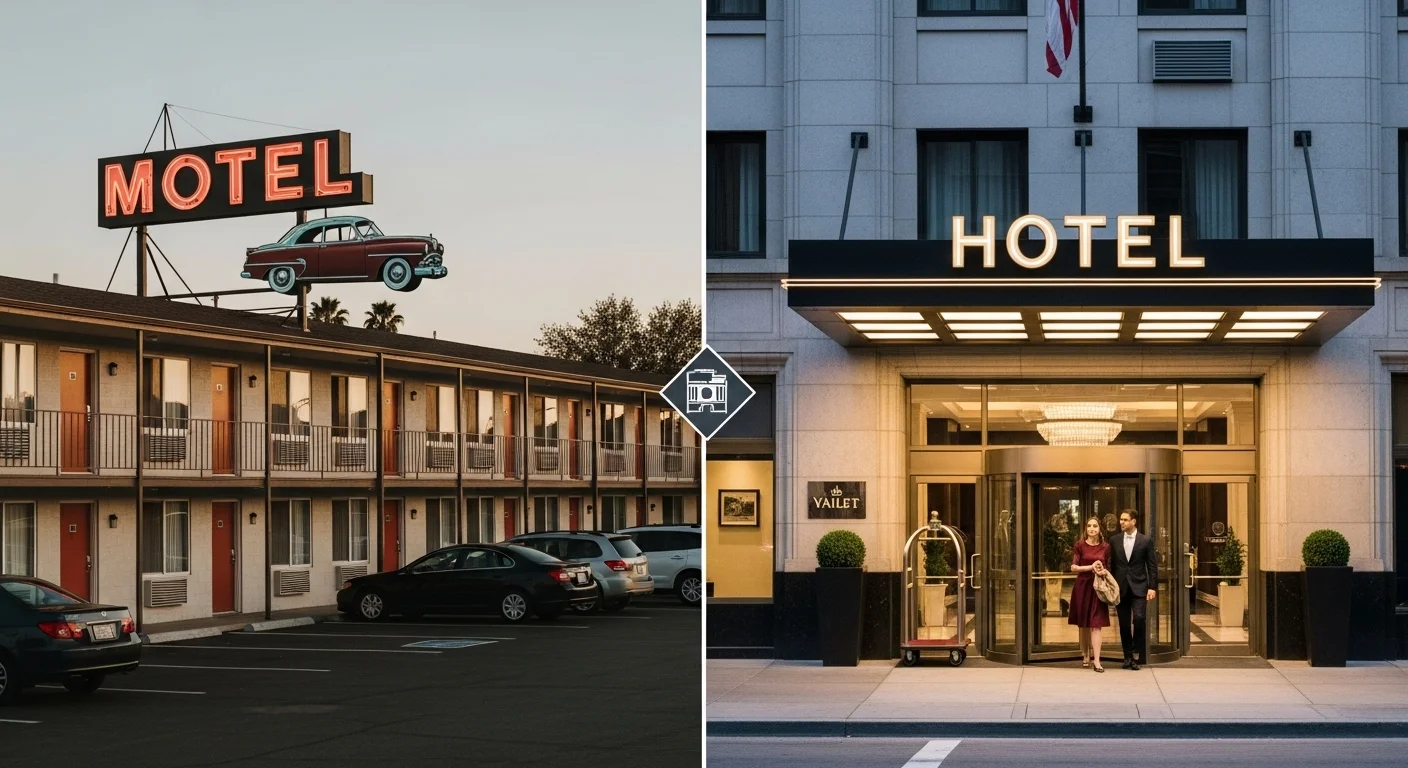
Grasping the difference between motel and hotel requires moving beyond surface-level perceptions to examine fundamental architectural DNA, operational philosophies, and evolutionary trajectories within the hospitality ecosystem. While casual observers often conflate these lodging categories, the difference between motel and hotel represents distinct responses to transportation infrastructure, guest behavior patterns, and economic optimization models. This technical exploration dissects the morphological, functional, and experiential divergences that separate motor courts from urban hospitality towers, providing industry professionals, travelers, and design enthusiasts with granular insight into these ubiquitous yet frequently misunderstood accommodation typologies.
At the core of hospitality taxonomy lies a singular organizing principle that bifurcates transient lodging into two primary branches: corridor-access versus direct-access spatial configurations. This distinction generates cascading implications for structural systems, operational workflows, guest demographics, and profitability matrices. Let’s discuss the difference between motel and hotel in more details.
The Motor Hotel Genesis: Automobility as Architectural Determinant
The motel—portmanteau of “motor” and “hotel”—emerged as a distinctly American architectural response to post-war automotive proliferation. Consequently, its entire organizational logic orbits vehicular accommodation. let’s Deconstructing the Fundamental Divergence: Access Patterns and Spatial Organization
Morphological Characteristics:
- Horizontally distributed guestroom modules: Typically 1-2 stories, eliminating vertical circulation dependencies
- Direct vehicular adjacency: Parking stalls positioned immediately outside guestroom entrances, enabling luggage transfer distances under 10 meters
- Drive-up accessibility: Porte-cochère elimination; guests proceed directly from vehicle to room without intermediate circulation
- Ribbon or courtyard configurations: Linear arrangements along highways or U-shaped plans enclosing parking courts
- Exterior-corridor necessity: Climate-controlled interior hallways economically unfeasible at low-rise scale
Furthermore, this typology minimizes capital expenditure through simplified structural systems—post-and-beam construction, slab-on-grade foundations, and reduced MEP (mechanical, electrical, plumbing) infrastructure complexity. The resulting cost efficiencies enabled rapid deployment along emerging interstate highway networks, democratizing roadside accommodation for middle-class motorists.
The Urban Hospitality Paradigm: Density and Amenity Aggregation
Conversely, hotels—particularly full-service variants—optimize for pedestrian-centric urban contexts and vertical density. Therefore, their organizational logic prioritizes spatial efficiency, programmatic layering, and revenue diversification through ancillary services.
Morphological Characteristics:
- Vertical stacking: Guestrooms arranged in floor plates above podium or base structures, maximizing land-use efficiency
- Interior-corridor systems: Climate-controlled circulation networks enabling year-round comfort regardless of external conditions
- Centralized vertical transportation: Elevator banks and stair cores organizing guest movement patterns
- Podium-base configuration: Ground floors dedicated to lobbies, food-and-beverage outlets, meeting facilities, and back-of-house operations
- Structured parking solutions: Multi-level garages, subterranean facilities, or valet systems accommodating vehicles without direct room adjacency
Moreover, this configuration facilitates amenity integration impossible in dispersed motel typologies—ballrooms, restaurants, fitness centers, and business facilities generate ancillary revenue streams while enhancing competitive positioning.
Historical Trajectories: From Auto Camps to Mixed-Use Hospitality Complexes
The Motel’s Evolutionary Arc
1920s-1930s: Auto Camps and Cabin Courts
Pioneering motorists utilized designated camping areas with basic sanitation facilities. Subsequently, entrepreneurs constructed classic cabins—often log-constructed or stone-built—providing weather protection without plumbing or climate control. These proto-motels emphasized authenticity and regional character.
1940s-1950s: Streamlined Moderne and Googie Architecture
Post-war prosperity catalyzed motel standardization. Consequently, architectural expression embraced futuristic aesthetics—cantilevered rooflines, neon signage, kidney-shaped pools, and bold geometric forms. The “motor court” concept flourished, with rooms arranged around central parking courts often featuring swimming pools as visual anchors.
1960s-1970s: Interstate Integration and Chain Standardization
The Federal-Aid Highway Act of 1956 transformed mobility patterns. Henceforth, motel development clustered at interstate interchanges, prioritizing visibility and accessibility over destination appeal. Franchise systems (Holiday Inn, Howard Johnson, Ramada) imposed rigorous standardization, sacrificing architectural individuality for brand recognition and operational predictability.
1980s-Present: Decline and Niche Refunctioning
Airline deregulation and suburban hotel proliferation eroded motel market share. Nevertheless, the typology persists through adaptive strategies:
- Budget segmentation: Microtel, Motel 6, and Super 8 optimizing price-sensitive transient demand
- Thematic rehabilitation: Retro-chic boutique motels (Ace Hotel Palm Springs, Austin Motel) leveraging nostalgia and Instagram aesthetics
- Extended-stay modification: Kitchenette-equipped rooms capturing weekly-rate demand from construction crews and relocating professionals
The Hotel’s Developmental Continuum
Pre-Automobile Era: Palace Hotels and Railway Proximity
Grand hotels—Ritz Paris, Waldorf-Astoria New York, Raffles Singapore—anchored urban centers and transportation nodes, catering to rail travelers and elite clientele. These establishments established service benchmarks and spatial hierarchies persisting in contemporary luxury hospitality.
Mid-20th Century: Suburban Expansion and Convention Centers
Post-war decentralization generated suburban hotel prototypes. Additionally, the convention center hotel emerged as civic infrastructure, with municipalities subsidizing large-format properties to capture delegate spending. These facilities—often 500+ rooms—required sophisticated back-of-house systems and banquet capabilities.
Late 20th-21st Century: Vertical Mixed-Use and Branded Residences
Contemporary hotel development increasingly integrates residential, retail, and office components. Furthermore, the “branded residence” phenomenon—Four Seasons Private Residences, Ritz-Carlton Residences—blurs hospitality and real estate, extending hotel services to permanent occupants within shared structural envelopes.
Operational Divergences: Staffing Models and Service Protocols
The Limited-Service Efficiency Matrix
Motels operate under severely constrained staffing paradigms, necessitating technological substitution and guest self-sufficiency.
Front Desk Operations:
- 24-hour coverage variability: Many budget motels implement automated check-in or after-hours window service, reducing labor costs
- Centralized property management: Single desk agent often handling reservations, guest services, and night audit simultaneously
- Minimal concierge function: Guest inquiries regarding local attractions typically addressed through collateral materials rather than personal consultation
Housekeeping Protocols:
- Reduced frequency: Stay-over service often available upon request only, diverging from daily standard in full-service contexts
- Exterior room access: Housekeeping carts positioned in parking areas, with staff exposed to weather and security variables absent in interior-corridor configurations
Security Considerations:
- Direct-access vulnerability: Ground-floor rooms with exterior doors present elevated security risks, necessitating enhanced locking systems and surveillance coverage
- Parking lot monitoring: CCTV networks and lighting design critical for guest safety perception, given uncontrolled vehicular access to room proximity
The Full-Service Operational Ecosystem
Hotels—particularly those exceeding 150 rooms—maintain complex organizational hierarchies enabling service customization.
Departmental Specialization:
- Rooms Division: Separated into front office, housekeeping, reservations, and concierge sub-departments
- Food and Beverage: Distinct kitchen, restaurant, bar, catering, and room service operations
- Sales and Marketing: Dedicated revenue management, group sales, and digital marketing personnel
- Engineering and Facilities: Round-the-clock maintenance coverage ensuring immediate response to climate control, plumbing, and electrical issues
Service Intensity Metrics:
Luxury hotels typically maintain staff-to-guest ratios of 1.5:1 or higher, whereas limited-service motels may operate with ratios below 0.3:1. Consequently, service interaction frequency and personalization capacity diverge dramatically.
Technological Infrastructure: Systems Divergence
Property Management Systems (PMS) Integration
Motel Technology Stack:
- Cloud-based PMS: Web-native systems (Cloudbeds, RoomKeyPMS) minimizing on-premise server infrastructure
- Self-service kiosks: Automated check-in terminals reducing front-desk labor requirements
- Mobile key integration: Smartphone-based room access eliminating physical key management
- Minimal IoT deployment: Basic thermostat and lighting controls, rarely integrated into centralized building management systems
Hotel Technology Ecosystem:
- Enterprise PMS: On-premise or hybrid cloud solutions (Opera PMS, Amadeus Hospitality) interfacing with extensive third-party integrations
- Building Automation Systems (BAS): Centralized climate control optimizing energy consumption across hundreds of guestrooms
- Guestroom Management Systems (GRMS): Integrated lighting, temperature, entertainment, and drapery control accessible via in-room tablets or mobile applications
- Revenue Management Systems (RMS): Algorithmic pricing optimization analyzing competitor rates, demand patterns, and booking pace in real-time
Connectivity and Infrastructure
Bandwidth Allocation:
Contemporary hotels provision 100+ Mbps per room in luxury contexts, supporting 4K streaming and video conferencing. Conversely, budget motels may provide basic connectivity (10-25 Mbps) sufficient for email and standard-definition streaming, reflecting cost constraints and guest expectation differentials.
Back-of-House Technology:
Full-service hotels deploy sophisticated platforms—inventory management, procurement systems, labor scheduling optimization—that would generate negative ROI in limited-service contexts due to operational scale inadequacy.
Market Segmentation and Demand Generator Analysis
Transient vs. Destination Positioning
Motel Demand Profile:
- Interstate highway proximity: 70%+ occupancy typically generated within 5-mile radius of interstate interchanges
- Price elasticity: Demand highly sensitive to rate positioning; 10% rate increase may generate 15-20% demand reduction
- Length-of-stay compression: Average stay typically 1.2-1.5 nights, reflecting overnight travel interruption rather than destination visitation
- Walk-in dependency: Significant unreserved demand captured through highway visibility and signage effectiveness
Hotel Demand Profile:
- Multi-source generation: Corporate transient, group business, leisure destination demand, and contract segments diversifying risk
- Rate inelasticity in compression: High-demand periods (citywide conventions, holiday weekends) enabling 300-500% rate premiums over baseline
- Extended-stay capture: Destination positioning generating 2.5-3.5 night average stays in resort contexts
- Advance booking patterns: Revenue management sophistication driving 30-60 day advance reservation windows, enabling demand forecasting
Learn more about difference at ….

Competitive Set Dynamics
Motel Competitive Positioning:
Competition typically restricted to immediate interchange vicinity—guests rarely comparison-shop beyond visible options. Therefore, signage visibility, rate board positioning, and TripAdvisor ratings within 1-mile radius determine market share.
Hotel Competitive Positioning:
Competitive sets (“compsets”) may encompass properties within 3-5 mile radii or broader market definitions. STR (Smith Travel Research) reporting enables granular performance benchmarking, with revenue per available room (RevPAR) indices determining relative market penetration.
Regulatory and Zoning Considerations
Land Use and Entitlement Complexity
Motel Zoning Advantages:
- Commercial corridor permissibility: Highway commercial zoning typically permits motel development by right, minimizing entitlement timelines
- Reduced parking requirements: 1:1 room-to-space ratios often sufficient given transient guest vehicle possession
- Height and density exemptions: Low-rise construction avoiding design review and architectural commission oversight prevalent in urban contexts
Hotel Zoning Challenges:
- Central business district placement: Urban core development requiring zoning variances, conditional use permits, or planned unit development approvals
- Height restrictions and view corridors: Historic district overlays and design guidelines constraining architectural expression
- Parking demand mitigation: Municipalities increasingly requiring transit pass subsidies, bike share integration, or transportation demand management plans in lieu of excessive parking provision. Further information is available at…
Building Code Implications
Type V Construction Dominance in Motels:
Wood-frame or light-gauge steel construction permissible for buildings under 4 stories, minimizing hard costs but requiring enhanced fire separation between units and comprehensive sprinkler system installation per IBC (International Building Code) requirements.
Type I and II Construction in Hotels:
High-rise hospitality (typically >75 feet or 7+ stories) mandates non-combustible construction—steel frame with concrete decking or post-tensioned concrete flat plates. Consequently, per-key construction costs escalate dramatically ($150,000-$500,000+ per key versus $50,000-$80,000 for limited-service motel construction).
The Boutique Convergence: Typological Hybridization
Contemporary hospitality development increasingly blurs traditional motel-hotel distinctions through intentional design strategies.
The “Motel Revival” Aesthetic
Design Characteristics:
- Low-rise massing maintaining direct access: Preservation of drive-up convenience
- Elevated materiality: Stucco and EIFS (Exterior Insulation and Finish Systems) replaced by brick, corten steel, and architectural concrete
- Interior-corridor simulation: Covered walkways or landscaped courtyards providing weather protection while maintaining exterior access
- Programmatic intensification: Restaurant and bar concepts, swimming pool activation, and programmed events generating destination appeal
Exemplar Properties:
- The Pearl (San Diego): Converted 1960s motor court transformed into luxury boutique property with retained exterior access
- Austin Motel: Iconic neon signage preserved while interiors upgraded to design-forward accommodations
- Thunderbird Inn (Savannah): Mid-century modern rehabilitation balancing automotive heritage with contemporary amenities
The “Micro-Hotel” Compression
Urban markets witness emergence of compact-room hotels (140-180 square feet) with reduced service levels approaching motel operational efficiency, yet maintaining interior-corridor configurations and vertical density. Yotel, CitizenM, and Moxy brands exemplify this convergence—hotel morphology with motel-like service minimalism.
Financial Performance Metrics: Investment and Returns
Development Economics
Motel Investment Parameters:
- Total project costs: $50,000-$90,000 per key (land, construction, soft costs, furniture, fixtures, and equipment)
- Franchise affiliation fees: 4-5% of gross room revenue plus marketing assessments
- Break-even occupancy: Typically 45-50% given minimal fixed cost structure
- Cash-on-cash returns: 10-15% achievable in stable markets with efficient management
Hotel Investment Parameters:
- Total project costs: $150,000-$1,000,000+ per key (urban luxury contexts)
- Franchise or management fees: 3% of gross revenue (base fee) plus 10-15% of gross operating profit (incentive fee) for flagged properties
- Break-even occupancy: 60-70% required given elevated fixed costs (union labor, extensive utilities, property taxes on improved value)
- IRR targets: 15-20% for institutional investors, with 5-7 year hold periods typical
Operational Profitability
GOPPAR Divergence:
Gross operating profit per available room (GOPPAR) reveals efficiency differentials. Limited-service motels may achieve 50-60% GOP margins through cost containment, whereas full-service hotels target 30-35% margins despite higher absolute revenue generation, reflecting labor and amenity cost burdens.
Future Trajectories: Electrification, Automation, and Experience Economy
Electric Vehicle Integration
Motel Adaptation:
Direct-access properties possess inherent advantages for EV charging deployment—guestrooms with dedicated parking stalls enable overnight Level 2 charging without shared infrastructure competition. Consequently, early-adopter motels are installing charging amenities as competitive differentiators.
Hotel Challenges:
Structured parking facilities require substantial electrical infrastructure upgrades for widespread EV accommodation, with load management systems necessary to prevent grid overload. Valet-assisted charging emerges as interim solution in urban contexts.
Automated Service Delivery
Contactless Evolution:
Both typologies accelerated technological adoption post-COVID-19, yet motels’ limited-service DNA positioned them advantageously for contactless operation. Mobile check-in, digital keys, and automated housekeeping request systems align with motel operational minimalism.
Human Touch Premium:
Paradoxically, luxury hotels emphasize “high-touch” service as differentiation strategy against automated alternatives, positioning staff-to-guest interaction as experiential amenity worth premium pricing.
Conclusion: Selecting Appropriate Typology
The difference between motel and hotel ultimately resolves into a decision matrix evaluating context, capital, and operational capacity. Developers seeking efficient roadside accommodation serving transient automotive demand will find motel typologies optimized for their requirements—lower barriers to entry, simplified operations, and rapid development timelines. Conversely, those targeting urban centers, destination markets, or corporate demand segments must embrace hotel configurations despite elevated complexity, recognizing that density, amenities, and service infrastructure generate revenue premiums justifying increased investment.
For travelers, this distinction informs expectation calibration. The motel promises convenience, affordability, and automotive integration—functional rest for the journey. The hotel offers immersion, service, and programmatic richness—destination experience unto itself. Neither supersedes the other; rather, they represent evolved responses to divergent mobility patterns, permanently inscribed within the built environment of human transit.
Understanding these architectural, operational, and economic divergences enables informed decision-making across development, investment, and consumption contexts—transforming mundane lodging selection into sophisticated spatial analysis.

Hi All! I’m Imran Abbas. I’m a Ph.D (scholar) in Structural Chemistry and I work in a number of domains like Bioinformatics, Literature, politics, sports and I’m a polyglot as well. I respect all irrespective of their ethnicity, locality and color. I’m always ready to learn new ideas and travel to different parts of the world.