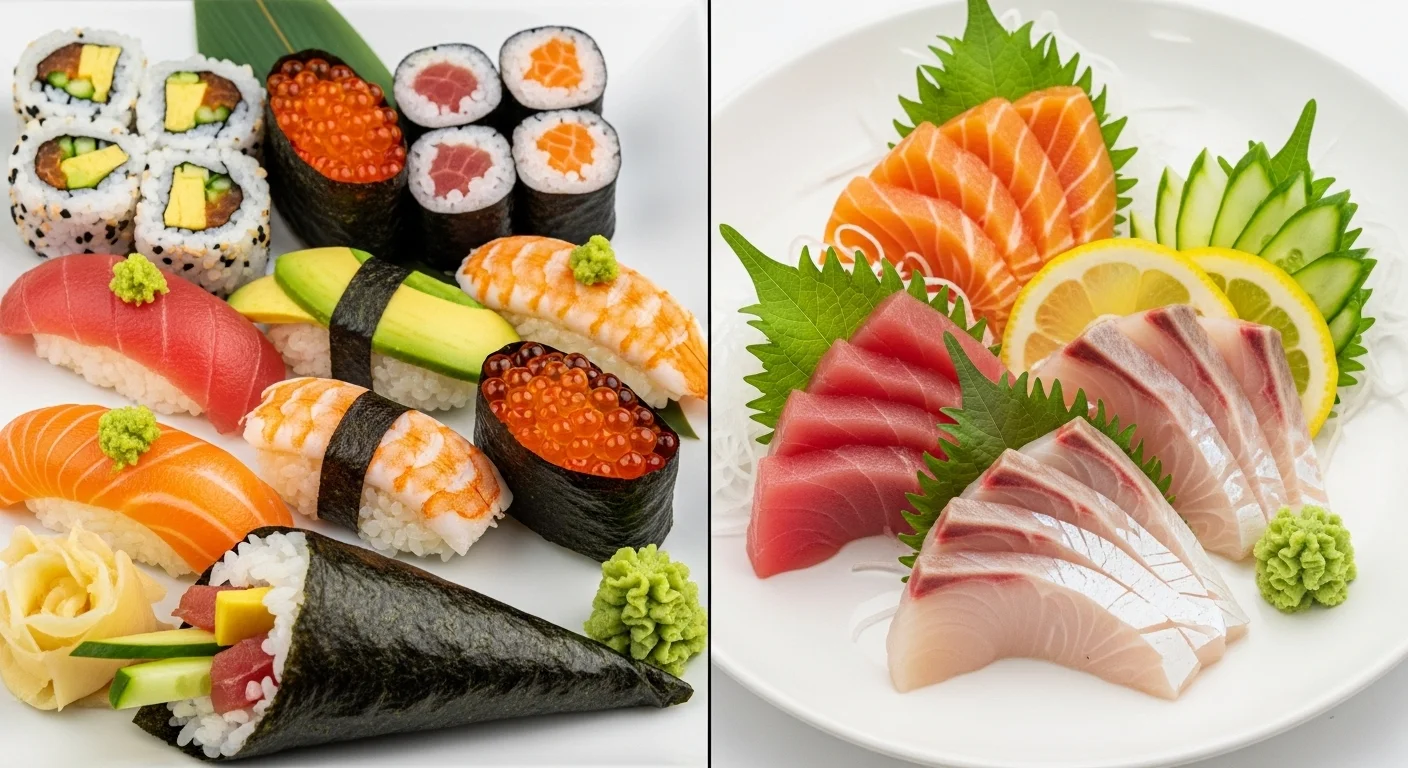
Understanding the difference between sushi and sashimi is essential for anyone exploring Japanese cuisine, as these distinct dining experiences represent centuries of culinary evolution, cultural philosophy, and masterful technique. While often conflated in Western perception, the difference between sushi and sashimi separates two entirely different approaches to showcasing seafood excellence—one emphasizing the harmonious marriage of vinegared rice and toppings, the other celebrating the pure, unadulterated essence of raw fish. In this comprehensive exploration, we’ll journey through the history, preparation methods, regional variations, and etiquette that elevate these dishes from mere food to edible art forms.
The fundamental difference between sushi and sashimi centers on composition and concept. Sushi (寿司) always incorporates shari (seasoned rice) as its foundation, with neta (toppings) serving as complement to the rice’s subtle tang. Sashimi (刺身) eliminates rice entirely, presenting sliced raw seafood as the sole protagonist, accompanied only by minimal garnishes that enhance without distracting. Think of sushi as a composed symphony where rice and fish achieve transcendence through union, while sashimi represents a solo virtuoso performance demanding absolute perfection.
Core Distinctions at a Glance
| Element | Sushi | Sashimi |
|---|---|---|
| Foundation | Vinegared rice (shari) | No rice; pure protein |
| Primary Ingredient | Seafood, vegetables, or egg atop rice | Sliced raw fish or seafood |
| Presentation | Hand-formed or rolled; rice always present | Artfully arranged slices; minimal accompaniments |
| Eating Method | Fingers or chopsticks; often in one bite | Chopsticks; savoring individual slices |
| Condiments | Wasabi between rice and fish; soy sauce for dipping | Wasabi on plate; soy sauce for dipping |
| Preparation Focus | Rice seasoning temperature; topping placement | Knife technique; slicing precision |
| Courses | Often combined in meals | Typically served as appetizer or dedicated course |
The Soul of Sushi: Vinegared Rice as Canvas
Sushi’s identity derives from shari—the short-grain rice seasoned with rice vinegar, sugar, and salt. This isn’t mere substrate; it’s the heart of the dish, requiring years to master.
The Anatomy of Shari
Rice Selection: Koshihikari or similar short-grain varieties prized for starch content, gloss, and subtle sweetness. Regional preferences vary—some chefs prefer slightly firmer grains for nigiri, others softer for optimal mouthfeel.
Seasoning Balance: The su (vinegar mixture) typically combines:
- Rice vinegar: Bright acidity cutting fish oils
- Sugar: Rounded sweetness balancing tartness
- Salt: Enhancing umami and preserving
- Kombu dashi: Some chefs add kelp infusion for depth
Temperature Criticality: Shari must be body-temperature warm (approximately 37°C/98°F) when formed. Cold rice hardens and loses aromatic complexity; overheated rice becomes gummy and overwhelms delicate fish.
Major Sushi Categories
Nigiri (握り) — The Iconic Hand-Press
Technique: Approximately 15-20 grams of shari formed into oval bed with gentle pressure, neta draped across top with wasabi interface. The chef’s palm temperature, pressure consistency, and forming speed determine quality.
Classical Forms:
- Gunkan-maki (軍艦巻き): “Battleship roll” with nori strip wrapping rice cylinder, topped with loose ingredients (ikura, uni, tobiko)
- Temari (手まり): Ball-shaped nigiri, often more decorative, popular in Kansai region
Neta Categories:
- Akami (紅身): Lean red fish (maguro, katsuo)
- Shiromi (白身): White fish (hirame, tai, suzuki)
- Hikarimono (光り物): Silver-skinned fish (saba, kohada, aji)
- Tanago (卵): Egg (tamago, ankimo)
- Nebaneba (ネバネバ): “Sticky” textures (uni, ikura, natto)
Maki (巻き) — The Rolled Art
Hosomaki (細巻き): Thin rolls with single filling, nori exterior, 1-1.5cm diameter. Classic examples: kappa-maki (cucumber), tekka-maki (tuna), kanpyo-maki (dried gourd).
Futomaki (太巻き): Thick rolls 4-6cm diameter, multiple ingredients, traditionally eaten during Setsubun festival.
Uramaki (裏巻き): “Inside-out” rolls with rice exterior, nori inside—California roll innovation, controversial in traditional contexts.
Temaki (手巻き): Hand rolls, cone-shaped nori wrapped around rice and fillings, immediate consumption required before sogginess develops.
Chirashi (ちらし) — Scattered Composition
Edomae-style: Artfully arranged neta atop rice in lacquered box, each piece positioned for visual and gustatory progression.
Gomoku-style: Ingredients mixed throughout rice, home-style preparation emphasizing abundance and variety.
Oshizushi (押し寿司) — Pressed Perfection
Originating in Osaka, layers of rice and fish pressed in wooden molds (oshibako). Battera (mackerel) and saba are classic preparations, the pressure creating distinctive dense texture and clean edges.
The Purity of Sashimi: Knifework as Meditation
Sashimi represents Japanese culinary minimalism at its apex—nowhere to hide imperfections, every cut revealing the chef’s skill and the ingredient’s soul.
The Philosophy of Sashimi
Ike-Jime: The humane killing method immediately destroying brain and spinal cord, preventing stress hormones from tainting flesh. Fish undergoes rigor mortis, then enters rigor resolution where texture optimizes—typically 1-3 days for most species, up to two weeks for certain tuna.
Yubiki and Aburi: Partial cooking techniques—yubiki (brief boiling) for tako (octopus) and kani (crab); aburi (searing) for fatty fish like salmon belly or Wagyu beef, creating temperature contrast and aroma release while maintaining raw interior.
Mastering the Cut: Hōchō Techniques
The sashimi chef’s knife (yanagiba or sujihiki) becomes extension of hand, with distinct cutting styles:
Hiki-zukuri (引き切り): Pull-cut, blade drawn toward chef in single motion, creating clean, glossy surface. Standard for most firm fish.
Sogi-zukuri (そぎ切り): Angled cut creating broader, thinner slices, maximizing surface area for delicate white fish like hirame.
Kaku-zukuri (角切り): Cubed cuts, typically for tuna or amberjack in poke-style preparations or tartare.
Ito-zukuri (糸切り): Thread-thin slicing for translucent fish like fugu or squid, demonstrating extreme precision.
Butsu-giri (ぶつ切り): Chunk-cut for firmer textures like octopus or conch, providing satisfying chew resistance.
Sashimi Presentation: Moritsuke Aesthetics
Sugata-zukuri (姿造り): “Shape-making”—fish arranged to resemble living form, often with head and tail attached, celebrating the ingredient’s life.
Yuki-zukuri (雪造り): “Snow-making”—paper-thin slices arranged in mound resembling snowdrift, classically for fugu.
Ike-zukuri (活け造り): “Living making”—extremely controversial preparation where fish remains alive during presentation, now restricted or banned in many regions.
Garnishes (Tsuma):
- Daikon radish: Spun into tsuma (hair-like strands) or kaki-age (bite-sized pieces), aids digestion and palate cleansing
- Shiso leaf: Perilla providing aromatic counterpoint
- Cucumber: Cooling crunch
- Carrot: Color contrast and sweetness
- Seaweed: Wakame or tosaka for textural variety
Historical Evolution: From Preservation to Art
Sushi’s Ancient Origins
Narezushi (馴れ寿司): The primordial form—fish packed in salted rice for fermentation, the rice discarded, fish consumed. Originated in Southeast Asia, arrived in Japan during Yayoi period (300 BCE-300 CE).
Haya-zushi (早寿司): Muromachi period (1336-1573) innovation adding vinegar to rice, making it edible and reducing fermentation time to days rather than months.
Edomae-zushi (江戸前寿司): Early 19th century Tokyo (Edo) development—Hanaya Yohei credited with inventing nigiri sushi, using fresh-caught bay fish served immediately without curing, establishing the “fast food” of its era.
Sashimi’s Aristocratic Lineage
Sashimi’s roots trace to Heian period (794-1185) aristocracy, where raw fish consumption demonstrated wealth and access to extremely fresh seafood. The term “sashimi” first appears in 15th century, possibly deriving from “sashimi-gui” (pierced and eaten) referring to harvesting technique.
Edo Period Refinement: Development of specialized knives and cutting techniques paralleled rise of kaiseki cuisine, establishing sashimi as essential element of formal dining.
Regional Variations: Japan’s Geographic Diversity
Hokkaido: The Northern Bounty
Sushi: Uni (sea urchin) and ikura (salmon roe) nigiri reign supreme, the cold waters producing unprecedented richness. Sanma (Pacific saury) pressed sushi showcases autumn bounty.
Sashimi: Tairagai (razor clam), hotate (scallop), and kegani (horsehair crab) demonstrate pristine cold-water sweetness. Ruibe (freeze-dried salmon) represents indigenous Ainu influence.
Tokyo (Edomae): The Standard-Bearer
Edomae Sushi: Traditional preparation involving curing, marinating, and cooking techniques applied to fish before serving—kohada (gizzard shad) in vinegar, maguro in soy, anago simmered in tsume sauce.
Sashimi: Tsukiji/Toyosu market access ensures unparalleled variety. Katsuo (skipjack tuna) tataki—seared exterior, raw interior—exemplifies Edomae innovation.
Kyoto-Osaka (Kansai): Refined Elegance
Oshizushi: Box-pressed mackerel (battera) and sabazushi (vinegared mackerel) reflect merchant-class preferences for preserved, transportable sushi.
Sashimi: Yuba (tofu skin) sashimi and fu (wheat gluten) preparations demonstrate Buddhist vegetarian influence in temple cuisine.
Kyushu: Bold and Fermented
Sushi: Kabura-zushi (fermented turnip and yellowtail) from Ishikawa prefecture represents narezushi survival.
Sashimi: Fugu (pufferfish) from Shimonoseki requires licensed preparation, the tenuous balance between deadly neurotoxin and sublime texture.
Okinawa: Tropical Fusion
Sashimi: Goat sashimi (yagi-sashi) and sea grapes (umibudo) reflect subtropical ecology and historical independence from mainland culinary norms.
Ingredient Deep Dive: The Hierarchy of Quality
Tuna (Maguro): The Undisputed King
Akami: Lean red loin, deep crimson, clean metallic flavor. Chūtoro (medium fatty belly) and ōtoro (fattiest belly) represent increasing marbling and price, with ōtoro achieving Wagyu-like richness.
Grading: Japanese auctions grade by color, fat content, and texture—#1 grade commands astronomical prices (2019 record: $3.1 million for 276kg bluefin).
Sustainability Crisis: Atlantic bluefin endangered status drives shift to farmed tuna and alternative species like bigeye and yellowfin.
Sea Urchin (Uni): Ocean’s Essence
Nama-uni: Fresh uni from shell, dramatically perishable, sweet and briny.
Murasaki-uni: Purple sea urchin, firmer texture, more intense flavor.
Bafun-uni: Short-spined species, considered premium for creamy consistency.
Processing: “Shucking” uni requires breaking shell without damaging fragile gonads (the edible portion), washing in saltwater to remove bitter liquid.
Salmon (Sake/Sake): The Controversial Favorite
Paradox: Salmon wasn’t traditional sushi fish due to Pacific salmon parasite load. Norwegian aquaculture introduction in 1980s revolutionized availability.
Aburi-style: Torch-seared belly (harasu) melts fat, creating temperature-play experience.
Sashimi-grade: Requires freezing to -20°C for 7 days or -35°C for 15 hours to kill parasites—”fresh” salmon sashimi is technically frozen-thawed.
Octopus (Tako): Texture Mastery
Yubiki Preparation: Dipped briefly in boiling water, immediately ice-bathed to set texture. Properly prepared tako offers resistance then yielding tenderness; overcooked becomes rubber, undercooked remains slimy.
Sashimi Presentation: Thinly sliced and arranged in chrysanthemum pattern, often with sudachi citrus and momiji oroshi (grated daikon with chili).
The Omakase Experience: Trusting the Master
Omakase (お任せ)—”I leave it to you”—represents the pinnacle of sushi and sashimi appreciation, surrendering choice to the itamae (chef).
The Omakase Structure
Progression Philosophy: Light to dark, lean to fatty, delicate to intense. Classic sequence:
- Hirame/Karei: Flatfish, subtle introduction
- Tai: Sea bream, gentle sweetness
- Ika: Squid, textural transition
- Akami: Lean tuna, building intensity
- Chūtoro/Ōtoro: Fatty tuna, crescendo
- Hikarimono: Silver fish, palate reset with acidity
- Ebi/Kani: Shellfish, sweetness
- Uni/Ikura: Roe, briny luxury
- Anago/Unagi: Cooked eel, savory conclusion
- Tamago: Sweet egg, dessert transition
Sashimi Omakase: Often precedes sushi courses, showcasing chef’s sourcing and knife skills through 5-7 varieties, each with specific garnish and sauce pairings.
Etiquette and Appreciation: The Complete Guide
Sushi Etiquette
Seating: Counter seating preferred for temperature-optimal timing and chef interaction. Never rub chopsticks together (implies cheap quality).
Ordering: Begin with “okonomi” (individual orders) progressing light-to-heavy, or commit to “omakase.” Avoid wasabi-in-soy-sauce slurry—chef has already applied optimal wasabi between rice and fish.
Consumption:
- Nigiri should be eaten in one bite if possible; two bites maximum
- Turn nigiri fish-side-down for soy dipping to prevent rice disintegration
- Use fingers for nigiri (traditional and temperature-sensitive); chopsticks acceptable
- Ginger (gari) cleanses palate between pieces, never placed atop sushi
Interaction: Engage chef with questions about sourcing; silence during actual consumption shows respect. Express appreciation with “gochisōsama deshita” upon completion.
Sashimi Etiquette
Presentation Respect: Admire arrangement before disturbing; consume from front to back or light-to-heavy as presented.
Soy Sauce Discipline: Pour minimal amount; drowning sashimi insults chef’s seasoning. Mix wasabi into soy sauce only if provided wasabi is fresh-grated (rare outside Japan); pre-made wasabi paste should touch fish directly.
Garnish Consumption: Tsuma (daikon) is edible and digestive; shiso and flowers are garnish unless explicitly indicated otherwise.
Temperature: Sashimi should be consumed immediately upon presentation; warming compromises texture and safety.
Health Considerations: Safety and Nutrition
Food Safety Protocols
Anisakiasis Prevention: Freezing requirements (-20°C for 7 days or -35°C for 15 hours) eliminate parasitic nematodes. “Sushi-grade” and “sashimi-grade” are marketing terms—verify freezing protocols with supplier.
Histamine Poisoning: Scombroid fish (tuna, mackerel, bonito) produce histamine when temperature-abused, causing allergic-reaction symptoms. Proper cold-chain maintenance prevents occurrence.
Vibrio Bacteria: Warm-water oysters and shellfish risks; avoid raw consumption during summer months or from questionable sources.
Mercury Concerns: Large predatory fish (bluefin tuna, swordfish, shark) accumulate mercury; conceiving women and children should limit consumption.
Nutritional Profiles
Sushi Benefits:
- Omega-3 fatty acids from fatty fish
- Resistant starch from cooled rice (lower glycemic impact)
- Probiotic potential from fermented ingredients
- Balanced macronutrients when vegetable-inclusive
Sashimi Advantages:
- Zero carbohydrate (keto/paleo compatible)
- Maximum protein bioavailability
- No rice means lower caloric density
- Concentrated omega-3 without filler
Global Adaptations: Fusion and Controversy
Western Innovations
California Roll: Avocado and crab (later imitation crab) inside-out roll, created in Los Angeles 1960s, originally hiding nori from unaccustomed American palates.
Spicy Tuna: Mayonnaise and chili sauce addition, masking lower-quality tuna while creating creamy texture profile.
Rainbow Roll: California roll topped with assorted fish slices, emphasizing visual appeal over traditional balance.
Sashimi Nachos: Wonton chips with raw fish, avocado, and Asian-inspired sauces—culinary sacrilege to purists, accessible entry point for novices.
Authenticity Debates
Wasabi Substitutes: Most “wasabi” outside Japan is horseradish, mustard, and green dye—true Wasabia japonica requires specific mountain stream conditions and commands $100+/pound.
Ginger Dye: Pink gari indicates artificial coloring; natural gari ranges pale yellow to light pink.
Rice Seasoning: Western sushi often under-seasoned or over-sweetened, missing shari’s essential supporting role.
For a whole new knowledge on difference….

Conclusion: Choosing Your Experience
The difference between sushi and sashimi ultimately reflects your dining intention. Choose sushi when seeking complete composition—the interplay of warm, vinegared rice with varied toppings creating harmonious bites. Select sashimi when pursuing purity—the unmediated expression of seafood quality through knife-craft and minimalist presentation.
For the complete experience, embrace both: begin with sashimi to appreciate individual ingredients in isolation, transition to sushi for the rice-fish synergy, and conclude with tamago or dessert. This progression mirrors traditional kaiseki structure and honors the full spectrum of Japanese culinary artistry.
Whether seated at a Tokyo subway-counter paying ¥1,000 for quick nigiri or experiencing three-Michelin-star omakase costing ¥50,000, understanding these distinctions transforms eating into education, consumption into appreciation. The itamae’s years of training, the fishmonger’s dawn auction selections, the rice farmer’s harvest—all culminate in moments on your tongue. Recognize the difference, respect the craft, and savor every bite. Further information at…

Hi All! I’m Imran Abbas. I’m a Ph.D (scholar) in Structural Chemistry and I work in a number of domains like Bioinformatics, Literature, politics, sports and I’m a polyglot as well. I respect all irrespective of their ethnicity, locality and color. I’m always ready to learn new ideas and travel to different parts of the world.