
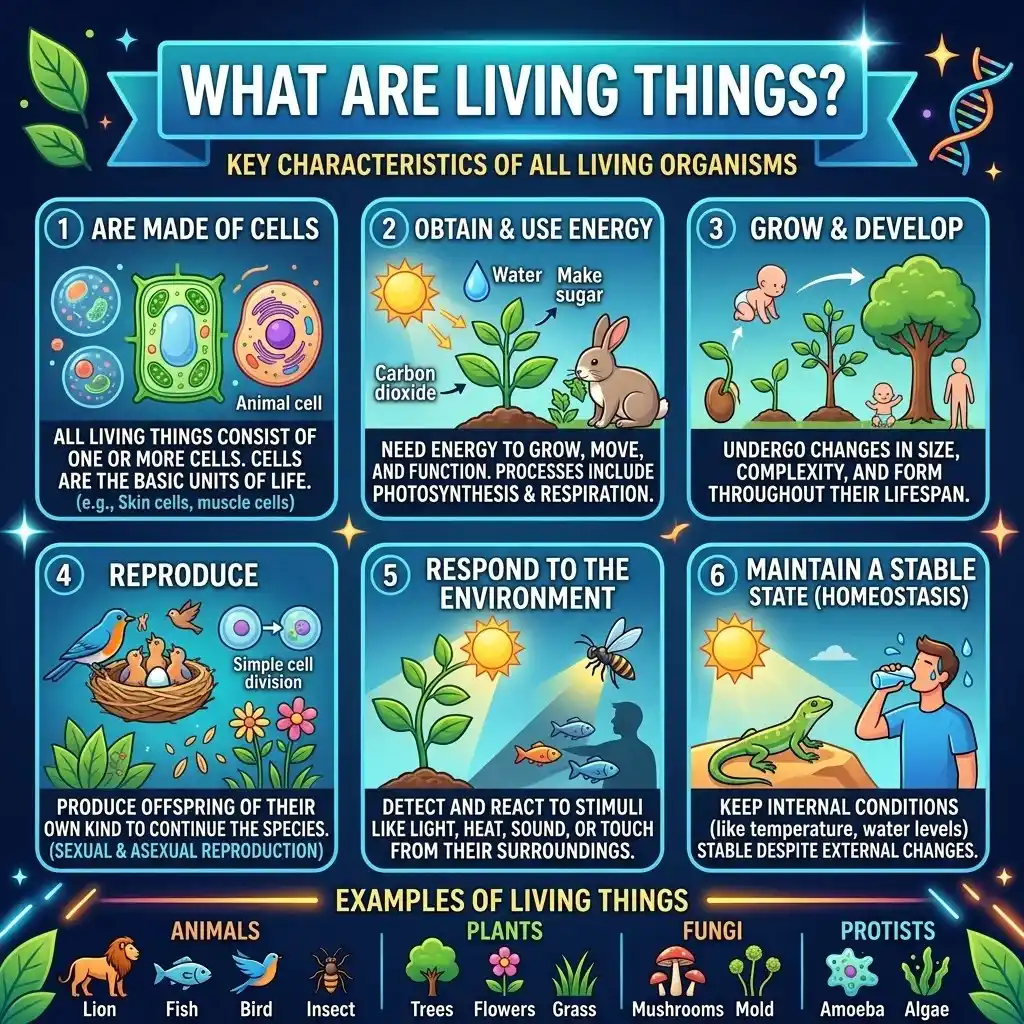
Living things are all around us. They include humans, animals, plants, and even tiny organisms we cannot see with our eyes. In this guide, you will clearly understand what living things are, how scientists define them, and how they differ from non-living things. Moreover, you will explore examples, diagrams, activities, worksheets, and common mistakes students often make.
This article uses simple English so every student can understand it easily.
Definition of Living Things
Living things are organisms that show life. They grow, breathe, reproduce, and respond to changes in their environment. In addition, they use energy to survive.
Simple Definition
Living things are organisms that have life and perform life processes like growth, respiration, and reproduction.
Scientific Definition
Scientists define living things as organisms made of cells that carry out essential life processes to maintain life and continue their species.
Therefore, if something performs life activities inside its body, we call it a living thing.
Scientific Explanation of Living Things 🔬
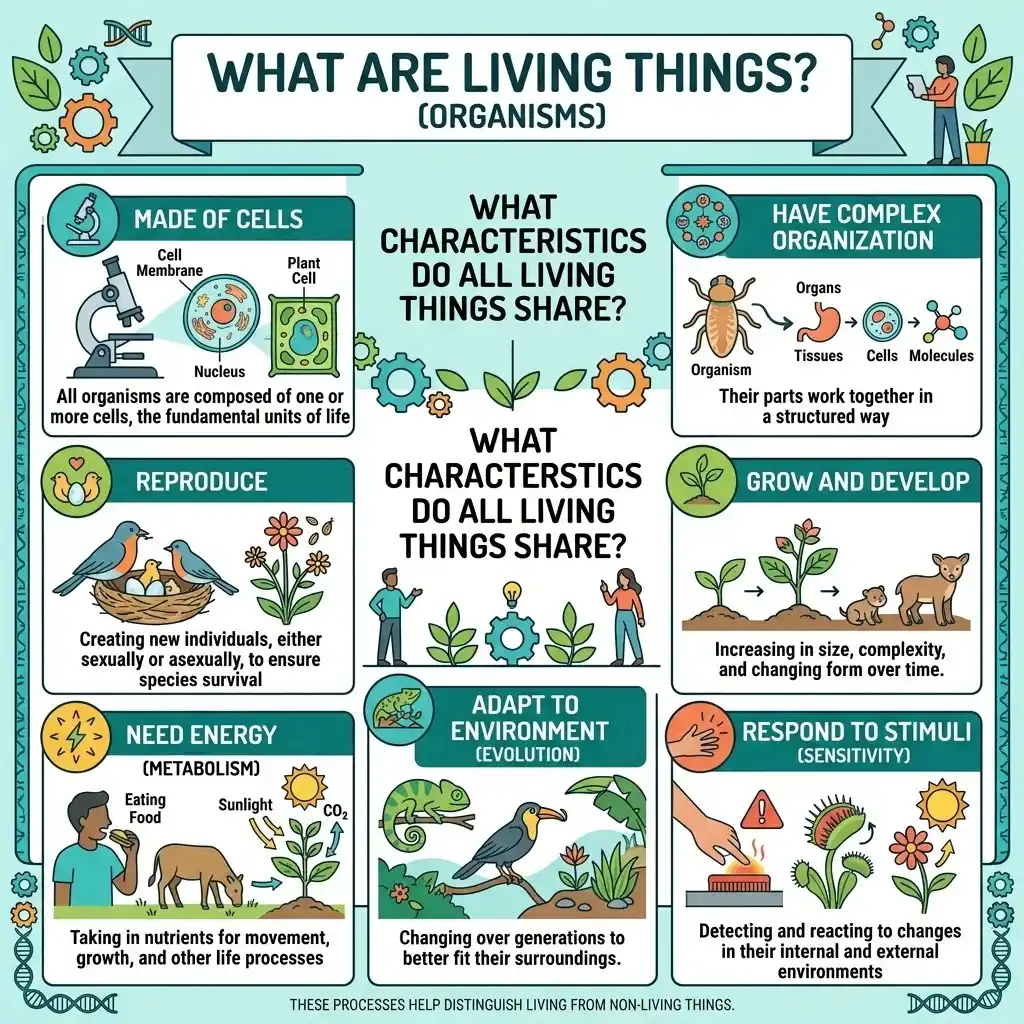
To understand living things deeply, we must look inside them. First of all, all living things consist of cells. A cell is the smallest unit of life.
Inside a cell:
- The nucleus controls all activities.
- The cytoplasm supports chemical reactions.
- The mitochondria produce energy.
Moreover, living things maintain balance inside their body. Scientists call this balance homeostasis.
In addition, living things use energy through a process called metabolism. This helps them grow, move, and survive.
So, cells and life processes together define life scientifically.
Characteristics of Living Things 🌿
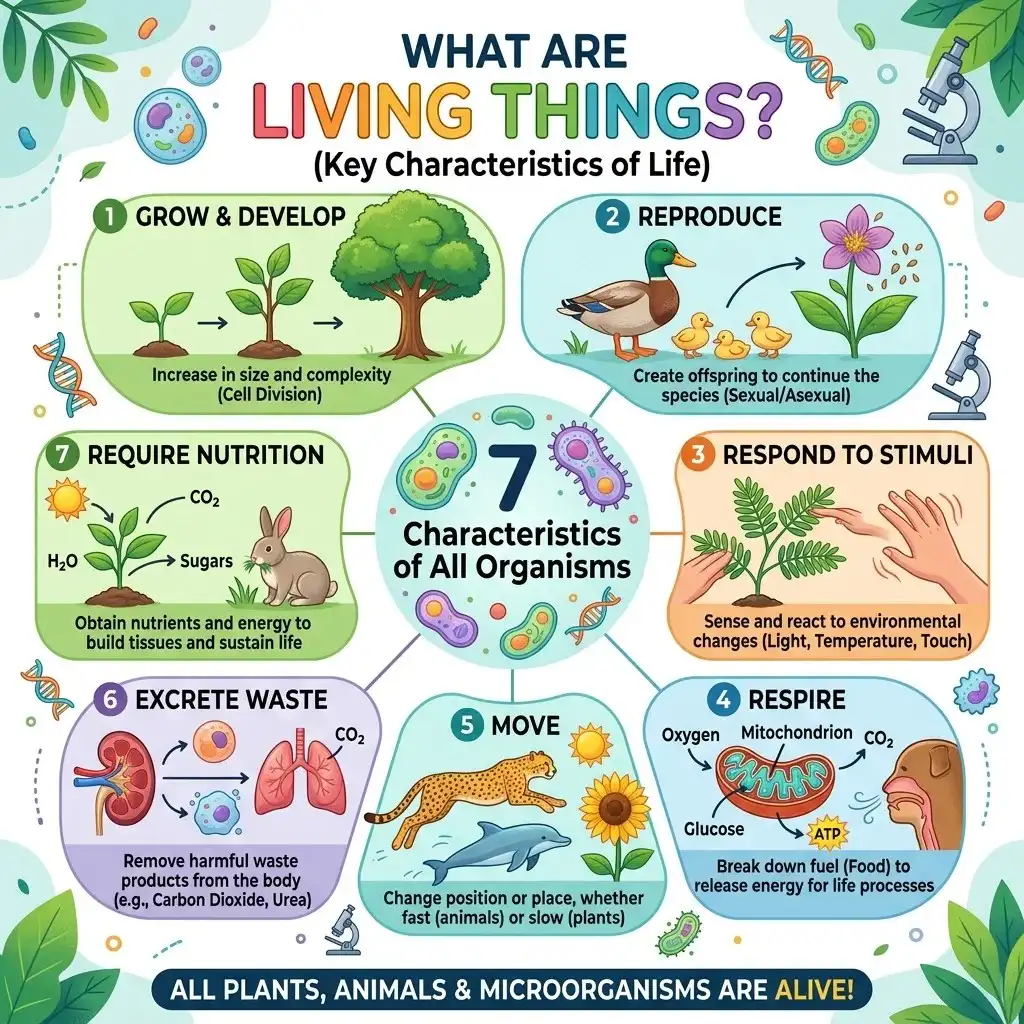
Living things share several important features. Students often remember them using the word MRS GREN.
1. Movement
First of all, living things move.
- Humans walk
- Birds fly
- Plants grow toward light
2. Respiration
Next, living things break down food to release energy.
3. Sensitivity
In addition, living things respond to changes like light, heat, or sound.
4. Growth
Moreover, all living things grow over time.
5. Reproduction
Living things produce new organisms like themselves.
6. Excretion
They remove waste materials from the body.
7. Nutrition
Finally, they take in food to get energy.
Therefore, all living things must show these characteristics to survive.
Life Processes in Living Things ⚙️
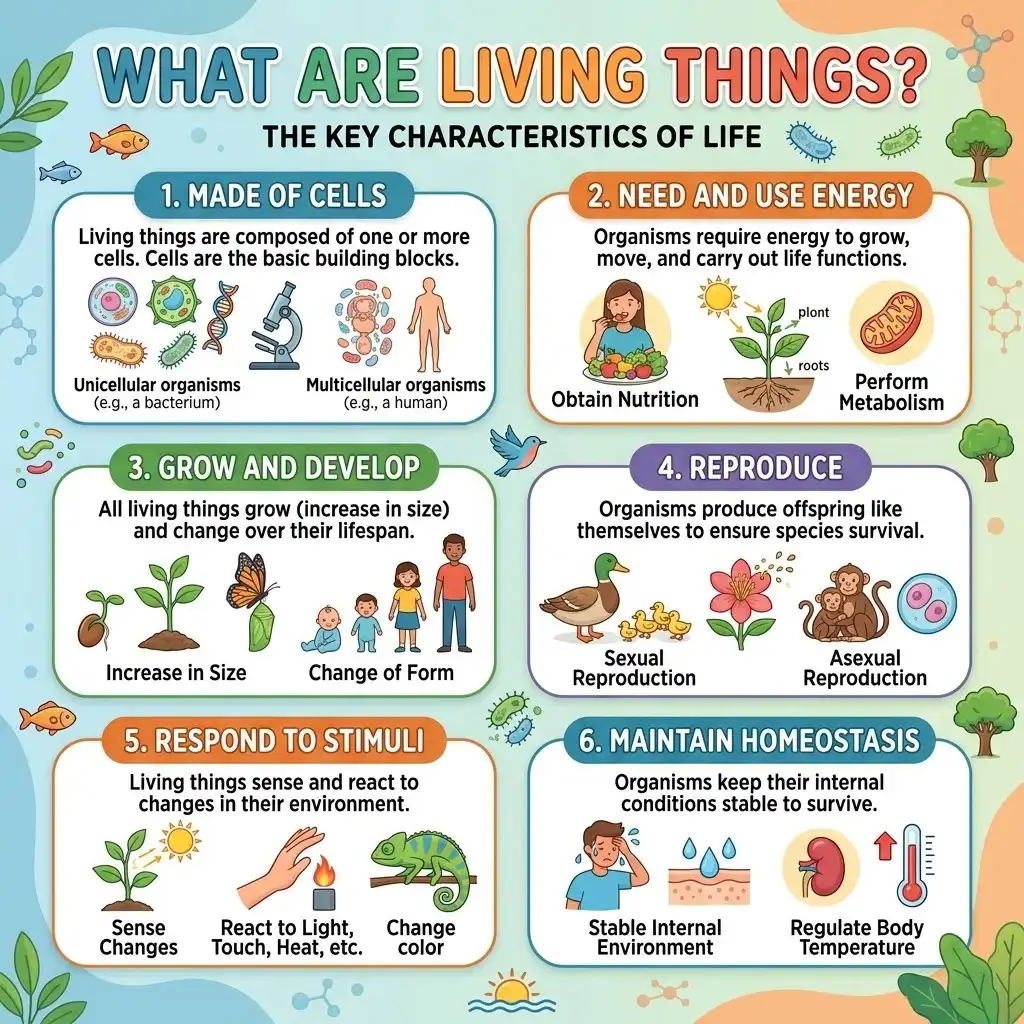
Living things perform several important processes. Let us understand them one by one.
Nutrition
First, living things take food. Plants make food using sunlight, while animals eat plants or other animals.
Respiration
Next, they convert food into energy. This energy helps them live and grow.
Transport
In addition, nutrients move inside the body. In humans, blood carries food and oxygen.
Excretion
Moreover, living things remove waste like carbon dioxide and urea.
Reproduction
Finally, they produce offspring to continue life on Earth.
Therefore, life processes keep living things active and alive.
Classification of Living Things 🌍
Scientists classify living things to study them easily.
Major Groups
- Plants 🌿
- Animals 🐘
- Microorganisms 🦠
Further Classification
- Vertebrates (with backbone)
- Invertebrates (without backbone)
- Flowering plants
- Non-flowering plants
Additionally, scientists also study microorganisms like bacteria and fungi.
So, classification helps us organize life in a better way.
Comparison Table: Living vs Non-Living Things 📊
| Feature | Living Things | Non-Living Things |
|---|---|---|
| Cells | Present | Absent |
| Growth | Natural growth | No growth |
| Respiration | Yes | No |
| Reproduction | Yes | No |
| Movement | Yes | Only external force |
| Energy use | Yes | No |
| Response | Yes | No |
Therefore, living things clearly differ from non-living things in many ways.
Examples of Living Things 🌱
Living things exist in different forms.
Plants
- Mango tree
- Grass
- Rose plant
Animals
- Lion
- Elephant
- Fish
- Human beings
Microorganisms
- Bacteria
- Amoeba
- Yeast
Moreover, all these organisms show life processes.
Real-Life Examples of Living Things 🌍
We see living things everywhere in daily life.
For example:
- A baby growing into an adult 👶➡️🧑
- A seed turning into a plant 🌱
- Birds building nests 🐦
- Fish swimming in water 🐟
In addition, even microorganisms in food and soil show life.
Therefore, life exists in both visible and invisible forms.
Importance of Living Things 🌎
Living things play a very important role in nature.
1. Balance in Nature
Living things maintain ecological balance.
2. Food Chains
Animals and plants depend on each other for food.
3. Oxygen Production
Plants produce oxygen through photosynthesis.
4. Decomposition
Microorganisms break down waste and clean the environment.
5. Human Survival
Humans depend on plants and animals for food and resources.
Thus, without living things, life on Earth cannot continue.
Diagrams of Living Things 🖼️
Simple Classification Diagram
              LIVING THINGS
                    |
     --------------------------------
     |              |               |
   Plants         Animals     Microorganisms
     |              |               |
 Trees         Lion, Fish      Bacteria, Yeast
Life Processes Flow
Food → Respiration → Energy → Growth → Reproduction
These diagrams help students understand concepts quickly.
Activities for Students 🎓
Activity 1: Observation Walk
Go outside and list:
- 5 living things
- 5 non-living things
Activity 2: Seed Growth Experiment
- Plant a seed in soil
- Water it daily
- Observe changes for 7–10 days
Activity 3: Sorting Game
Mix objects and sort them into:
- Living things
- Non-living things
Activity 4: Response Test
Touch a plant gently and observe how it reacts over time.
Therefore, these activities make learning fun and practical.
Worksheets 📝
Fill in the blanks
- Living things are made of __________.
- Plants make food by __________.
- The smallest unit of life is __________.
True or False
- Rocks are living things. ( )
- All living things grow. ( )
- Animals do respiration. ( )
Short Questions
- What are living things?
- Name any four characteristics of living things.
- Give two examples of microorganisms.
Common Misconceptions ❌
1. All moving things are living
However, movement alone does not define life. Cars move but are non-living.
2. Plants are non-living
In reality, plants grow, reproduce, and respond to sunlight.
3. Fire is living
Fire does not have cells, so it is non-living.
4. Viruses are fully living
Viruses behave like living things only inside host cells.
Therefore, we must understand science carefully to avoid confusion.
Frequently Asked Questions (FAQs) ❓
What are living things in simple words?
Living things are organisms that grow, breathe, and reproduce.
How do we identify living things?
We identify them by checking life processes like growth and respiration.
Are plants living things?
Yes, plants are living because they grow and respond to the environment.
Are non-living things completely inactive?
No, they may move or change, but they do not show life processes.
Why do living things need energy?
They need energy for growth, movement, and survival.
Do all living things breathe?
Yes, all living things perform respiration in different ways. Know more here.
Conclusion
In conclusion, living things form the foundation of all life on Earth. They include humans, animals, plants, and microorganisms, and they all share essential life processes such as growth, respiration, reproduction, and response to the environment. First of all, they are built from cells, which act as the basic units of life. Moreover, they continuously use energy to survive and maintain balance inside their bodies.
In addition, living things interact with each other and with their surroundings, which helps maintain ecosystems and keeps nature in harmony. Without living things, Earth would be silent, inactive, and lifeless.
Therefore, understanding living things is not only an important part of science but also a way to appreciate the beauty and complexity of life itself. Finally, when we observe even a small plant or a tiny insect, we are actually witnessing a complete system of life in action. For a video click here.
Hi All! I’m Imran Abbas. I’m a Ph.D (scholar) in Structural Chemistry and I work in a number of domains like Bioinformatics, Literature, politics, sports and I’m a polyglot as well. I respect all irrespective of their ethnicity, locality and color. I’m always ready to learn new ideas and travel to different parts of the world.