
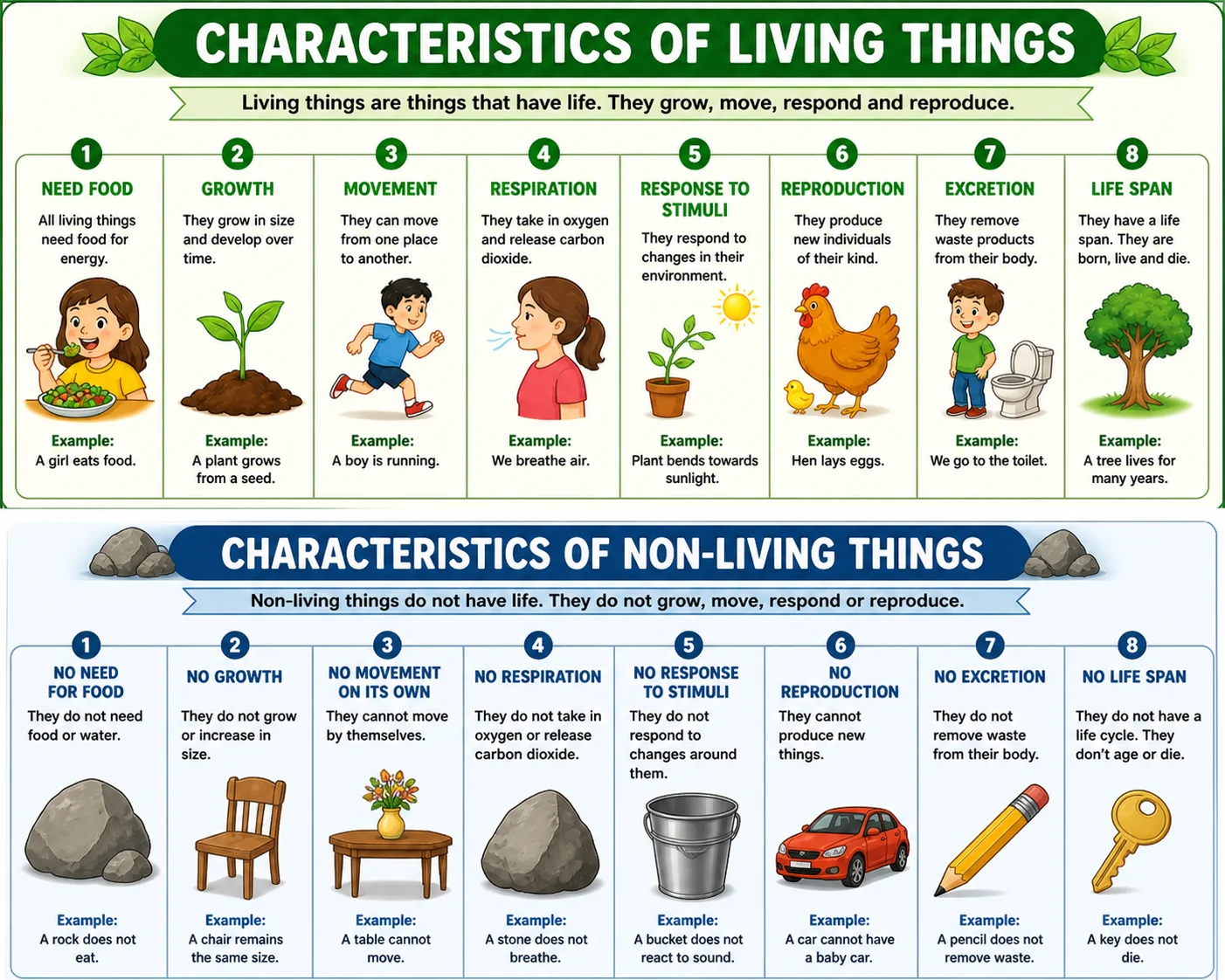
Definition: Characteristics of living and non living things are the special traits that show whether something grows, breathes, moves, and needs food, or lacks these traits.
Pronunciation: kar-ik-ter-IS-tiks (of LIV-ing and non-LIV-ing things)
Origin: The word “characteristic” comes from the Greek word “kharakter.” This word means “a special mark or quality.”
Introduction
Have you ever looked at a rock and a bird and wondered what makes them different? Both exist in the world around you. However, one moves, eats, and grows. The other sits still and never changes. The characteristics of living and non living things help you tell them apart. These traits matter because they help you understand life itself. Moreover, they guide scientists, doctors, and teachers every day. When you learn these differences, you start thinking like a biologist. Notice which objects breathe and which ones do not. Also see which items reproduce and which ones stay the same. Therefore, this topic opens your eyes to the natural world. In this article, you will discover simple ways to spot living things. You will also learn why this knowledge helps everyone stay curious about science.
What Are Characteristics of Living and Non Living Things?
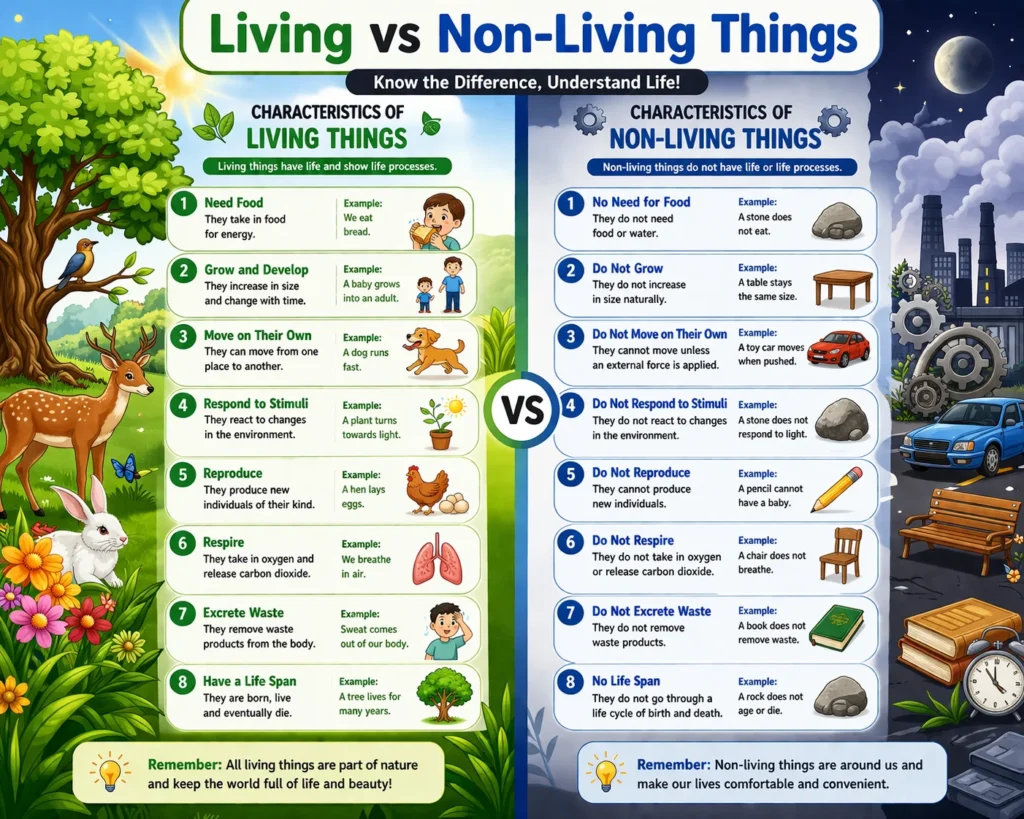
Characteristics of living and non living things are the special signs that show whether something is alive or not alive. Living things eat, grow, move, breathe, and make babies. Non-living things do none of these actions.
For example, a dog is living. It runs and eats food. A chair is non-living. It stays in one place and never eats.
Simple Explanation of Characteristics of Living and Non Living Things
Think of a living thing like a busy student. This student wakes up, eats breakfast, runs to school, grows taller, and makes new friends. A non-living thing acts like a backpack sitting in a corner. The backpack stays still. It never eats or grows. It never makes baby backpacks.
To tell them apart, follow four simple steps. First, look for movement. Living things move on their own. Non-living things only move when something pushes them. Next, check for growth. Living things get bigger over time. Non-living things stay the same size. Then, listen for breathing. Living things take in air. Non-living things do not breathe. Finally, watch for reproduction. Living things make babies or seeds. Non-living things never create copies of themselves. Therefore, these four steps help you classify anything you see.
Key Characteristics of Living and Non Living Things
Living Things
- They move on their own. A cat walks to its food bowl.
- They need food and water. A plant drinks water through its roots.
- They grow and change. A baby becomes an adult.
- They breathe or exchange gases. Fish take oxygen from water.
- They reproduce. A chicken lays eggs.
- They respond to changes. A flower turns toward sunlight.
- They produce waste. Your body removes waste every day.
Non-Living Things
- They do not move on their own. A stone stays on the ground.
- They do not need food. A car uses fuel but does not eat like an animal.
- They do not grow. A table stays the same size for years.
- They do not breathe. A book takes in no air.
- They do not reproduce. A chair never makes a baby chair.
- They do not respond to touch or light. A lamp stays hot but does not react like a living thing.
Types and Classification of Living and Non Living Things
Living Things
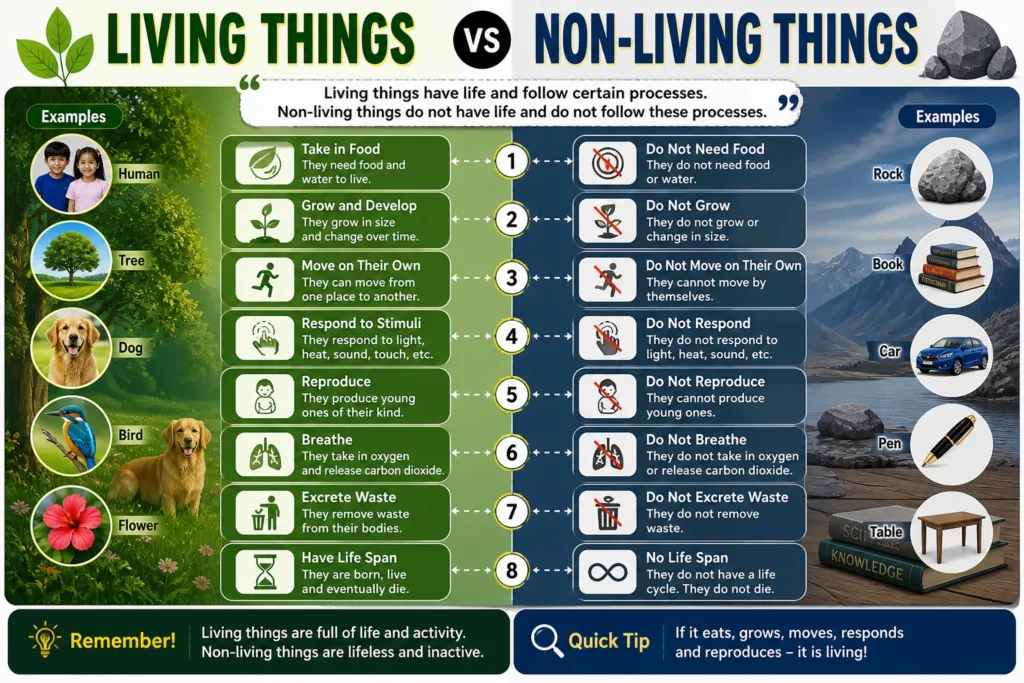
Living things include animals, plants, fungi, and tiny organisms. All these groups share the seven traits of life. However, they show these traits in different ways. For example, plants make their own food. Animals hunt or gather food.
Non-Living Things
Non-living things include natural objects and human-made objects. Natural non-living things include rocks, water, and air. Human-made non-living things include cars, phones, and toys. Neither group eats, grows, or reproduces.
Things That Confuse People
Some things confuse people because they seem alive. Fire moves and grows. However, fire does not reproduce or breathe in a living way. Viruses also confuse scientists. They reproduce but only inside other living cells. Therefore, many scientists call viruses non-living.
How Do Characteristics of Living and Non Living Things Work?
Scientists use a simple process to classify objects.
First, they observe the object closely. They watch it for several minutes or days.
Next, they test for movement. They check whether the object moves by itself. Then, they look for growth. They measure the object over time.
After that, they check for breathing. They see if the object takes in air or releases gases.
Finally, they test for reproduction. They see if the object makes babies or seeds. If the object passes all these tests, scientists call it living. If it fails, they label it non-living.
Therefore, this step-by-step method keeps science clear and fair.
Importance of Characteristics of Living and Non Living Things
Daily Life
You use these traits every day. Water your plants because they need food and water. Feed your pets because they grow and stay healthy. Do not feed rocks because they lack life.
Environment
Scientists study forests and oceans. They check which parts are alive. This helps them protect endangered animals and plants. Moreover, they track pollution effects on living things.
Human Health
Doctors study living cells. They need to know which germs are alive. This helps them choose the right medicines. Moreover, understanding life traits helps farmers grow better crops.
Examples of Characteristics of Living and Non Living Things in Real Life
A puppy runs, barks, eats, and grows. A teddy bear sits still and never eats.
A tree takes in sunlight, water, and carbon dioxide. It grows taller and makes seeds. A plastic bottle stays the same size and never makes baby bottles.
A coral reef looks like a rock but holds millions of tiny living animals. A cloud moves and changes shape but holds only water droplets and lacks life.
Characteristics of Living and Non Living Things for Different Age Groups
Kids
Imagine a toy robot and a real puppy. The robot walks if you turn it on. The puppy walks because it wants to. The robot stops when the battery dies. The puppy keeps playing because it is alive.
Living things want to eat and grow. Non-living things need someone else to make them work.
Students
Living things contain cells. These cells divide and multiply. This process causes growth.
Living things also carry out metabolism. Metabolism means they break down food to make energy. Non-living things lack cells.
They also lack metabolism. Therefore, a car burns gas but does not metabolize like a mouse.
For Advanced Learners
- Biologists define life using seven key criteria. These include cellular organization, metabolism, homeostasis, growth, adaptation, response to stimuli, and reproduction.
- Homeostasis means keeping internal conditions stable. Living organisms maintain homeostasis. For example, your body sweats to stay cool.
- Non-living entities lack organized cellular structures.
- They also lack the chemical reactions that keep cells running. Scientists call these reactions biochemical pathways.
- Moreover, living systems evolve through natural selection. This means living things change over generations to fit their environment.
- Non-living matter does not evolve in this biological sense. Therefore, the distinction rests on biochemical and genetic continuity. Genetic continuity means passing traits to offspring through genes.
Common Misconceptions About Characteristics of Living and Non Living Things
Misconception: Fire is alive because it moves and grows.
Correction: Fire lacks cells and does not reproduce in a biological way. Therefore, fire is non-living.
Misconception: Plants do not move, so they are non-living.
Correction: Plants move slowly. They turn toward light and grow roots toward water. Therefore, plants are living.
Misconception: Machines are alive because they work and use energy.
Correction: Machines lack cells and metabolism. They do not grow or reproduce. Therefore, machines are non-living.
Misconception: Water is alive because it flows and changes shape.
Correction: Water lacks all seven traits of life. It does not eat, grow, or reproduce. Therefore, water is non-living.
Borderline Cases (The Gray Zone)
Some things look alive but fail the full test. Let’s check them one by one:
- Fire
- Uses energy and spreads
- Does not have cells
- ❌ Not living
- Virus
- Shows life only inside a host
- Does not act alone
- ⚠️ Not fully living
- Seed (Dormant)
- Looks inactive
- Starts growth in the right conditions
- ✅ Living
- Crystal
- Grows in size
- Does not use energy or reproduce
- ❌ Not living
Key idea: One or two features do not decide life. You must check all main characteristics.
Decision Tool (Step-by-Step Thinking)
Use this simple rule to decide:
- Does it use energy?
- Does it grow and develop?
- Does it respond to surroundings?
- Does it reproduce?
- Does it have cells?
If most answers are “yes,” it is living.
If answers are “no,” it is non living.
Feature Strength Scale (Not All Features Look the Same)
- Movement
- Animals move fast
- Plants move slowly
- Response
- Humans react quickly
- Plants respond slowly
Insight: Living things show features in different ways, but all still count as living.
Mini Case Studies (Learn by Thinking)
Instance 1: Dog
- Eats, moves, grows, reproduces
- ✅ Living
2: Car
- Moves but needs driver
- Does not grow or reproduce
- ❌ Non living
Case 3: Tree
- Grows, makes food, responds to light
- ✅ Living
Exceptions That Teach Rules
- Mule
- Cannot reproduce
- Still grows and uses energy
- ✅ Living
- Dry Seed
- Looks dead
- Grows when water is available
- ✅ Living
Lesson: Missing one feature does not remove life.
Ecosystem Connection
Living and non living things depend on each other:
- Plants need sunlight, water, and soil
- Animals depend on plants for food
- Air supports breathing
Result: Life stays balanced through this connection.
Micro-Level Insight (Cell Connection)
- All living things contain cells
- Cells perform life processes
- Non living things do not contain cells
Cells act like the basic unit of life
Real-Life Decision Practice
Try these:
- Robot
- Moves and responds
- Does not grow or reproduce
- ❌ Non living
- Cloud
- Changes shape
- Does not use energy like living things
- ❌ Non living
- Bacteria
- Grows and reproduces
- Has cells
- ✅ Living
Difference Between Characteristics of Living and Non Living Things and Similar Concepts
Living Things vs. Dead Things
Living things show all seven traits. Dead things once showed these traits but now lack them. A fallen leaf was living. Now it is dead. It no longer grows or breathes.
Living Things vs. Dormant Things
Some living things seem non-living because they sleep. Seeds lie still for years. However, they contain life inside. When water and warmth arrive, they sprout. Therefore, dormant things are living, not non-living.
Characteristics of Life vs. Traits of Matter
All things contain matter. Matter includes both living and non-living things. However, only living things show life characteristics. A rock contains matter but lacks life.
Comparison Table: Living vs Non Living Things
| # | Feature | Living Things | Non Living Things |
|---|---|---|---|
| 1 | Need for Food | Living things take in food for energy. Example: A cow eats grass. | Non living things do not need food. Example: A rock does not eat. |
| 2 | Growth | Living things grow and develop over time. Example: A baby grows into an adult. | Non living things do not grow naturally. Example: A chair stays the same size. |
| 3 | Movement | Living things move on their own or show internal movement. Example: A dog runs. | Non living things move only with external force. Example: A ball moves when you kick it. |
| 4 | Respiration (Breathing) | Living things exchange gases for energy. Example: Humans breathe oxygen. | Non living things do not breathe. Example: A table does not take in air. |
| 5 | Response to Stimuli | Living things respond to light, heat, and touch. Example: A plant bends towards sunlight. | Non living things do not respond actively. Example: A stone does not react to light. |
| 6 | Reproduction | Living things produce new organisms. Example: Birds lay eggs. | Non living things do not reproduce. Example: A car cannot create another car. |
| 7 | Cellular Structure | Living things consist of cells. Example: Human body has millions of cells. | Non living things do not contain cells. Example: Water has no cells. |
| 8 | Energy Use | Living things use energy for activities. Example: A cat uses energy to jump. | Non living things do not use energy internally. Example: A stone does not need energy. |
| 9 | Excretion (Waste Removal) | Living things remove waste from their bodies. Example: Humans sweat and excrete waste. | Non living things do not remove waste. Example: A book does not produce waste. |
| 10 | Life Span | Living things have a life cycle. Example: A tree grows, ages, and dies. | Non living things do not have a life cycle. Example: A metal object does not have a natural life span. |
Quick Insight
Living things act like active systems that grow, respond, and reproduce.
Non living things act like static objects that stay unchanged unless an outside force acts on them.
Applications of Characteristics of Living and Non Living Things
Medicine
Doctors must know which germs are alive. This helps them choose antibiotics. Antibiotics kill living bacteria. They do not hurt non-living viruses in the same way.
Environment
Scientists classify soil organisms. They protect living creatures in ecosystems. They also study how non-living factors like temperature affect living things.
Technology
Engineers build robots. They study living muscles to design better machines. However, they know robots remain non-living.
Daily Life
Sort your trash at home. Compost living scraps like apple cores. Recycle non-living materials like plastic. This keeps the planet clean.
Interesting Facts About Characteristics of Living and Non Living Things
- The largest living thing on Earth is a honey fungus in Oregon. It covers over 2,000 acres.
- Some seeds stay dormant for thousands of years. Scientists grew a date palm from a 2,000-year-old seed.
- Tardigrades are tiny living animals. They survive extreme heat, cold, and radiation.
- A volcano grows and moves lava. However, it remains non-living because it lacks cells and DNA.
- Scientists debate whether viruses are living or non-living. Viruses reproduce only inside host cells.
- The human body contains about 37 trillion living cells. Each one performs life processes every second.
FAQs About Characteristics of Living and Non Living Things
Q1: What are the characteristics of living and non living things?
Living things move, grow, eat, breathe, reproduce, respond, and produce waste. Non-living things do none of these actions.
Q2: How many characteristics do living things have?
Scientists recognize seven main characteristics. These include movement, nutrition, growth, respiration, reproduction, response, and excretion.
Q3: Is a virus living or non-living?
Viruses confuse scientists. They reproduce but only inside living cells. Therefore, many scientists call them non-living.
Q4: Can non-living things become living?
Non-living things do not become living under normal conditions. Life comes only from other life.
Q5: Why do we need to know these characteristics?
This knowledge helps you understand nature. It also helps doctors, farmers, and scientists make better decisions.
How People Search for Characteristics of Living and Non Living Things
- what are characteristics of living and non living things
- simple explanation of living and non living things
- examples of living and non living things
- seven characteristics of living things
- how to tell if something is alive
- living things vs non living things for kids
- is fire a living thing
- characteristics of life biology
- non living things definition and examples
- difference between living and non living things
Conclusion
The characteristics of living and non living things shape how you see the world. They help you sort everything around you into two clear groups. Living things move, grow, eat, breathe, reproduce, respond, and remove waste. Non-living things lack these traits. Therefore, you classify a bird, a tree, a rock, or a car with confidence. Moreover, this knowledge helps scientists protect ecosystems. This knowledge helps doctors fight diseases. Moreover, it helps you make smart choices every day. When you understand these differences, you think more clearly about nature. You appreciate the complexity of life. In conclusion, never stop observing the world. Ask yourself: does this object show signs of life? That simple question opens the door to biology, medicine, and environmental science. Keep exploring, ask questions, and never stop learning. Learn more here.

Hi All! I’m Imran Abbas. I’m a Ph.D (scholar) in Structural Chemistry and I work in a number of domains like Bioinformatics, Literature, politics, sports and I’m a polyglot as well. I respect all irrespective of their ethnicity, locality and color. I’m always ready to learn new ideas and travel to different parts of the world.