
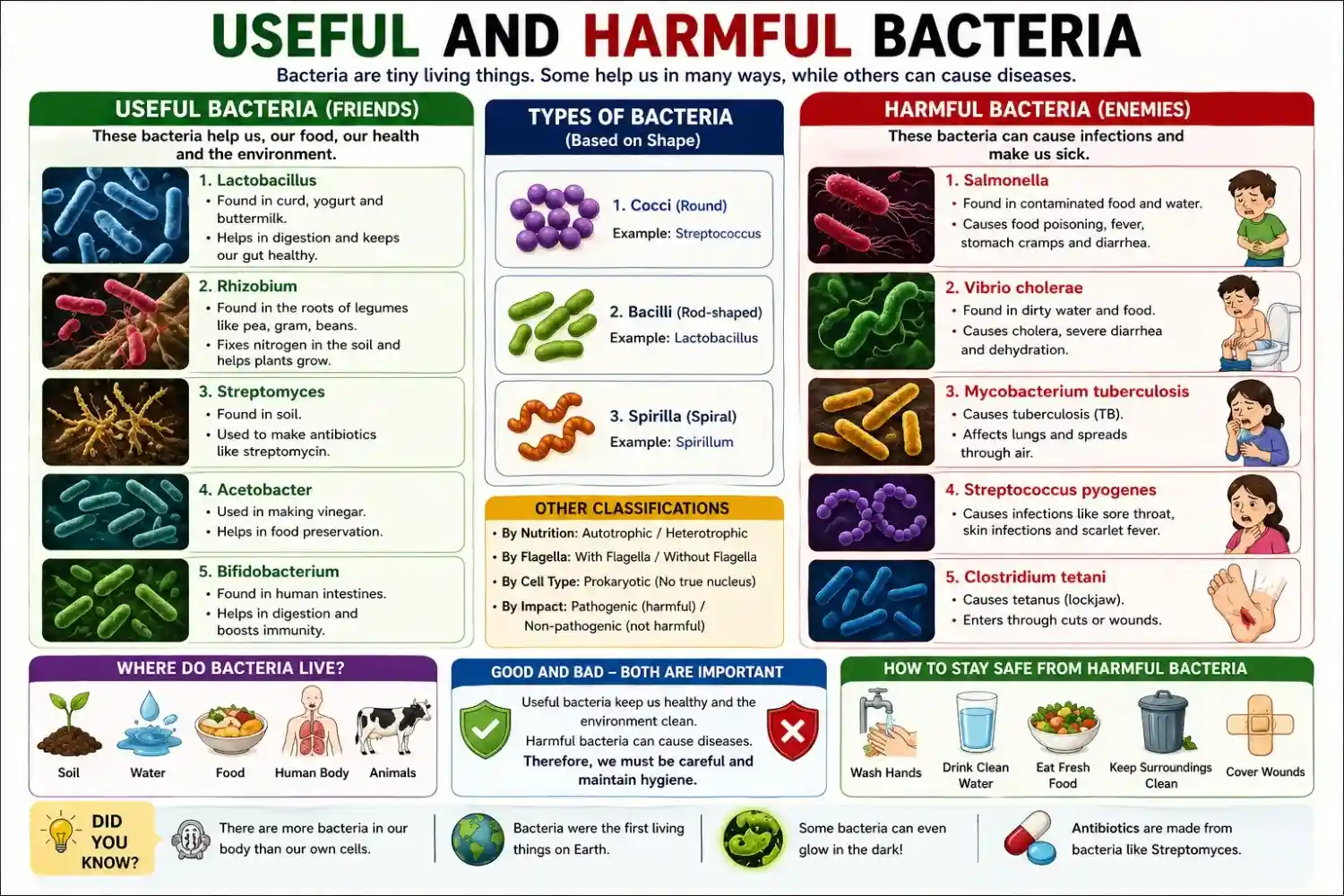
Definition: Useful and harmful bacteria are tiny living things that either help or hurt other organisms.
Pronunciation: USE-ful and HARM-ful bak-TEER-ee-uh
Origin: The word “bacteria” comes from the Greek word “bakterion.” Bakterion means small rod or staff.
Introduction
Have you ever eaten yogurt and wondered what makes it thick and creamy? Have you ever caught a stomach bug and felt tiny germs attacking your body? Both situations involve bacteria. Useful and harmful bacteria live everywhere. They float in the air, swim in water, cover your skin. They fill your gut. Some bacteria help you digest food. Other bacteria cause sickness. Therefore, learning about these tiny creatures matters for your health. Moreover, farmers, doctors, and chefs use this knowledge every day. When you understand which bacteria help and which hurt, you make smarter choices about food, medicine, and hygiene. In this article, you will meet the good guys and the bad guys of the microscopic world. You will discover how they look, how they work, and why they change your life.
What Are Useful and Harmful Bacteria?
Bacteria are tiny living things. You need a microscope to see them. A single bacterium looks like a tiny dot or rod. Useful bacteria help humans, animals, and plants. Harmful bacteria cause disease and damage. For example, Lactobacillus helps make yogurt. Salmonella causes food poisoning.
Classification of Bacteria by Shape
Scientists group bacteria by their shapes. First, cocci look like tiny balls. They group together like clusters of grapes. Second, bacilli look like small rods or sticks. Third, spirilla look like tiny corkscrews or spirals. Fourth, vibrios look like curved commas. Therefore, shape helps scientists identify bacteria quickly.
Classification of Bacteria by Mode of Nutrition
Bacteria eat in different ways.
Autotrophic:
Autotrophic bacteria make their own food.
Chemotrophic:
They use sunlight or chemicals to build meals.
Heterotrophic:
Heterotrophic bacteria eat other organisms.
They absorb nutrients from dead matter or living hosts.
Saprotrophic:
Saprophytic bacteria feed on decaying material. Parasitic bacteria feed on living hosts and cause harm.
Classification of Bacteria by Presence and Absence of Flagella
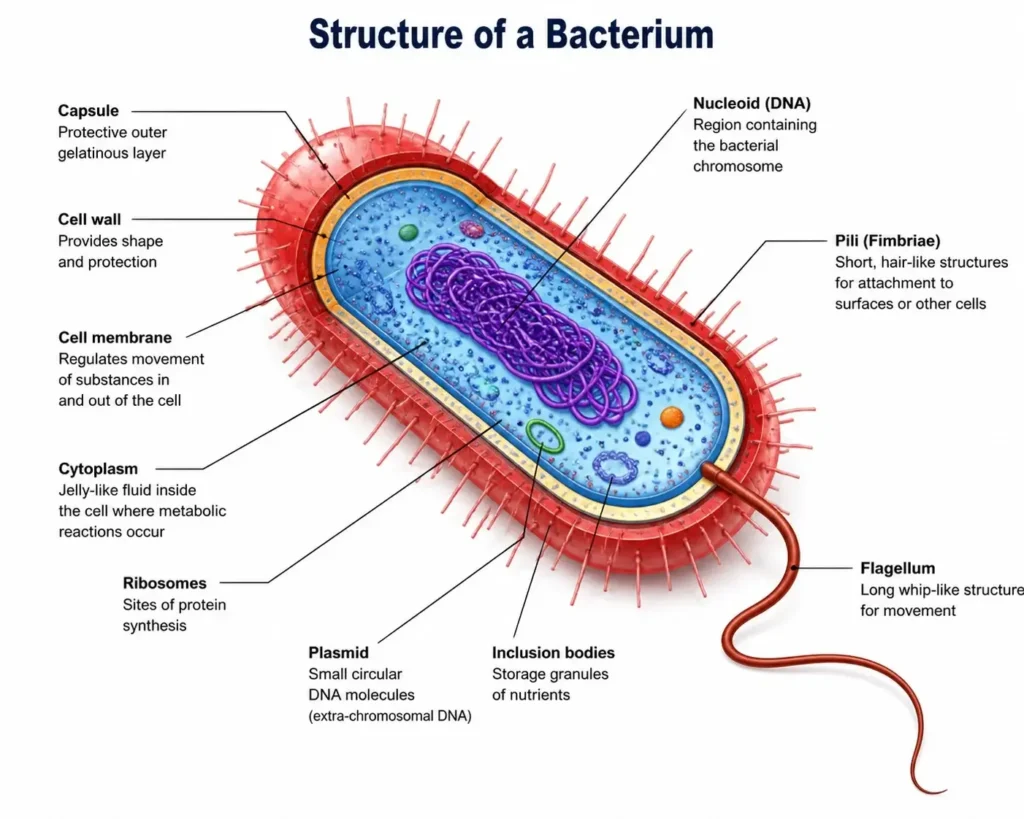
Some bacteria swim. These bacteria contain flagella. Flagella are tiny tail-like parts that whip around and push the bacteria through liquid.
Other bacteria lack flagella. These non-flagellated bacteria do not swim. They drift or stick to surfaces. Therefore, flagella determine how bacteria move.
Classification of Bacteria by Type of Cell
All bacteria are prokaryotes. This word means their cells lack a true nucleus. Their genetic material floats freely inside the cell. They also lack membrane-bound organelles.
In contrast, plant and animal cells are eukaryotes. Eukaryotes contain a nucleus and many organelles. Therefore, bacteria belong to a simpler cell type.
Classification of Bacteria by Mode of Attack
Useful bacteria attack problems in helpful ways.
- They crowd out harmful germs.
- They also produce vitamins and acids that protect the body.
- Harmful bacteria attack hosts directly.
- They invade tissues and release poisons called toxins. These toxins damage cells and cause fever, pain, and swelling.
Simple Explanation of Useful and Harmful Bacteria
- Think of your body as a busy city. Useful bacteria act like friendly neighbors. They clean the streets, guard the buildings. They even run the power plants. Meanwhile, the friendly neighbors keep working. Therefore, the city stays safe when good neighbors outnumber the vandals.
- Harmful bacteria act like vandals. They break windows and pray graffiti. They shut down power lines. Your immune system acts like the police force. It spots the vandals and arrests them.
Key Features and Characteristics of Bacteria
- Bacteria are microscopic. You do not see them without a microscope.
- Bacteria reproduce quickly. One bacterium splits into two every 20 minutes in warm, moist places.
- Bacteria live everywhere. They survive in hot springs, deep ice, and inside your gut.
- Useful bacteria produce vitamins. Your gut bacteria make vitamin K and some B vitamins.
- Harmful bacteria cause disease. They trigger infections like strep throat and tuberculosis.
- Bacteria have cell walls. These walls protect them and give them shape.
Types of Useful and Harmful Bacteria
Useful Bacteria
- Lactobacillus lives in yogurt. It breaks down milk sugar and creates a sour taste.
- Rhizobium lives in soil. It fixes nitrogen from the air and feeds plants.
- E. coli in your gut helps digest food and makes vitamins.
Harmful Bacteria
- Streptococcus causes strep throat. It invades the throat and triggers pain.
- Mycobacterium tuberculosis causes tuberculosis. It attacks the lungs and creates severe cough.
- Vibrio cholerae causes cholera. It spreads through dirty water and triggers deadly diarrhea.
How Do Bacteria Work?
Bacteria work through simple but powerful steps;
First, a bacterium finds a suitable place to live. It needs moisture, nutrients, and the right temperature.
Next, the bacterium absorbs food through its cell wall. It breaks down the nutrients to release energy.
Then, the bacterium grows and copies its genetic material. After that, the cell splits into two identical parts.
Scientists call this process binary fission. Finally, the new bacteria repeat the cycle. In warm, moist places, millions of bacteria form in just a few hours. Useful bacteria perform these steps in soil, food, or guts. Harmful bacteria perform these steps inside host bodies and cause damage.
Importance of Useful and Harmful Bacteria
Daily Life: Chefs use bacteria to make cheese, yogurt, and pickles. Farmers use bacteria to enrich soil.
Environment: Bacteria break down dead leaves and animals. This process returns nutrients to the earth.
Human Health: Doctors use useful bacteria to create probiotics. These supplements restore gut health. Scientists also study harmful bacteria to design antibiotics that kill disease-causing germs.
Examples of Useful and Harmful Bacteria in Real Life
A dairy farm uses Streptococcus thermophilus to turn milk into yogurt. A hospital fights Staphylococcus aureus with strong cleaners and antibiotics. A compost pile relies on millions of bacteria to rot banana peels and egg shells. A person with food poisoning suffers from Salmonella invading the intestines.
Useful and Harmful Bacteria for Different Age Groups
Easy View for Kids
- Imagine bacteria as tiny workers inside and around you.
- Some bacteria act like builders with hard hats.
- They help in making food like yogurt.
- They keep your stomach happy and strong.
- On the other hand, some bacteria act like sneaky troublemakers.
- They enter your body and cause illness.
- They can make you cough, sneeze, or feel weak.
- Therefore, you must wash your hands to remove harmful ones.
- Moreover, you can eat healthy foods like yogurt to grow helpful bacteria.
Simple idea: Good bacteria help you. Bad bacteria harm you.
Clear Understanding for Students
- Bacteria are prokaryotic organisms, so they have a simple structure.
- They do not contain a nucleus or membrane-bound organelles.
- Moreover, they grow and multiply very quickly.
Useful Bacteria
- Participate in nitrogen fixation
- Example: Rhizobium improves soil fertility
- Help in fermentation
- Example: Lactobacillus forms yogurt
- Support vitamin production in the human gut
- Example: Vitamin B and K synthesis
Harmful Bacteria
- Produce harmful substances called toxins
- Endotoxins remain inside the cell
- Exotoxins release outside the cell
- These toxins damage tissues and disturb body functions
- Example: Food poisoning and infections
Control and Treatment
- Antibiotics target bacterial structures like cell walls
- Therefore, they stop bacterial growth or kill them
- However, antibiotics do not work against viruses
- As a result, proper diagnosis becomes very important
Deeper Insight for Advanced Learners
- Bacteria show diverse metabolic pathways, so they survive in many environments
Types Based on Nutrition
- Chemoautotrophs
- Use energy from chemical reactions
- Example: Bacteria in deep-sea vents
- Photoautotrophs
- Use sunlight for energy
- Example: Cyanobacteria
- Heterotrophs
- Depend on organic matter
- Example: Many soil and gut bacteria
Pathogenic Mechanisms
- Harmful bacteria use virulence factors to infect hosts
- Adhesins
- Help bacteria attach to host tissues
- Invasins
- Allow entry into host cells
- Toxins
- Endotoxins:
- Present in Gram-negative bacteria
- Made of lipopolysaccharides
- Exotoxins:
- Secreted proteins
- Target specific cells and cause damage
- Endotoxins:
Beneficial Mechanisms
- Probiotics contain live useful bacteria
- Improve gut health
- Strengthen immune response
- These bacteria balance gut microbiota
- Therefore, they protect against harmful microbes
Antibiotic Resistance
- Bacteria develop resistance through horizontal gene transfer
- They share genetic material with other bacteria
- As a result, resistant strains spread quickly
- Therefore, misuse of antibiotics increases this problem
Final Insight
- Bacteria act as both helpers and harmful agents
- Their role depends on type, environment, and interaction with the host
- Therefore, understanding bacteria helps in health, medicine, and environment management
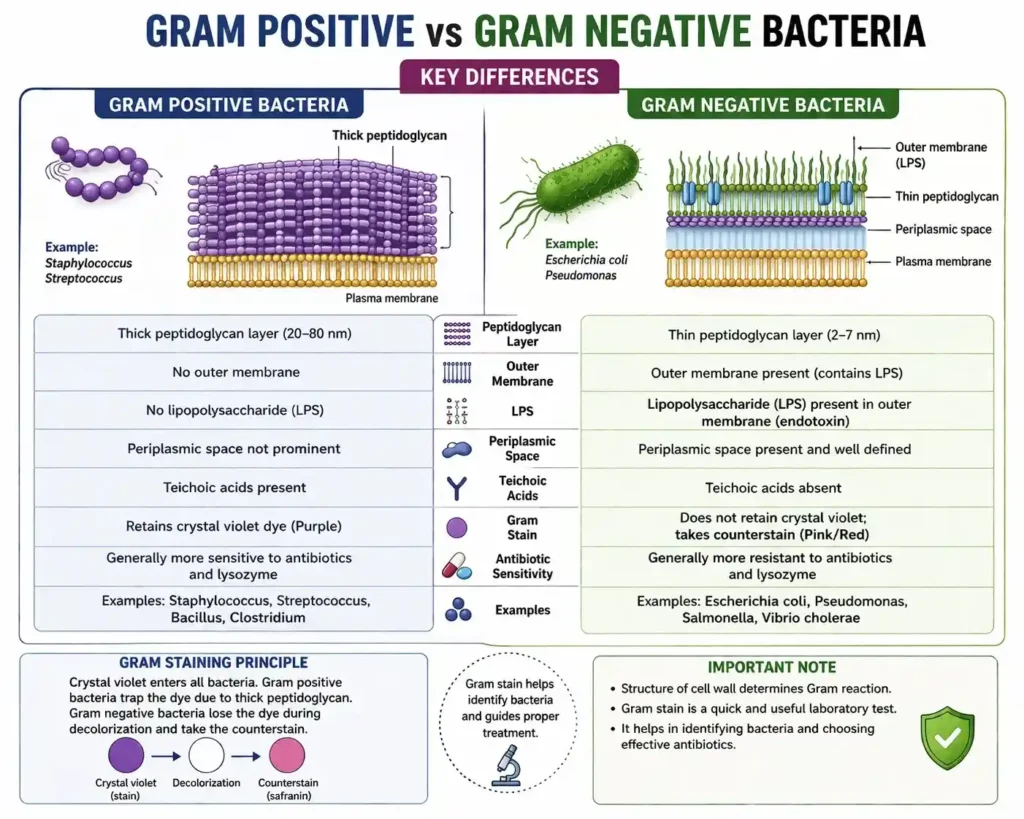
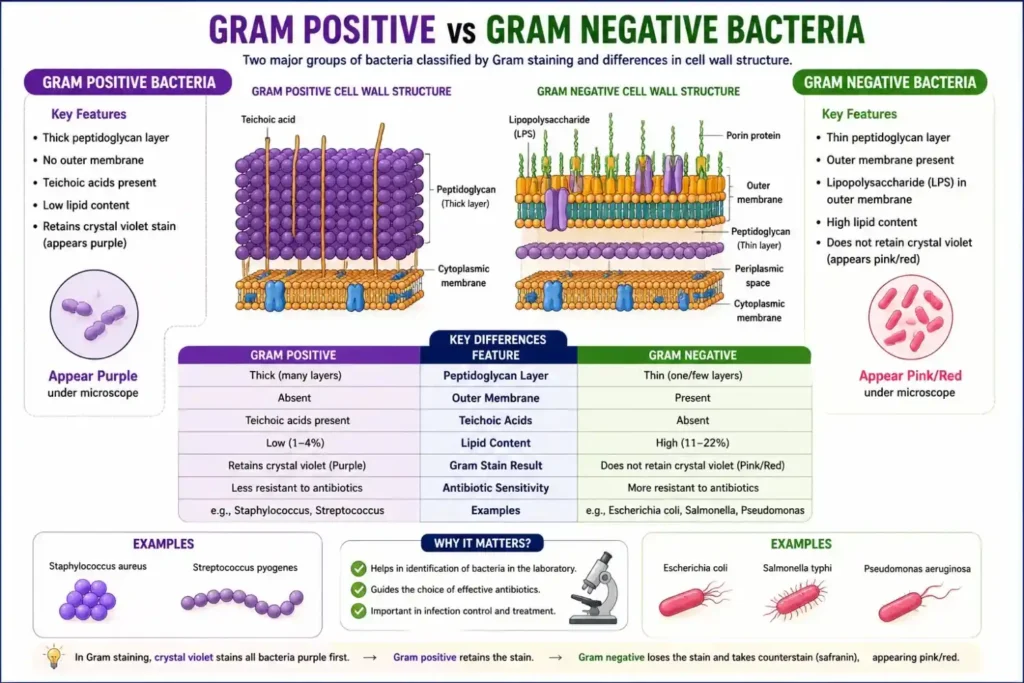
Gram-Positive Bacteria
- Cell wall: Thick peptidoglycan layer (like a heavy brick wall)
- Outer membrane: ❌ Absent
- Gram stain color: 🟣 Purple (retains crystal violet dye)
- Teichoic acids: ✅ Present (help maintain structure)
- Resistance: Usually more sensitive to antibiotics (penicillin works well)
- Toxins: Mainly produce exotoxins
👉 Examples:
- Staphylococcus aureus
- Streptococcus pneumoniae
Gram-Negative Bacteria
- Cell wall: Thin peptidoglycan layer (like a light mesh)
- Outer membrane: ✅ Present (extra protective layer)
- Gram stain color: 🔴 Pink/Red (does not retain crystal violet)
- Lipopolysaccharide (LPS): ✅ Present (can act as endotoxin)
- Resistance: Often more resistant to antibiotics (due to outer membrane)
- Toxins: Produce endotoxins (can be harmful)
👉 Examples:
- Escherichia coli
- Salmonella typhi
Below is their comparison in pictures (click here);
Common Misconceptions About Bacteria
Misconception: All bacteria cause disease.
Correction: Most bacteria are harmless or helpful. Only a small group causes sickness.
Misconception: Antibiotics kill all germs.
Correction: Antibiotics kill bacteria only. They do not kill viruses.
Misconception: Bacteria are animals.
Correction: Bacteria belong to their own kingdom. They are prokaryotes, not animals.
Misconception: Hand sanitizer kills all bacteria forever.
Correction: Hand sanitizer kills many bacteria on contact. However, bacteria return quickly after cleaning.
Difference Between Useful and Harmful Bacteria and Related Concepts
Useful Bacteria vs. Harmful Bacteria: Useful bacteria support digestion, food production, and soil health. Harmful bacteria invade tissues and release toxins.
Bacteria vs. Viruses: Bacteria are living cells. They eat and reproduce on their own. Viruses are not cells. They need host cells to reproduce.
Bacteria vs. Fungi: Both are microbes. However, bacteria are prokaryotes. Fungi are eukaryotes with nuclei and cell walls made of chitin.
Applications of Useful and Harmful Bacteria
Medicine: Scientists engineer bacteria to produce insulin. Doctors prescribe probiotics to restore healthy gut flora.
Environment: Bacteria clean oil spills. They break down petroleum into harmless substances.
Technology: Researchers use bacteria in genetic engineering. They insert human genes into bacterial DNA to make medicines.
Daily Life: Cooks ferment cabbage into sauerkraut using bacteria. Bakers use bacterial cultures to create sourdough bread.
Interesting Facts About Bacteria
- Your body contains trillions of bacterial cells. This number rivals your human cells.
- Bacteria live in boiling water near underwater volcanoes. Scientists call these extremophiles.
- The smell of rain comes from bacteria. A soil bacterium called Streptomyces releases a chemical called geosmin.
- Some bacteria glow in the dark. Anglerfish use these glowing bacteria to lure prey.
- Bacteria invented antibiotics long before humans. They use these chemicals to fight rival bacteria.
- A single gram of soil holds 40 million bacterial cells.
FAQs
Q1: What are useful and harmful bacteria?
Useful bacteria help humans digest food and make products. Harmful bacteria cause infections and disease.
Q2: How do bacteria make you sick?
Harmful bacteria invade your body and release toxins. These toxins damage your cells and trigger fever.
Q3: Are all bacteria bad?
No. Most bacteria are harmless or helpful. Your gut relies on billions of friendly bacteria.
Q4: How do you kill harmful bacteria?
Heat, soap, antibiotics, and disinfectants kill harmful bacteria. Cooking food thoroughly destroys them.
Q5: Can useful bacteria become harmful?
Yes. Some bacteria stay harmless in one place but cause harm in another. E. coli lives safely in your gut. However, specific strains invade the bloodstream and cause severe illness.
How People Search for Useful and Harmful Bacteria
- what are useful and harmful bacteria
- simple explanation of bacteria
- examples of useful bacteria
- examples of harmful bacteria
- how do bacteria cause disease
- bacteria for kids
- difference between good and bad bacteria
- probiotics and gut bacteria
- common harmful bacteria list
- uses of bacteria in daily life
Conclusion
Useful and harmful bacteria shape your health, food, and environment every single day. These tiny organisms work silently inside your gut, in your food, and across the entire planet. Useful bacteria build strong soil, create delicious foods, and protect your digestive system from invaders. Harmful bacteria invade tissues, release dangerous toxins, and trigger painful sickness. Therefore, understanding both groups helps you make smart health choices every day. Wash your hands to reduce harmful germs. Eat fermented foods to support helpful microbes. Moreover, scientists continue discovering new ways to harness bacterial power for medicine and technology. In conclusion, bacteria are not simply germs to fear. They are complex partners in life. Treat the good ones well. Fight the bad ones wisely. This balance keeps you and the entire planet healthy. For another source of information click here.

Hi All! I’m Imran Abbas. I’m a Ph.D (scholar) in Structural Chemistry and I work in a number of domains like Bioinformatics, Literature, politics, sports and I’m a polyglot as well. I respect all irrespective of their ethnicity, locality and color. I’m always ready to learn new ideas and travel to different parts of the world.