
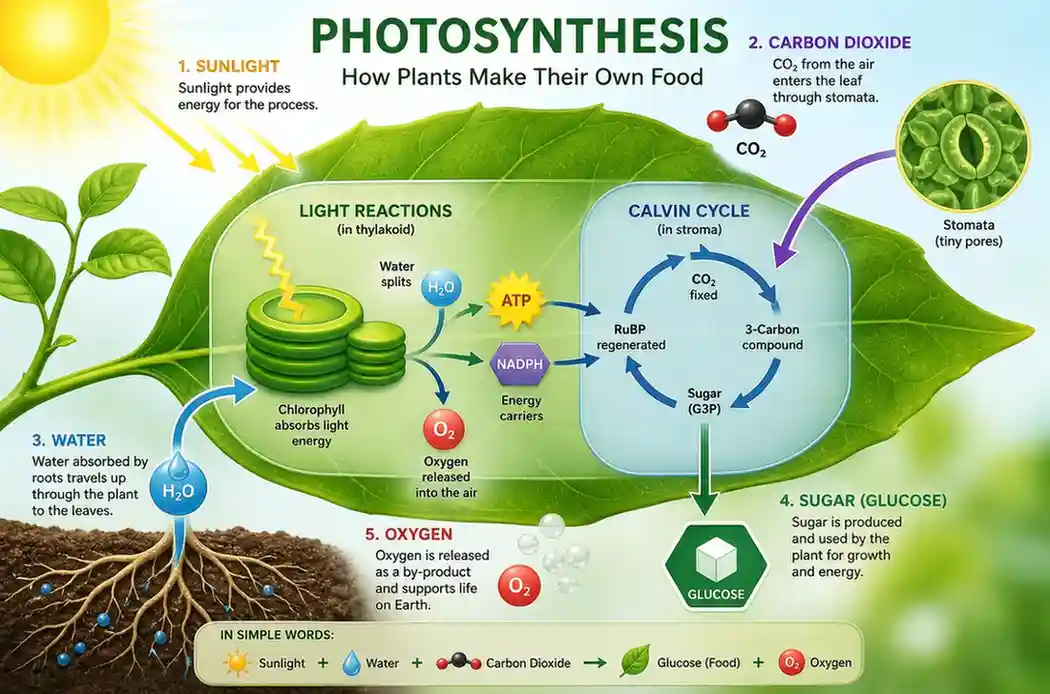
Definition: The process green plants use to make food from sunlight, water, and carbon dioxide.
Pronunciation: /ˌfoʊ.t̬oʊˈsɪn.θə.sɪs/ (foh-toh-SIN-thuh-sis)
Origin: Greek words “photo” meaning light and “synthesis” meaning putting together.
Introduction
Photosynthesis makes your breakfast possible. You wake up hungry and pour cereal into a bowl. You add milk. Then you take a big bite. That cereal comes from oats. Those oats grew on a farm. But here is a wild question. How did those oats get food? Oats never visit a grocery store. Oats never cook dinner. Instead, the oat plant makes its own food through photosynthesis. This process powers every green plant on Earth. Moreover, it feeds animals and humans. Without photosynthesis, trees would starve. Crops would die. Oxygen would vanish. Therefore, understanding photosynthesis helps you value every leaf, every lawn, and every salad on your plate. Now, step into this green miracle and see how plants perform this daily magic.
What is Photosynthesis? (Basic Definition)
Photosynthesis means plants make their own food. They use three simple ingredients. First, they grab sunlight from the sky. Second, they pull water up through their roots. Third, they take in carbon dioxide from the air. Inside the leaf, the plant mixes these parts together. As a result, the plant produces sugar called glucose. This sugar feeds the plant and helps it grow. Moreover, the plant releases oxygen into the air as a bonus.
For example, an oak tree in your neighborhood performs photosynthesis every sunny day. The tree grows taller and stronger because it makes its own food. In contrast, a mushroom cannot perform photosynthesis. It must find food in the soil instead.
Simple Explanation of Photosynthesis
Think of photosynthesis like baking a cake in a green kitchen. The sun acts as the oven. The leaf serves as the mixing bowl. Water serves as one ingredient. Carbon dioxide works as the second ingredient. Chlorophyll, the green stuff inside leaves, acts as the baker.
First, the leaf opens tiny holes to pull in carbon dioxide from the air. Next, the roots drink water from the ground. Then, chlorophyll catches sunlight like a baseball glove catches a ball. After that, the leaf mixes everything together. Finally, the plant bakes up sugar food and releases oxygen into the sky. This simple recipe keeps plants alive. Moreover, it gives animals and humans the oxygen we need to breathe.
🌿 Equation of Photosynthesis
👉 In simple words:
Carbon dioxide + water + sunlight → glucose (food) + oxygen
Visual Understanding
Picture this:
🌞 Sun → 🌿 Leaf → 💧 Water + 🌫️ CO₂ → 🍬 Glucose + 🌬️ Oxygen
- Sun = energy source
- Leaf = factory
- Roots = water supply
- Air = carbon dioxide source
⚙️ Mechanism of Photosynthesis (Step-by-Step)
Think of this as a two-stage green factory 🌱
🔹 Step 1: Light Reaction (Happens in Leaves)
- First, sunlight hits the leaf
- Then, chlorophyll captures light energy
- Next, water splits into hydrogen and oxygen
- Oxygen releases into the air
- Energy gets stored in small packets (ATP, NADPH)
👉 This step depends on sunlight
🔹 Step 2: Dark Reaction (Calvin Cycle)
- First, carbon dioxide enters the leaf
- Then, the plant uses stored energy
- Next, it combines carbon dioxide with hydrogen
- Finally, it forms glucose (plant food)
👉 This step does NOT need direct sunlight
🧠 Simple Flow Summary
- Sunlight hits leaf
- Water splits → oxygen releases
- Carbon dioxide enters
- Plant builds glucose
🖼️ Visual Understanding (Wha
Types or Classification of Photosynthesis
C3 Photosynthesis
Most plants follow this type. They grow well in cool conditions.
C4 Photosynthesis
These plants grow better in hot climates. They use sunlight more efficiently.
CAM Photosynthesis
These plants survive in dry areas. They store carbon dioxide at night.
Key Features / Characteristics of Photosynthesis
Photosynthesis follows clear rules. Here are the main features:
→ Light drives the process. Plants perform photosynthesis only when sunlight shines on them. A plant in a dark closet stops making food.
→ Chlorophyll plays the lead role. This green pigment lives inside leaves. Chlorophyll grabs the sunlight and starts the whole process.
→ Carbon dioxide feeds the reaction. Plants pull this gas from the air through tiny openings under their leaves.
→ Water completes the mix. Roots absorb water from the soil. Then tubes inside the stem carry water up to the leaves.
→ Glucose serves as the reward. The plant produces a special sugar. This sugar fuels growth, repair, and flower production.
→ Oxygen leaves as a gift. After making sugar, the plant pushes extra oxygen out into the air. Humans and animals breathe this oxygen.
Types or Classification of Photosynthesis
Not every living thing performs photosynthesis the same way. Scientists group this process into two main types.
Oxygenic Photosynthesis
Green plants, algae, and certain bacteria perform oxygenic photosynthesis. These living things use water as their main ingredient. During the process, they split water molecules. As a result, they release oxygen into the air. This type powers forests, grasslands, and ocean algae. Moreover, it produces nearly all the oxygen on Earth.
Anoxygenic Photosynthesis
Some bacteria perform anoxygenic photosynthesis. These bacteria live in dark, muddy places or deep underwater vents. Instead of using water, they use other substances from their environment. Therefore, they do not release oxygen. This type came first in Earth’s history. However, it creates less energy than oxygenic photosynthesis.
How Does Photosynthesis Work? (Mechanism)
Photosynthesis happens in two main stages inside the leaf. Let’s walk through each step.
Stage One: Trapping the Light
First, sunlight hits the leaf. Chlorophyll inside the leaf cells grabs this light energy. Next, the plant splits water molecules. The plant keeps the hydrogen from this split. Then, it releases oxygen as a waste product. This stage needs light. Therefore, it only happens during the day.
Stage Two: Making the Sugar
After the plant captures light energy, the real cooking begins. The leaf takes carbon dioxide from the air. It mixes this gas with the hydrogen from water. Then, the plant builds glucose molecules. This sugar feeds the plant and helps it grow tall. Finally, the plant stores extra sugar as starch for later use.
Importance of Photosynthesis
Photosynthesis matters in every corner of our lives.
→ Daily life: Every apple, carrot, and loaf of bread starts with photosynthesis. Farmers grow crops that perform this process. Therefore, our entire food chain depends on green plants making sugar.
→ Environment: Plants pull carbon dioxide out of the air. This gas warms our planet. By removing it, plants cool the Earth. Moreover, forests act like giant air filters because they perform photosynthesis constantly.
→ Human health: The process releases fresh oxygen. Every breath you take contains oxygen that once came from a leaf. Without photosynthesis, our air would hold too much carbon dioxide and too little oxygen. Therefore, this green process keeps our lungs full and our bodies strong.
Photosynthesis for Different Age Groups
For Kids
Plants cook their food using sunlight, like a kitchen in leaves.
For Students
Plants convert sunlight into chemical energy stored in glucose.
For Advanced Learners
Photosynthesis includes light reactions and dark reactions that form ATP and glucose.
Examples of Photosynthesis in Real Life
You see photosynthesis everywhere once you know what to look for.
→ A dandelion pushes through a sidewalk crack. It catches sunlight and grows yellow flowers. This weed performs photosynthesis every sunny day.
→ A tomato vine in your backyard turns red fruits sweet. The vine uses sunlight, water, and air to build those tomatoes. This plant performs photosynthesis in your garden.
→ Kelp forests sway under ocean waves. These giant algae catch light filtering through the water. This seaweed performs photosynthesis beneath the surface.
→ A houseplant on your windowsill grows new leaves every spring. It drinks water from its pot and catches rays through the glass. This indoor green friend performs photosynthesis on your sill.
Photosynthesis for Different Age Groups
For Kids
Plants eat sunshine! Imagine a leaf as a tiny superhero. The leaf wears a green cape called chlorophyll. Every morning, the leaf opens its mouth and drinks light. It also sips water through a straw in its stem. Then, the leaf mixes light and water with air. Poof! The leaf makes sugar candy for itself. It also blows out oxygen for us to breathe. So every time you see a green leaf, you see a tiny kitchen cooking up food and fresh air.
For Students
Plants convert light energy into chemical energy through photosynthesis. This process happens inside special parts of the cell called chloroplasts. Chloroplasts contain chlorophyll, a pigment that absorbs red and blue light. The plant takes in carbon dioxide through stomata, tiny pores on the leaf surface. Water travels up from the roots through xylem tubes. Inside the chloroplast, light reactions split water and create energy carriers. Then the Calvin cycle uses these carriers to turn carbon dioxide into glucose. This sugar fuels cellular respiration and growth.
For Advanced Learners
Photosynthesis consists of light-dependent reactions and the Calvin cycle. In the thylakoid membranes of chloroplasts, photosystem II and photosystem I drive electron transport. Water photolysis replaces electrons and releases oxygen. The resulting proton gradient powers ATP synthase to produce ATP. NADP+ reductase generates NADPH. In the stroma, the Calvin cycle fixes atmospheric CO2 via RuBisCO enzyme. The cycle produces glyceraldehyde-3-phosphate, which regenerates RuBP and synthesizes glucose. C3, C4, and CAM plants exhibit distinct anatomical and biochemical adaptations to optimize carbon fixation under varying environmental conditions.
Common Misconceptions About Photosynthesis
Many people hold wrong ideas about this process. Let’s clear them up.
→ Misconception: Plants eat soil to get food.
Correction: Plants make their own food through photosynthesis. Roots absorb water and minerals from soil. However, soil alone never feeds the plant.
→ Misconception: Photosynthesis happens at night.
Correction: This process needs light. Therefore, it stops when the sun sets. At night, plants perform respiration instead.
→ Misconception: Only land plants perform photosynthesis.
Correction: Algae in the ocean and some bacteria also perform photosynthesis. In fact, ocean algae produce over half the oxygen we breathe.
→ Misconception: Plants breathe in oxygen like us during photosynthesis.
Correction: Plants take in carbon dioxide and release oxygen during photosynthesis. They breathe in oxygen only during respiration, a separate process.
Difference Between Photosynthesis and Related Concepts
Photosynthesis vs. Respiration
Photosynthesis builds sugar using light. It takes in carbon dioxide and releases oxygen. Respiration breaks down sugar for energy. It takes in oxygen and releases carbon dioxide. Plants perform both processes. However, photosynthesis happens only in light, while respiration happens all day and night.
Photosynthesis vs. Fermentation
Fermentation breaks down food without using oxygen. Yeast uses fermentation to make bread rise. Photosynthesis does the opposite. It builds food up using light energy. Therefore, these two processes move in opposite directions.
Applications of Photosynthesis
Scientists and inventors use ideas from photosynthesis to improve our world.
→ Medicine: Researchers study plant cells to develop new drugs. Understanding how plants make complex molecules helps scientists create better medicines in labs.
→ Environment: Conservation groups plant millions of trees. These trees perform photosynthesis and clean our air. Cities build green roofs covered in plants. Those roofs reduce heat and pull carbon from the sky.
→ Technology: Engineers design solar panels that copy leaves. Like chlorophyll, these panels trap sunlight and turn it into electricity. This biomimicry creates cleaner power for homes and cars.
→ Daily life: Farmers use knowledge of photosynthesis to grow bigger crops. They place plants in sunny spots and water them well. Gardeners prune leaves so more light reaches every branch. Therefore, this science feeds families every single day. For more topics on biology, click here.
Interesting Facts About Photosynthesis
→ One mature tree produces enough oxygen each year to support two human beings.
→ Scientists believe photosynthesis started about 3.5 billion years ago. Ancient bacteria began this process long before plants existed.
→ Ocean algae and phytoplankton perform photosynthesis underwater. Together, they create over 50% of the oxygen in our atmosphere.
→ A single square meter of leaf surface contains millions of chloroplasts. Each one acts like a tiny engine for making sugar.
→ Chlorophyll makes plants look green because it reflects green light. It absorbs red and blue light instead.
→ The Amazon rainforest alone performs about 20% of the world’s photosynthesis. People call it the lungs of the Earth for this reason.
FAQs (5 Questions)
1. Do all plants perform photosynthesis?
Nearly all green plants perform photosynthesis. However, a few special plants trap insects for food instead. These plants live in poor soil and need extra nutrients.
2. Can photosynthesis happen without sunlight?
No. Photosynthesis needs light energy to start. Without light, the leaf fails to split water or make sugar. Therefore, the process stops in complete darkness.
3. Why do plants look green?
Chlorophyll reflects green light. It absorbs red and blue light for energy. Our eyes see the reflected green light. Therefore, leaves look green to us.
4. What gas do plants release during photosynthesis?
Plants release oxygen. This gas comes from splitting water molecules. Humans and animals need this oxygen to live and breathe.
5. Do plants perform photosynthesis at night?
No. Photosynthesis needs light. At night, plants rest. They perform respiration instead, which uses oxygen and releases carbon dioxide.
How People Search for Photosynthesis
- what is photosynthesis
- simple explanation of photosynthesis
- how does photosynthesis work
- why is photosynthesis important
- photosynthesis for kids
- examples of photosynthesis
- steps of photosynthesis
- where does photosynthesis happen
- photosynthesis vs cellular respiration
- interesting facts about photosynthesis
Conclusion
Photosynthesis powers every green leaf, every forest, and every meal on your table. This amazing process turns sunlight, water, and air into food and oxygen. Without it, plants would starve. Animals would lose their food sources. Humans would run out of fresh air to breathe. Therefore, protecting plants means protecting life itself. Moreover, understanding photosynthesis helps us grow better crops, design cleaner technology, and appreciate the natural world. Every time you see a tree swaying in the breeze, remember that it works hard to feed itself and clean your air. Keep learning about this green miracle. Support your local plants. And never underestimate the power of a single leaf performing its daily magic. Learn more about it.

Hi All! I’m Imran Abbas. I’m a Ph.D (scholar) in Structural Chemistry and I work in a number of domains like Bioinformatics, Literature, politics, sports and I’m a polyglot as well. I respect all irrespective of their ethnicity, locality and color. I’m always ready to learn new ideas and travel to different parts of the world.