
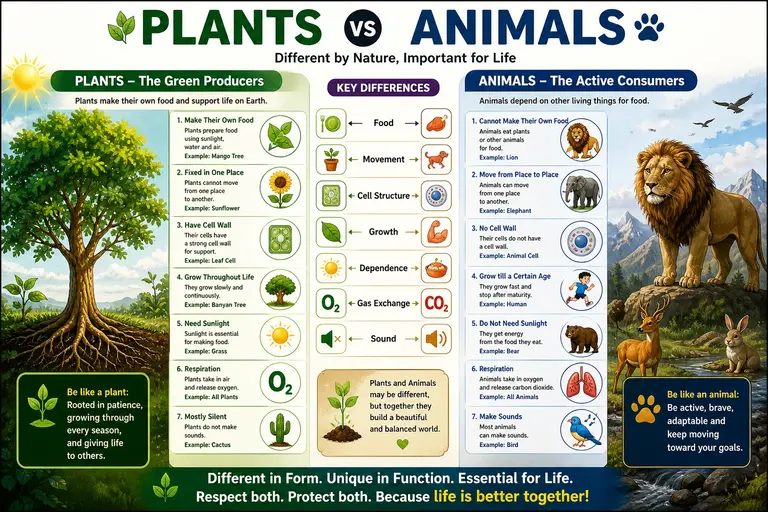
Definition: The difference between plants and animals refers to the special traits that separate these two groups of living things.
Pronunciation: DIF-fer-ence be-TWEEN plants and AN-i-mals
Origin: The word “plant” comes from the Latin word “planta.” Planta means sprout. The word “animal” comes from the Latin word “animalis.” Animalis means having breath.
Introduction
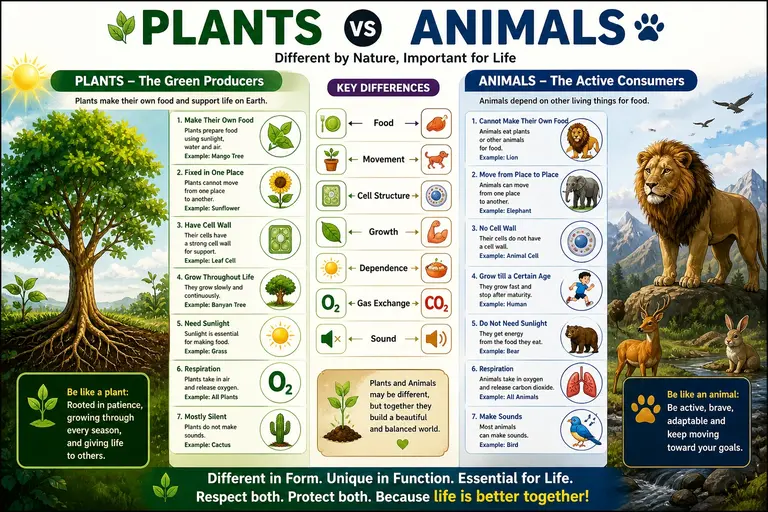
Look at your backyard. A tree stands still and reaches toward the sun. A squirrel runs up the trunk and searches for nuts. Both are alive. However, they live very different lives. The difference between plants and animals shapes the world around you. This topic matters because it helps you understand how nature works. Moreover, farmers, doctors, and scientists use this knowledge every day. When you know these differences, you appreciate why flowers need sunlight and why dogs need meat. You also understand why forests clean the air and why bees help plants grow. Therefore, learning about plants and animals opens your eyes to life itself. In this article, you will discover simple ways to tell them apart. You will also see why these differences help everyone on Earth.
What Is the Difference Between Plants and Animals?
The difference between plants and animals includes the special ways these living things, eat, move, breathe, and grow.
Plants make their own food. Animals hunt or gather food. For example, a rose bush turns sunlight into sugar. A lion catches prey for dinner.
Simple Explanation of the Difference Between Plants and Animals
Think of plants as solar chefs. They stand in one spot and cook their own meals using sunlight. Plants wear green outfits because they contain chlorophyll. This green substance catches sunlight. Moreover, plants grow throughout their lives at the tips of stems and roots.
Think of animals as food shoppers. They run, fly, or swim to find meals at stores or in nature. Animals lack this green substance. Therefore, animals must find ready-made food. Animals grow to a certain size and then stop. In contrast to plants, animals have brains and nerves. These parts help them react quickly to danger.
Key Characteristics of the Difference Between Plants and Animals
- Plants contain chlorophyll. This green substance helps them make food. Animals lack chlorophyll.
- Plants stay in one place. They attach to soil with roots. Animals move from place to place.
- Plants breathe through tiny holes in leaves. Animals breathe through lungs, gills, or skin.
- Plants make their own food through photosynthesis. Animals eat other plants or animals.
- Plants grow at specific spots called meristems. Animals grow all over and then stop.
- Plants lack a nervous system. Animals contain brains and nerves.
- Plants store food as starch. Animals store food as glycogen or fat.
Scientific Difference Between Plants and Animals
Plants and animals share life, yet they run on very different “operating systems.” One builds its own food from light; the other hunts, grazes, or gathers. Here’s a clear, science-based contrast:
1. Mode of Nutrition (How they get food)
- Plants: Autotrophic. They make food by photosynthesis using light, water, and carbon dioxide.
Example: A leaf produces glucose in sunlight. - Animals: Heterotrophic. They obtain food from other organisms.
Example: A lion eats meat; a cow eats grass.
2. Energy Strategy
- Plants: Convert light energy into chemical energy and store it as glucose.
- Animals: Break down food (glucose, fats) through respiration to release energy for movement and work.
3. Cell Structure
- Plants: Cells have a cell wall (cellulose), chloroplasts, and a large central vacuole.
- Animals: Cells lack a cell wall and chloroplasts; vacuoles stay small or temporary.
4. Photosynthetic Machinery
- Plants: Contain chlorophyll in chloroplasts, which captures light.
- Animals: Do not contain chlorophyll; cannot perform photosynthesis.
5. Movement
- Plants: Mostly fixed in one place; show slow movements (tropisms like bending toward light).
- Animals: Show active locomotion using muscles (walking, flying, swimming).
6. Control and Coordination
- Plants: Use chemical signals (plant hormones) for slow coordination.
- Animals: Use a nervous system and hormones for fast responses.
7. Gas Exchange
- Plants: Exchange gases through stomata (leaves) and lenticels (stems).
- Animals: Use specialized organs such as lungs, gills, or tracheae.
8. Water Balance
- Plants: Large vacuole maintains turgor (internal pressure) and shape.
- Animals: Maintain balance through organs like kidneys and skin.
9. Storage of Food
- Plants: Store carbohydrates mainly as starch.
- Animals: Store carbohydrates mainly as glycogen.
10. Growth Pattern
- Plants: Indeterminate growth. They keep growing at tips (meristems).
- Animals: Determinate growth. They reach a fixed size after maturity.
11. Reproduction
- Plants: Use sexual and asexual methods (seeds, spores, vegetative parts).
- Animals: Mostly sexual reproduction with specialized organs.
12. Structural Support
- Plants: Rely on cell wall and turgor pressure for support.
- Animals: Use internal or external skeletons (bones, shells).
Core Scientific Insight
- Plants = Producers
They build organic molecules from simple inorganic inputs. - Animals = Consumers
They depend on organic food produced by plants or other animals.
Types and Classification Based on the Difference Between Plants and Animals
Types of Plants
Scientists group plants into several kinds. Flowering plants produce seeds inside fruits. Examples include apple trees and daisies. Non-flowering plants reproduce using spores. Ferns and mosses belong to this group. Conifers produce cones instead of flowers. Pine trees are conifers.
Types of Animals
Scientists group animals by body structure. Vertebrates contain backbones. Mammals, birds, fish, reptiles, and amphibians are vertebrates. Invertebrates lack backbones. Insects, spiders, and worms are invertebrates.
How Does the Difference Between Plants and Animals Work?
The differences work through special body parts and processes.
First, plants capture sunlight with leaves. The chlorophyll inside leaves absorbs the light energy. Next, plants mix this energy with water and carbon dioxide. This mixture produces sugar and oxygen. Then, plants store the sugar for later use.
Animals cannot perform this process. Instead, animals find food in the environment. They chew and swallow this food. Their stomachs break the food into nutrients. Finally, their blood carries these nutrients to every cell. Therefore, plants act as producers. Animals act as consumers. This system keeps nature in balance.
Importance of the Difference Between Plants and Animals
Daily Life: You eat plants like carrots and rice. You also eat animals like chicken and fish and wear cotton from plants. You use leather from animals. Therefore, both groups supply your basic needs.
Environment: Plants release oxygen into the air. Animals breathe this oxygen. Moreover, animals spread seeds and pollen. This helps plants reproduce. Therefore, both groups depend on each other.
Human Health: Doctors study plant chemicals to make medicine. They also study animal bodies to understand human organs. Therefore, both groups help scientists fight sickness.
Examples of the Difference Between Plants and Animals in Real Life
A sunflower turns its head to follow the sun. It makes food while standing in a garden. A Venus flytrap catches bugs. This plant shows animal-like behavior but still makes food through photosynthesis. A cactus stores water in its thick stem. It survives in hot deserts without moving.
A dog runs across the yard. It eats food from a bowl. A camel walks across the desert. It drinks water and eats plants.
Difference Between Plants and Animals for Different Age Groups
How Kids Should Perceive Both
Imagine a plant as a superhero that makes its own lunch. Plants wear green capes called chlorophyll. Animals wear fur, feathers, or scales. Plants stay in their garden homes. It stands in the sun and cooks food in its leaves.
An animal is like a student in a cafeteria. It must walk to the line and pick up trays of food. Animals explore the neighborhood.
For Students
Plants and animals both contain cells. However, plant cells contain cell walls. These walls give plants a boxy shape. Plants perform photosynthesis in organelles called chloroplasts. Moreover, plants store energy as starch.Plants respond slowly to stimuli because they lack nerves.
Animal cells lack cell walls. Therefore, animal cells have flexible shapes. Animals store energy as glycogen and lack chloroplasts.. Animals react quickly because they possess nervous systems.
Concept for Advanced Learners
The difference between plants and animals extends to cellular and genetic levels. Plant cells contain rigid cell walls made of cellulose. Plant cells possess large central vacuoles. Plants are autotrophs. This word means they make their own food. They fix carbon through a process called the Calvin cycle. This happens inside chloroplasts.
Animal cells lack this structure. These vacuoles store water and maintain turgor pressure. Animal cells contain small vacuoles if any. Animals are heterotrophs. This word means they eat other organisms. They break down food through enzymatic digestion. Moreover, plants show indeterminate growth. Meristematic tissues allow continuous growth at stem tips and root tips.
Animals show determinate growth. They stop growing after reaching adult size. Furthermore, plants lack a centralized nervous system. Animals possess complex neural networks. These networks enable rapid responses and learning.
Common Misconceptions About the Difference Between Plants and Animals
Misconception: Plants do not move.
Correction: Plants move slowly. They turn toward light and open their flowers. However, they do not walk or run like animals.
Misconception: All animals have four legs.
Correction: Animals come in many forms. Snakes have no legs. Birds have two legs. Insects have six legs.
Misconception: Plants breathe like animals.
Correction: Plants take in carbon dioxide and release oxygen through tiny leaf holes. Animals inhale oxygen and exhale carbon dioxide through lungs or gills.
Misconception: Fungi are plants.
Correction: Fungi form a separate group. They lack chlorophyll and do not perform photosynthesis. Therefore, fungi are neither plants nor animals.
Plants and Animals Compared to Similar Groups
Plants vs. Fungi: Both stay in one place. However, plants make their own food. Fungi absorb nutrients from decaying matter. Therefore, fungi are more like animals in their eating habits.
Animals vs. Bacteria: Both eat other organisms. However, bacteria are single-celled. Animals contain many cells organized into tissues and organs.
Plants vs. Algae: Both perform photosynthesis. However, algae lack true roots, stems, and leaves. Moreover, algae grow in water more often than on land.
Applications of the Difference Between Plants and Animals
Medicine: Scientists extract chemicals from plants to make drugs. They also study animal models to test new treatments. For example, doctors use foxglove plants to treat heart conditions. They study mice to understand human diseases.
Environment: Conservationists protect plant habitats to save animal species. They know animals need plants for food and shelter. Therefore, saving forests saves tigers, birds, and insects.
Technology: Engineers design solar panels by studying leaves. They also build robots that mimic animal movement. Therefore, both groups inspire inventions.
Daily Life: Farmers grow crops and raise livestock. They know plants need sunlight and water. They know animals need food and space. Therefore, agriculture depends on understanding both groups.
Interesting Facts About the Difference Between Plants and Animals
- The largest plant on Earth is a grove of aspen trees in Utah. All the trees share one root system.
- Some animals like the sea slug steal chloroplasts from plants. They use these stolen parts to make food like a plant.
- Plants make up about 80 percent of all biomass on Earth. Animals make up only a tiny fraction.
- The fastest animal is the peregrine falcon. It dives at over 200 miles per hour. No plant moves anywhere near this speed.
- Some carnivorous plants eat animals. The Venus flytrap snaps shut on bugs. However, it still performs photosynthesis.
- Coral looks like a plant but is actually an animal. It stays in one place and catches food from the water.
FAQs About the Difference Between Plants and Animals
Q1: What is the main difference between plants and animals?
Plants make their own food using sunlight. Animals must find and eat food.
Q2: Do plants breathe?
Yes. Plants take in carbon dioxide and release oxygen through tiny holes in their leaves.
Q3: Can plants move?
Plants move slowly. They turn toward light and grow toward water. However, they do not walk or run.
Q4: Are humans animals?
Yes. Humans belong to the animal kingdom. They eat food, move around, and have nervous systems.
Q5: Why are plants green?
Plants contain chlorophyll. This green substance catches sunlight for photosynthesis.
How People Search for the Difference Between Plants and Animals
- what is the difference between plants and animals
- simple explanation of plants vs animals
- examples of differences between plants and animals
- how do plants and animals get food
- do plants breathe like animals
- plants and animals for kids
- difference between plant cells and animal cells
- why are plants green and animals not
- can plants move like animals
- importance of plants and animals
Conclusion
The difference between plants and animals shapes every ecosystem on Earth. Plants act as producers. They capture sunlight and create food. Animals act as consumers. They move, hunt, and eat. Therefore, both groups depend on each other completely. Without plants, animals would lack oxygen and food. Without animals, many plants would fail to spread seeds and pollen. Moreover, humans rely on both groups for food, clothing, medicine, and shelter. In conclusion, understanding these differences helps you respect nature. It also guides you to make smart choices about health, farming, and conservation. So keep observing the living world. Notice the green leaves and the running creatures. Each one plays a vital role in the circle of life. Read more here.
Hi All! I’m Imran Abbas. I’m a Ph.D (scholar) in Structural Chemistry and I work in a number of domains like Bioinformatics, Literature, politics, sports and I’m a polyglot as well. I respect all irrespective of their ethnicity, locality and color. I’m always ready to learn new ideas and travel to different parts of the world.