
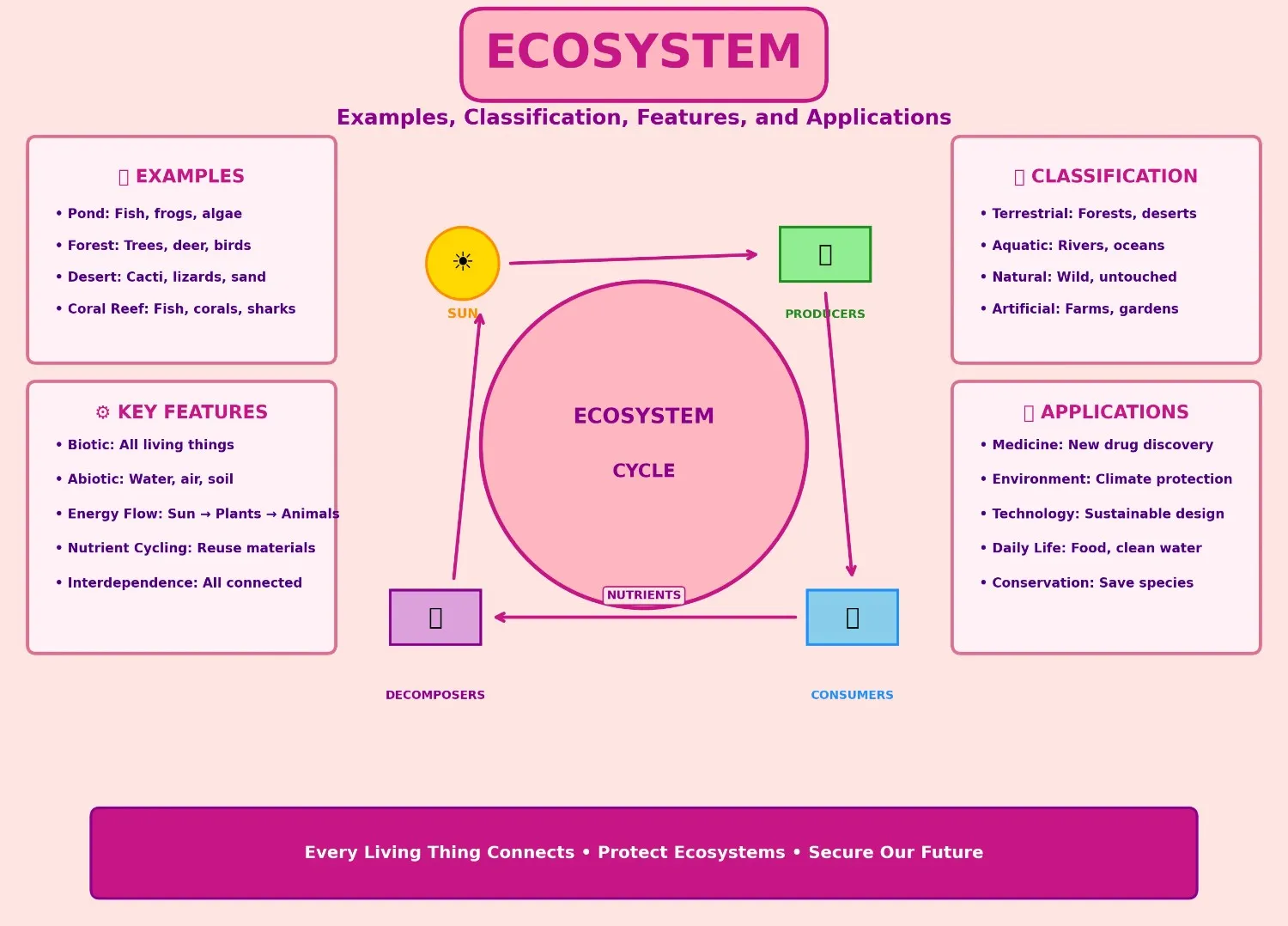
Definition: An ecosystem includes all living things and their physical surroundings in a specific area. Living things interact with each other and with non-living factors like water, air, and soil.
Pronunciation: EE-koh-sis-tum
Origin: The word “ecosystem” comes from two Greek words. “Eco” means house or household. “System” means a set of connected parts. Scientists combined these words in 1935 to describe nature as one connected household.
Introduction
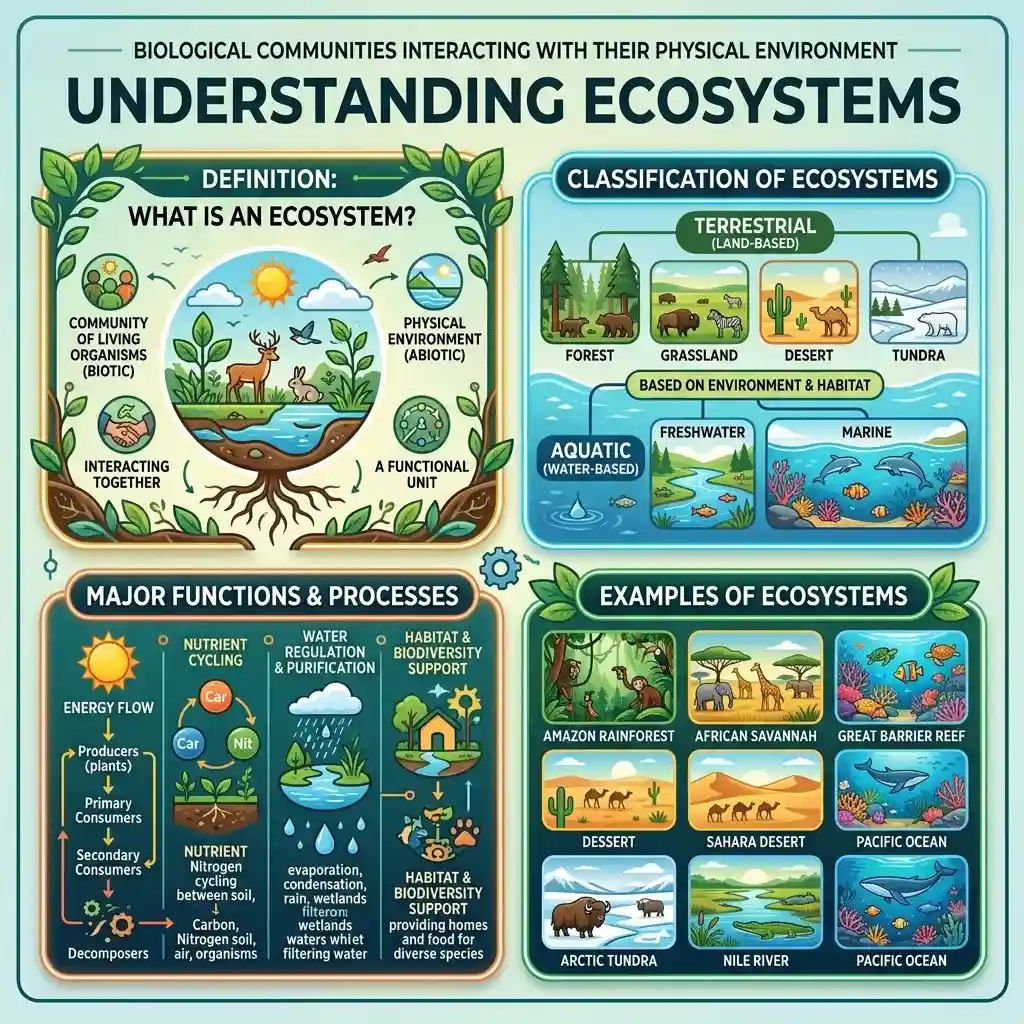
Have you ever watched ants carry food across your backyard? Moreover, did you notice how birds, trees, and rain all connect in that same space? What is an ecosystem with examples represents one of the most important questions in biology. An ecosystem includes every living creature and every non-living element in a particular place. Therefore, understanding ecosystems helps us protect nature, grow food, and stay healthy. In this article, you will discover what makes an ecosystem, how it functions, and why it matters for your daily life. Let us explore the fascinating web of life together.
What Is an Ecosystem With Examples?
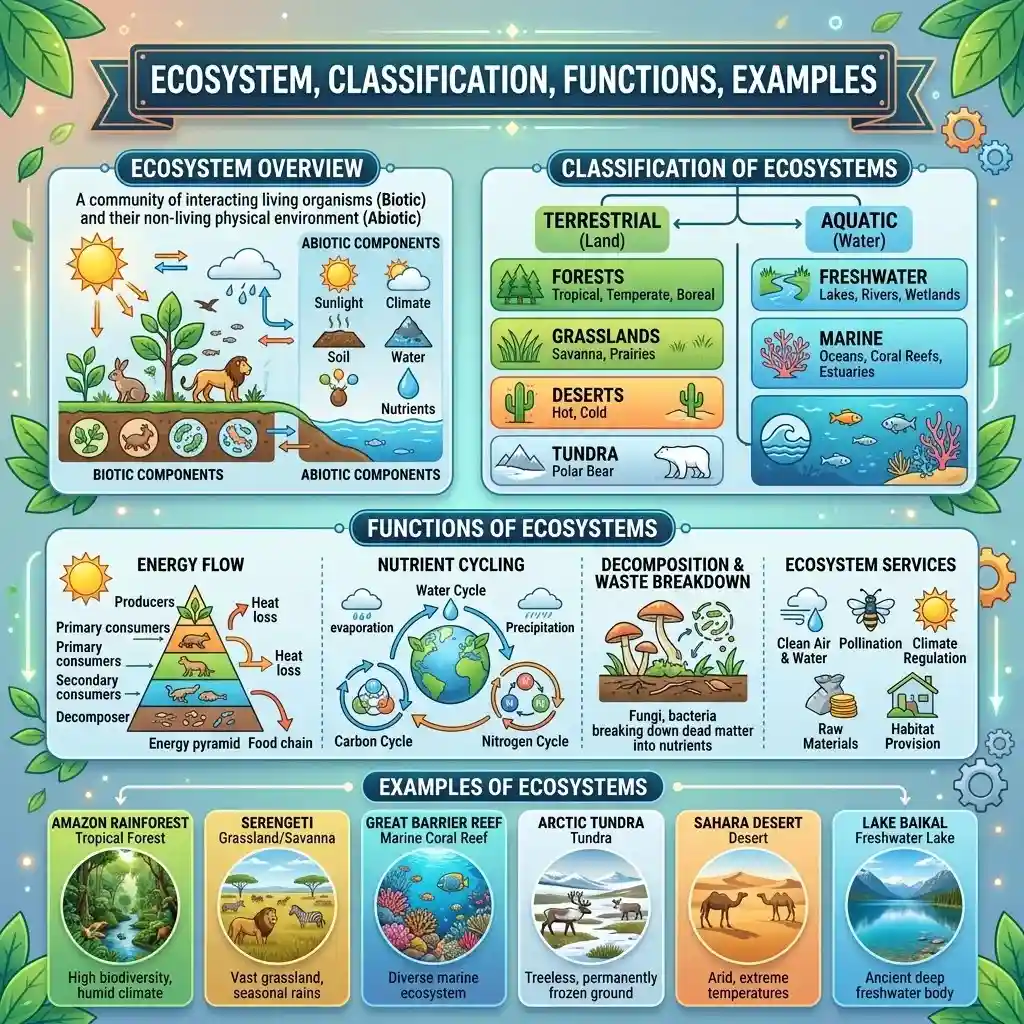
An ecosystem includes all living organisms and their physical environment in a specific area. Living organisms include plants, animals, fungi, and bacteria. Non-living elements include sunlight, water, soil, air, and temperature.
For example, a pond ecosystem includes fish, frogs, algae, water, mud, and sunlight. Another example, a desert ecosystem includes cacti, lizards, sand, heat, and very little rain.
Simple Explanation of an Ecosystem
Imagine a pizza with many toppings. Each topping plays a role. The cheese holds everything together. The sauce adds flavor. The toppings provide texture. An ecosystem works like this pizza.
First, producers like plants make food using sunlight. They form the base of the ecosystem.
Next, consumers like animals eat the plants or eat other animals. They transfer energy through the system.
Then, decomposers like fungi and bacteria break down dead matter. They return nutrients to the soil.
Finally, non-living factors like water and temperature shape how everything lives. Therefore, an ecosystem functions as one connected team.
Key Features / Characteristics of an Ecosystem
- Biotic components: All living things in the area. For example, trees, birds, insects, and bacteria.
- Abiotic components: All non-living things in the area. For example, rocks, water, sunlight, and wind.
- Energy flow: Sunlight powers the ecosystem. Plants capture this energy. Animals eat plants or other animals.
- Nutrient cycling: Decomposers break down waste and dead organisms. They return nutrients to the soil for plants to use again.
- Interdependence: Every organism depends on others. If one part fails, the whole system suffers.
Types or Classification of Ecosystems
Scientists classify ecosystems based on their main characteristics.
Terrestrial Ecosystems
Terrestrial ecosystems exist on land. They include forests, grasslands, deserts, and tundra. For example, the Amazon rainforest hosts millions of species in one terrestrial ecosystem.
Aquatic Ecosystems
Aquatic ecosystems exist in water. They include freshwater systems like rivers and lakes. They also include marine systems like oceans and coral reefs. For example, the Great Barrier Reef represents a massive marine ecosystem.
Natural Ecosystems
Natural ecosystems develop without human help. They include wild forests, untouched oceans, and remote mountains. These systems maintain balance through natural processes.
Artificial Ecosystems
Artificial ecosystems need human care and management. They include farms, gardens, aquariums, and zoos. For example, a rice paddy field counts as an artificial ecosystem because farmers control water, plants, and pests.
How Does an Ecosystem Work?
First, the sun sends energy to Earth. Plants capture this energy through photosynthesis. They become producers.
Next, herbivores eat the plants. Carnivores eat the herbivores. Omnivores eat both plants and animals. These animals become consumers.
Then, when plants and animals die, decomposers break down their bodies. Bacteria and fungi absorb nutrients from the dead matter.
Finally, the soil releases these nutrients back to the plants. The cycle starts again. Therefore, energy flows through the ecosystem while nutrients recycle continuously.
Importance of an Ecosystem
Daily Life: Ecosystems provide food, clean water, and raw materials. Farmers depend on healthy soil ecosystems to grow crops. Therefore, your breakfast comes from a functioning ecosystem.
Environment: Ecosystems clean the air, filter water, and control climate. Forests absorb carbon dioxide. Wetlands filter pollutants. As a result, ecosystems protect the entire planet.
Human Health: Healthy ecosystems reduce disease spread. Diverse ecosystems control pest populations naturally. Moreover, many medicines come from plants and animals in wild ecosystems.
Examples of an Ecosystem in Real Life
- Your backyard: Grass, worms, birds, ants, soil, rain, and sunlight form a small ecosystem.
- A coral reef: Fish, corals, algae, sharks, and ocean water create a vibrant underwater ecosystem.
- A city park: Trees, squirrels, pigeons, grass, benches, and people form an urban ecosystem.
- A rotting log: Beetles, fungi, moss, and moisture create a tiny but complete ecosystem.
What Is an Ecosystem With Examples for Different Age Groups
Ecosystem Explained for Everyone
1️⃣ For Kids (The Living City Idea)
Imagine a tiny magical city inside nature.
Everyone has a job:
- 🌿 Plants are the chefs — they cook food using sunlight
- 🐛 Insects are cleaners — they break down waste
- 🐇 Animals are the residents — they eat plants or other animals
- ☀️ Sun gives energy
- 🌧️ Rain gives water
- 🌱 Soil gives support
💡 Everything works together like a perfectly balanced city.
👉 This is exactly what an ecosystem is — a living teamwork system of nature.
2️⃣ For Students (Clear Scientific View )
An ecosystem is a natural system where living and non-living things interact.
It has two main parts:
- Biotic factors: plants, animals, bacteria
- Abiotic factors: sunlight, water, air, soil
How it works:
- Producers (plants) create food using sunlight
- Consumers (animals) eat plants or other animals
- Decomposers (fungi, bacteria) break down waste
🔄 important processes:
- Energy flows in one direction
- Nutrients are recycled again and again
- Every organism depends on others
👉 Ecosystems can be:
- A small pond
- A forest
- Or even the entire Earth
3️⃣ For Advanced Learners (Deep Ecological Insight)
An ecosystem is a self-regulating functional unit of life and environment.
Structural Components:
- Biotic communities (producers, consumers, decomposers)
- Abiotic environment (energy, climate, nutrients, water, soil)
Energy Flow:
- Energy moves through trophic levels
- Only ~10% energy is transferred to the next level
- Most energy is lost as heat during metabolism
Ecological Dynamics:
- Succession: gradual change in ecosystem structure over time
- Homeostasis: ecosystems maintain balance through feedback loops
Global Integration:
- Biogeochemical cycles (carbon, nitrogen, water) connect ecosystems
- Local systems influence global climate and planetary stability
👉 Ecosystems are not isolated units — they are interconnected life-support systems of Earth.
Common Misconceptions About an Ecosystem
- Misconception: Ecosystems only include animals and plants.
Correction: Ecosystems include bacteria, fungi, water, rocks, air, and sunlight. Non-living parts matter just as much as living parts. - Misconception: Ecosystems stay the same forever.
Correction: Ecosystems change constantly. Seasons, disasters, and human activity alter them regularly. - Misconception: Humans stand outside ecosystems.
Correction: Humans live inside ecosystems. We depend on them for survival just like every other organism.
Difference Between an Ecosystem and Related Concepts
| Feature | Ecosystem | Biome |
|---|---|---|
| Size | Small to medium area | Large region spanning continents |
| Focus | Interactions within one area | Climate and dominant vegetation |
| Examples | A pond, a forest patch | Tropical rainforest, tundra |
| Feature | Ecosystem | Habitat |
|---|---|---|
| Scope | All organisms and environment | Place where one species lives |
| Complexity | Complex web of interactions | Simple address for one organism |
Applications of Ecosystem Knowledge
Medicine: Scientists study rainforest ecosystems to discover new medicines. Many cancer drugs come from plants in tropical ecosystems.
Environment: Conservationists restore damaged ecosystems to fight climate change. For example, replanting mangrove ecosystems protects coastlines from storms.
Technology: Engineers mimic ecosystem designs to create sustainable technology. For example, wastewater treatment plants copy wetland ecosystems.
Daily Life: Gardeners create balanced backyard ecosystems to grow vegetables without chemicals. Therefore, understanding ecosystems improves your dinner table.
Interesting Facts About Ecosystems
- The smallest ecosystem fits inside a single drop of water. It contains bacteria, algae, and tiny animals.
- Scientists estimate that soil ecosystems contain more than half of all living things on Earth.
- Coral reef ecosystems cover less than 1% of the ocean floor but host 25% of all marine species.
- Urban ecosystems grow faster than natural ecosystems. Cities create new habitats for pigeons, rats, and cockroaches.
- The human gut contains an ecosystem of trillions of bacteria. These bacteria help digest food and fight disease.
- Ecosystems can collapse suddenly if too many species disappear. This happened in some lake ecosystems when invasive fish ate all the native species. More on biology related topics.
FAQs
Q1: What is an ecosystem with examples in simple words?
A: An ecosystem includes all living things and their surroundings in one area. For example, a forest with trees, deer, birds, soil, and rain forms an ecosystem.
Q2: Can an ecosystem exist without animals?
A: Yes. Some ecosystems contain only plants, bacteria, and non-living elements. However, most ecosystems include animals.
Q3: How do humans damage ecosystems?
A: Humans pollute water, cut down forests, and introduce invasive species. These actions break the balance of ecosystems.
Q4: What happens if one species leaves an ecosystem?
A: Other species suffer. For example, if bees leave an ecosystem, plants cannot pollinate. Therefore, the whole system weakens.
Q5: How many ecosystems exist on Earth?
A: Scientists cannot count them exactly. Ecosystems range from tiny puddles to vast oceans. They overlap and connect in countless ways.
How People Search for What Is an Ecosystem With Examples
- what is an ecosystem with examples
- simple explanation of an ecosystem with examples
- examples of an ecosystem for kids
- types of ecosystems with examples
- what is an ecosystem in biology
- ecosystem examples in real life
- how does an ecosystem work
- importance of ecosystem in daily life
- ecosystem vs biome difference
- ecosystem facts for students
Conclusion
An ecosystem represents one of nature’s most powerful ideas. It shows how every living thing connects to every other thing. Moreover, it proves that non-living elements like water and sunlight matter just as much as plants and animals. Therefore, protecting ecosystems means protecting our future. Whether you tend a garden, visit a park, or simply breathe clean air, you depend on healthy ecosystems every single day. Keep exploring the natural world around you. Every backyard, pond, and forest holds a fascinating ecosystem waiting for your discovery. More about ecosystems can be found here.
