
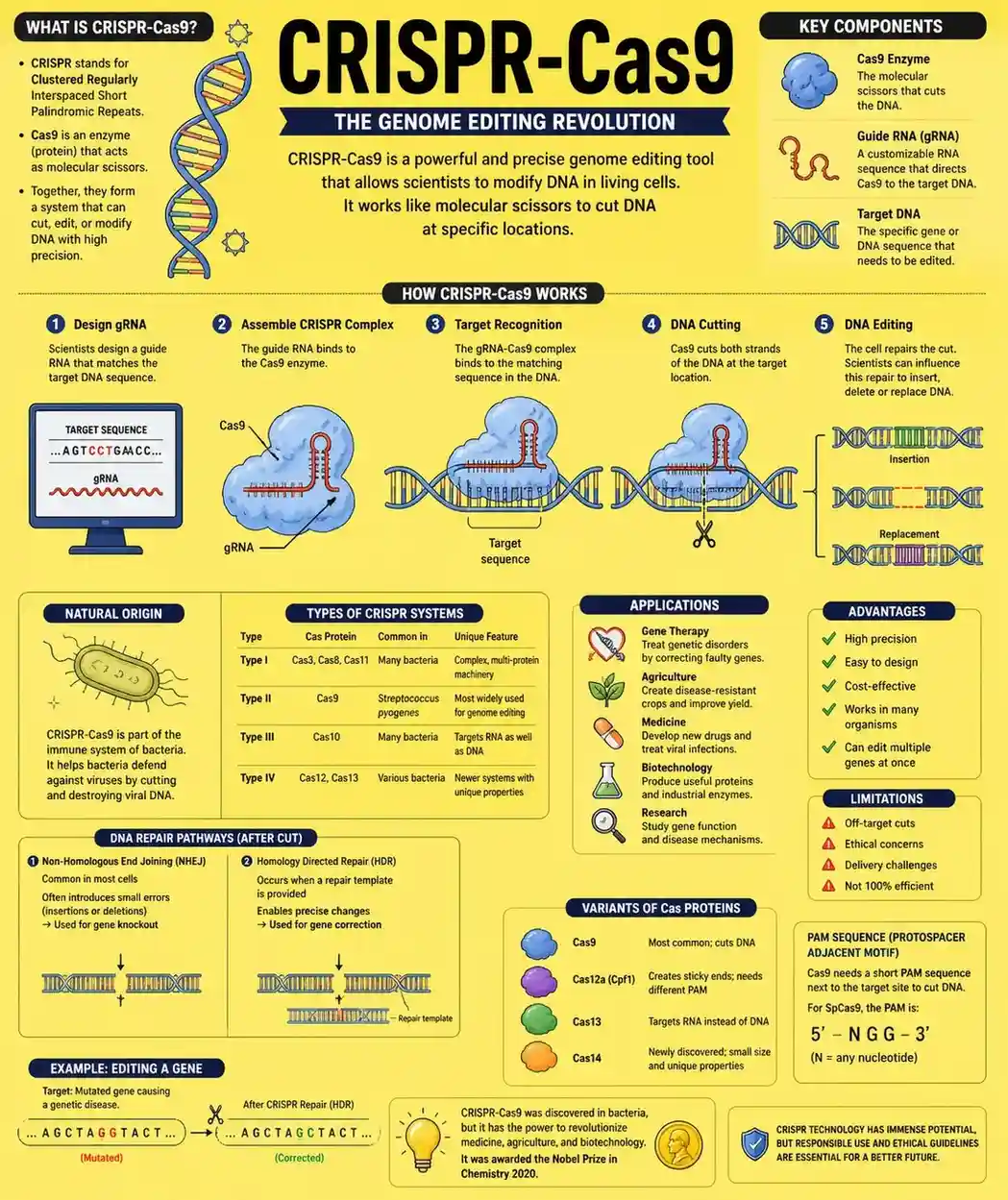
Definition: CRISPR CAS9 technology gives scientists a precise tool to cut and edit DNA inside living cells.
Pronunciation: CRISPER-CASS-nine
Origin: Scientists coined the word “CRISPR” to describe the clustered repeat patterns they observed in bacterial DNA.
Full Acronym: CRISPR stands for Clustered Regularly Interspaced Short Palindromic Repeats. Cas9 stands for CRISPR-Associated Protein 9.
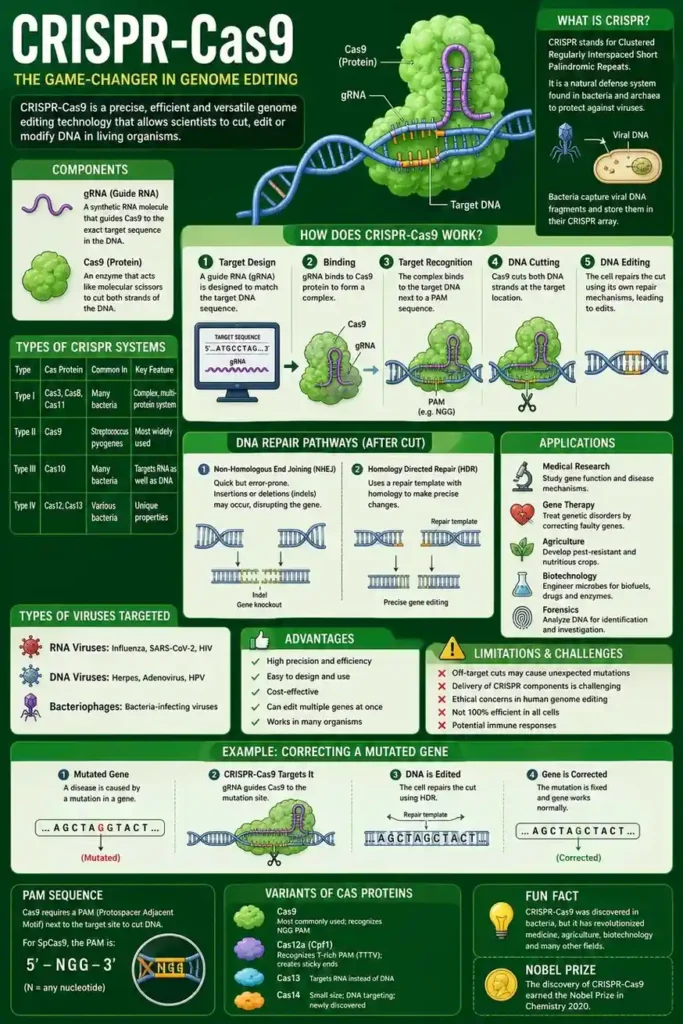
Introduction
Have you ever imagined doctors fixing broken genes inside your body? Moreover, did you know that bacteria already carry a natural tool for this exact purpose? CRISPR CAS9 technology transforms this bacterial defense system into a powerful editing tool for all life forms. Therefore, scientists now rewrite DNA in plants, animals, and humans. This breakthrough matters because it offers cures for inherited diseases, stronger crops, and revolutionary medical treatments. In this article, you will discover how CRISPR CAS9 technology works, why it changes everything, and what it means for your future. Let us dive into the exciting world of genetic scissors together.
What is CRISPR-Cas9 Technology?
🔹 Simple Definition
CRISPR-Cas9 is a powerful tool that allows scientists to edit DNA with high precision.
🔹 Easy Idea to Understand
Think of DNA as a life instruction manual 📖 for every living organism.
Sometimes, this manual contains mistakes (mutations) that can lead to diseases.
👉 CRISPR-Cas9 works like a smart editing system that can:
- Find the mistake
- Cut out the faulty part
- Replace or fix it
🔹 Real-Life Uses
CRISPR-Cas9 is already helping in many areas:
- Medicine:
Used to treat diseases like sickle cell anemia by repairing faulty blood cells - Agriculture:
Helps create crops like rice that can survive drought and harsh conditions
Nobel Prize Achievement
🔹 Who discovered it?
Scientists:
- Emmanuelle Charpentier
- Jennifer Doudna
won the 2020 Nobel Prize in Chemistry for developing CRISPR-Cas9.
🔹 Why they won the Nobel Prize
They transformed a natural bacterial defense system into a programmable gene-editing tool.
Their key contributions:
- Charpentier discovered a key RNA molecule called tracrRNA in bacteria
- Doudna contributed deep expertise in RNA biochemistry
- Together, they simplified the system into a usable genetic tool
🔹 Important Milestone
- In 2012, they published their breakthrough research
- It was the first time two women shared a Nobel Prize in Chemistry
Simple Explanation of CRISPR-Cas9
🔹 Easy Analogy
Imagine a huge book with thousands of pages and one page has a spelling mistake.
You don’t want to rewrite the whole book. You just want to fix that one error.
CRISPR-Cas9 does exactly that.
🔹 Step-by-step process
1️⃣ Finding the mistake
- Guide RNA scans the DNA like a search tool
- It finds the exact location of the error
2️⃣ Cutting the DNA
- Cas9 protein acts like molecular scissors
- It cuts the DNA at the correct spot
3️⃣ Fixing the gene
- Scientists either:
- remove the error, or
- insert correct DNA
4️⃣ Final result
- 📖 The DNA is repaired
- The genetic “instruction book” works correctly again
🔹 Key Takeaway
CRISPR-Cas9 does not rewrite the whole DNA.
It simply fixes the exact mistake, making it one of the most precise tools in modern biology.
Key Features / Characteristics of CRISPR CAS9 Technology
- Precision: CRISPR CAS9 technology cuts DNA at exact locations. Scientists program the guide RNA to match specific gene sequences.
- Simplicity: Researchers need only two main parts: the Cas9 protein and guide RNA. This makes the tool easy to use.
- Speed: Scientists create guide RNA in days instead of months. Therefore, experiments move much faster.
- Versatility: CRISPR CAS9 technology works in bacteria, plants, animals, and human cells.
- Affordability: This tool costs much less than older gene-editing methods.
Types or Classification of CRISPR CAS9 Technology
Scientists classify CRISPR systems into different classes based on their protein makeup.
Class 1 CRISPR Systems
Class 1 systems use multiple proteins working together. These proteins form a large complex that finds and cuts viral DNA. However, scientists find these systems harder to program.
Class 2 CRISPR Systems
Class 2 systems use a single protein like Cas9. This simplicity makes Class 2 systems popular in laboratories. CRISPR CAS9 technology belongs to this group.
Other Cas Proteins
Scientists have discovered other proteins beyond Cas9. For example, Cas12 cuts DNA differently than Cas9. Cas13 targets RNA instead of DNA. Therefore, researchers now choose the best protein for each job.
How Does CRISPR CAS9 Technology Work?
First, scientists design a guide RNA that matches the target DNA sequence. This guide RNA acts like a GPS system.
Next, scientists attach this guide RNA to the Cas9 protein. The combination forms the genetic scissors.
Then, the guide RNA scans the DNA and locks onto the matching sequence.
After that, Cas9 cuts both strands of the DNA at that exact spot.
Finally, the cell repairs the cut. Scientists introduce a corrected DNA template during this repair. As a result, the gene now contains the correct instructions.
How CRISPR is Delivered into Cells (New Addition)
Scientists use different delivery methods:
- Viral vectors (modified harmless viruses)
- Lipid nanoparticles (fat-based carriers)
- Electroporation (electrical pulse opening cell pores)
Delivery is one of the biggest challenges in real treatments.
Ethical Concerns
CRISPR raises serious global debates:
- Should we edit human embryos?
- Can we design “perfect babies”?
- Who controls genetic modification?
In 2018, the birth of gene-edited babies sparked worldwide ethical controversy. Many countries now regulate or restrict human germline editing.
Importance of CRISPR CAS9 Technology
Daily Life: CRISPR CAS9 technology helps create juicier tomatoes, longer-lasting bananas, and leaner meat. Therefore, your grocery store already benefits from this science.
Environment: Scientists use this tool to engineer crops that need less water and fewer pesticides. Moreover, researchers explore ways to save endangered species.
Human Health: Doctors use CRISPR CAS9 technology to treat sickle cell disease, certain cancers, and inherited blindness. This technology brings hope to millions of families.
Examples of CRISPR CAS9 Technology in Real Life
- Scientists created mushrooms that resist browning. Therefore, these mushrooms stay fresh longer.
- Researchers developed pigs with organs safe for human transplant.
- Doctors treated a patient with sickle cell disease by editing her blood cells.
- Plant breeders grew rice with lower levels of harmful heavy metals.
CRISPR-Cas9 Technology for Different Age Groups
CRISPR-Cas9 can feel complex, but let’s unlock it in three levels of understanding, like climbing a ladder from imagination to expertise.
For Kids (The Magic Repair Kit Version)
Imagine your body is a huge instruction book .
Sometimes, a page has a typo or mistake.
Now imagine:
- ✂️ Tiny magical scissors go inside your body
- 🔍 They search for the wrong instruction
- ❌ They cut out the mistake
- 🧩 Then a healthy piece is pasted back
CRISPR-Cas9 is like a smart repair kit inside living cells
It fixes broken instructions so your body can work better again.
For Students (The Science Made Simple)
Now let’s upgrade the idea from magic to biology:
Where it comes from:
- CRISPR-Cas9 originally exists in bacteria
- It is a natural defense system
- Bacteria use it to remember and destroy viruses
How scientists use it:
Scientists converted this system into a gene-editing tool:
- Guide RNA = GPS that finds the target DNA
- Cas9 protein = molecular scissors that cut DNA
- DNA is then repaired or replaced
Result:
- Scientists can now edit genes with high accuracy
- It is used in medicine, agriculture, and research
For Advanced Learners (Deep Molecular Mechanism )
Now we go into the molecular engine room of life:
Biological Origin:
- Derived from Type II CRISPR-Cas system
- Found in Streptococcus pyogenes
RNA-Guided Targeting:
- Two RNAs originally involved:
- crRNA
- tracrRNA
- These were engineered into a single molecule:
- sgRNA (single guide RNA)
DNA Cutting Mechanism:
- Cas9 is an RNA-guided endonuclease
- It creates double-strand breaks (DSBs) in DNA
Target Specificity:
- Requires PAM sequence (NGG) to bind DNA correctly
DNA Repair Pathways:
After cutting, cells repair DNA using:
- 🔧 NHEJ (Non-Homologous End Joining)
→ often disables genes (gene knockout) - 🧩 HDR (Homology-Directed Repair)
→ allows precise gene correction or insertion (knock-in)
Scientific Impact:
- Enables programmable genome editing
- Forms the basis of modern gene therapy and synthetic biology
Final Insight
From magical scissors 🧚♂️ → biological tool 🔬 → molecular engineering system ⚙️, CRISPR-Cas9 grows in depth but keeps one purpose:
👉 To rewrite life’s instructions with precision and control
Limitations and Challenges
- Off-target effects: Wrong DNA cuts may occur
- Delivery difficulty: Not all cells are easy to reach
- Immune response: Body may react against Cas9 protein
- Mosaicism: Not all cells get edited equally
So, CRISPR is powerful but still being perfected.
Common Misconceptions About CRISPR CAS9 Technology
- Misconception: CRISPR CAS9 technology changes DNA in every cell automatically.
Correction: Scientists must deliver the tool to specific cells. It does not spread through the body on its own. - Misconception: CRISPR CAS9 technology always works perfectly.
Correction: Sometimes the scissors cut the wrong spot. Scientists call this off-target effects. Researchers work hard to reduce these mistakes. - Misconception: CRISPR CAS9 technology only edits human genes.
Correction: Scientists use this tool in plants, animals, bacteria, and fungi.
Difference Between CRISPR CAS9 Technology and Related Concepts
| Feature | CRISPR CAS9 Technology | Gene Therapy |
|---|---|---|
| Method | Cuts and edits DNA directly | Adds healthy genes without cutting |
| Precision | Targets exact locations | Inserts genes randomly |
| Cost | Low | High |
| Feature | CRISPR CAS9 Technology | Traditional Breeding |
|---|---|---|
| Speed | Changes genes in weeks | Takes many years |
| Control | Edits specific genes | Mixes all genes randomly |
Applications of CRISPR CAS9 Technology
Medicine: Doctors develop cures for cancer, sickle cell disease, and muscular dystrophy. Moreover, scientists create better models for studying diseases.
Environment: Researchers engineer algae that absorb more carbon dioxide. Therefore, this tool helps fight climate change.
Technology: Scientists use CRISPR CAS9 technology to build biological computers and advanced diagnostic tests.
Daily Life: Food companies grow non-browning apples and high-oleic soybeans. Therefore, your diet already includes CRISPR-edited foods. Learn more about related biology topics here.
Future of CRISPR
Future developments include:
- Base editing: changes single DNA letters
- Prime editing: advanced precision editing
- Gene therapy cures: permanent disease correction
- Synthetic biology: designing new life functions
Interesting Facts About CRISPR CAS9 Technology
- Bacteria invented CRISPR millions of years ago to fight viruses.
- The 2020 Nobel Prize marked the first time two women shared a science Nobel together.
- Scientists edit multiple genes at once using CRISPR.
- CRISPR CAS9 technology helped create rapid tests for detecting viruses.
- Some scientists use CRISPR to bring back traits of extinct animals.
- Scientists created the first CRISPR-edited babies in 2018, sparking global ethical debates.
FAQs
Q1: What does CRISPR CAS9 technology do?
A: It gives scientists a tool to cut and edit DNA with high precision.
Q2: Is CRISPR CAS9 technology safe?
A: Scientists continue testing its safety. Most treatments show promise, but researchers watch for off-target effects.
Q3: Does CRISPR CAS9 technology cure all diseases?
A: No. This technology treats certain genetic diseases well. However, many diseases involve complex factors beyond single genes.
Q4: How much does CRISPR CAS9 technology cost?
A: It costs much less than older gene-editing tools. Therefore, more laboratories use it worldwide.
Q5: Who owns CRISPR CAS9 technology?
A: Universities and research institutions hold patents. Scientists around the world use the tool for research.
How People Search for CRISPR CAS9 Technology
- what is CRISPR CAS9 technology
- simple explanation of CRISPR CAS9 technology
- examples of CRISPR CAS9 technology
- how does CRISPR CAS9 technology work
- CRISPR CAS9 technology Nobel Prize winners
- CRISPR CAS9 technology applications in medicine
- CRISPR CAS9 technology vs gene therapy
- CRISPR CAS9 technology facts for kids
- CRISPR CAS9 technology importance in daily life
- CRISPR CAS9 technology ethical concerns
Conclusion
CRISPR CAS9 technology gives humanity a powerful tool to rewrite the code of life. This genetic scissors system transforms medicine, agriculture, and science in remarkable ways. Moreover, it offers real hope for curing inherited diseases and protecting our environment. As scientists continue improving this technology, society must also consider ethical guidelines. Therefore, CRISPR CAS9 technology represents both an incredible opportunity and a serious responsibility. The future of gene editing shines bright, and you now understand the basics of this revolutionary science. Keep learning, because this field changes every day. Tomorrow brings new discoveries that will shape our world forever. For more information, click here.

Hi All! I’m Imran Abbas. I’m a Ph.D (scholar) in Structural Chemistry and I work in a number of domains like Bioinformatics, Literature, politics, sports and I’m a polyglot as well. I respect all irrespective of their ethnicity, locality and color. I’m always ready to learn new ideas and travel to different parts of the world.