
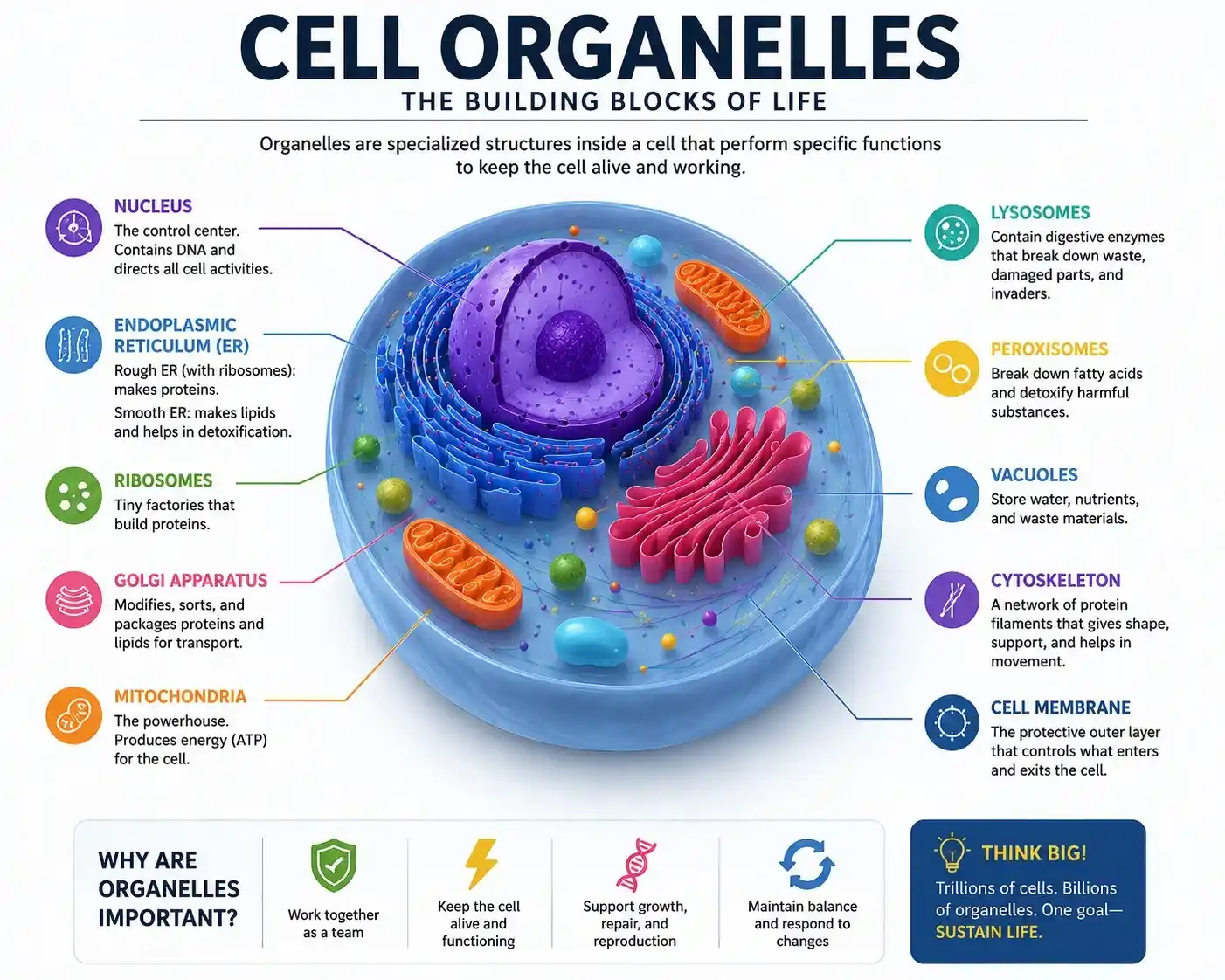
Definition: Cell organelles are specialized structures inside living cells. Each one performs a specific job to keep the cell healthy and working.
Pronunciation: /sel ɔːrɡəˈnɛlz/ (sell or-guh-NELZ)
Origin: The word “organelle” comes from Latin. “Organellum” means “little organ.” Scientists chose this name because organelles work like tiny organs inside a cell, just as organs work inside your body.
Introduction
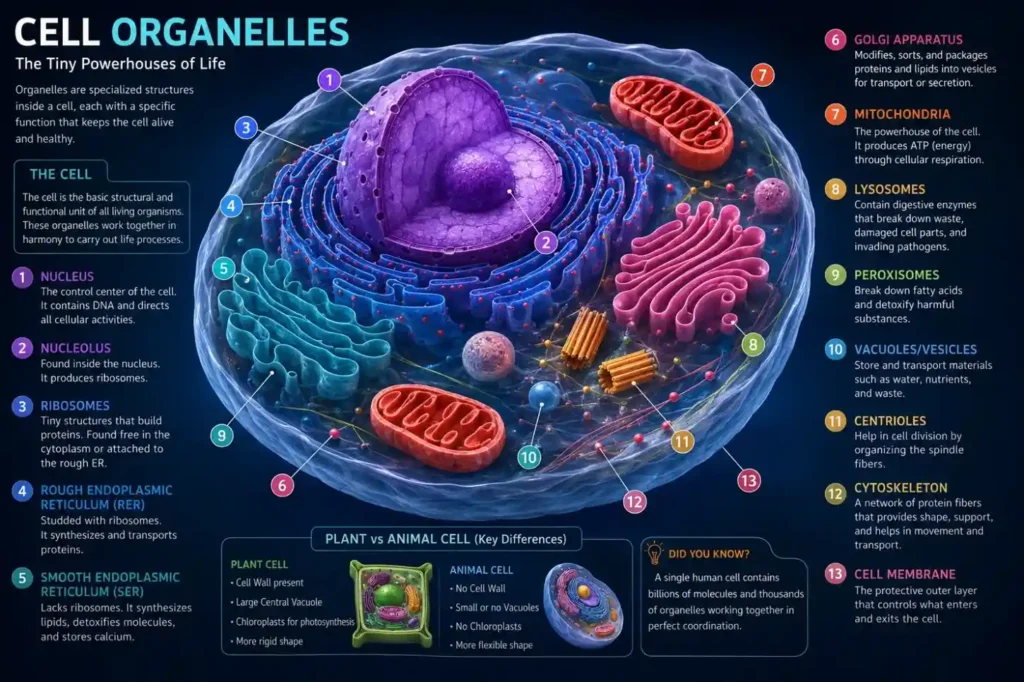
Imagine you are looking at a bustling city through a microscope. You see tiny buildings, power plants, shipping centers, and recycling stations. Each part has a job. Each part works day and night. This is exactly what happens inside your body right now. Cell organelles are these tiny workers. They live inside every cell in your body. They build proteins, create energy, clean waste, and protect your DNA. Without them, life stops. Learning about cell organelles helps you understand how your body heals cuts, grows muscles, and fights germs. This knowledge builds the foundation for biology, medicine, and health science. Let us explore this hidden world together.
What Are Cell Organelles?
Cell organelles are tiny parts inside a cell. Each part has a special task. Think of a cell like a factory. In a factory, different departments handle different jobs. One department packs boxes. Another makes energy. Another cleans the floors. Cell organelles work the same way. Some organelles make proteins, other store water. Some create power. Scientists group cells into two main types: prokaryotic cells and eukaryotic cells. Prokaryotic cells, like bacteria, have very few organelles. Eukaryotic cells, like the ones in your body, have many organelles surrounded by membranes . These membrane-bound organelles create separate workspaces inside the cell. This separation allows the cell to perform many tasks at once without mixing chemicals that should stay apart.
Simple Explanation of Cell Organelles
Let us break this down step by step.
Step 1: Every living thing consists of cells. Cells are the basic units of life.
Step 2: Inside each cell, you find a gel-like fluid called cytoplasm. This fluid holds all the organelles in place.
Step 3: Each organelle has a shape that matches its job. For example, the mitochondria have folded inner membranes. These folds create more space for energy production .
Step 4: Organelles talk to each other. They pass materials back and forth. A protein made in one organelle travels to another for packaging. Then it ships out to do its job.
Step 5: All organelles work as a team. If one fails, the whole cell suffers. This teamwork keeps you alive.
Think of a pizza restaurant. The dough station prepares the crust. The sauce station adds flavor. The oven bakes the pie. The box station packages it for delivery. Each station needs the others. Cell organelles operate with the same teamwork.
Key Features and Characteristics of Cell Organelles
Cell organelles share some important traits:
- Specialization: Each organelle performs one main job. The nucleus stores DNA. The mitochondria make energy. The lysosomes break down waste .
- Membrane Boundaries: Most organelles in eukaryotic cells have membranes. These membranes control what enters and exits. They create safe workspaces.
- Structure Matches Function: The shape of each organelle helps it work better. The rough endoplasmic reticulum has ribosomes on its surface. This surface helps it make proteins faster .
- Dynamic Interactions: Organelles do not work alone. They form teams. The endoplasmic reticulum passes proteins to the Golgi apparatus. The Golgi apparatus packages them for delivery .
- Own Genetic Material: Some organelles, like mitochondria and chloroplasts, carry their own DNA. This fact supports the endosymbiotic theory, which states these organelles were once free-living bacteria .
Types and Classification of Cell Organelles
Scientists classify organelles based on their jobs. Here are the main groups:
Energy Organelles
Mitochondria: These are the powerhouses of the cell. They convert food into ATP, the energy currency of the cell. They have two membranes and their own DNA .
Chloroplasts: These exist only in plant cells. They capture sunlight and turn it into sugar through photosynthesis. They also have their own DNA .
Manufacturing Organelles
Ribosomes: These tiny structures read genetic instructions and build proteins. They float freely in the cytoplasm or attach to the rough endoplasmic reticulum .
Endoplasmic Reticulum (ER): This network of tubes acts as a factory and highway. The rough ER makes proteins. The smooth ER makes lipids and detoxifies chemicals .
Golgi Apparatus: This organelle looks like a stack of flattened pouches. It receives proteins from the ER, modifies them, and ships them to their final destinations .
Storage and Transport Organelles
Vacuoles: These are storage sacs. Plant cells have one large central vacuole that stores water and maintains shape. Animal cells have smaller vacuoles .
Vesicles: These are tiny transport bubbles. They move materials between organelles and to the cell surface.
Breakdown and Recycling Organelles
Lysosomes: These contain strong digestive enzymes. They break down worn-out parts, food particles, and invading germs. Scientists call them the suicide bags of the cell because they can destroy the cell if they break open .
Peroxisomes: These neutralize toxic substances. They break down fatty acids and hydrogen peroxide.
Structural and Movement Organelles
Cytoskeleton: This is a network of protein fibers. It gives the cell shape and helps it move.
Cilia and Flagella: These are hair-like structures that wave or whip. They move the cell or move fluid over the cell surface.
Control Center
Nucleus: This is the brain of the cell. It stores chromosomes, controls gene expression, and directs all major activities. It has a double membrane with pores that allow materials to pass .
How Do Cell Organelles Work?
Let us follow a protein from start to finish. This shows how organelles work as a team.
First, a gene in the nucleus sends a message. This message tells the cell to build a specific protein.
Next, the message travels to a ribosome. The ribosome reads the message and links amino acids together. It builds a protein chain.
Then, if the protein needs modification, the ribosome attaches to the rough endoplasmic reticulum. The protein enters the ER, where it folds into its proper shape.
After that, a vesicle buds off from the ER. It carries the protein to the Golgi apparatus.
Inside the Golgi, workers modify the protein. They add tags that tell the protein where to go.
Finally, another vesicle carries the finished protein to the cell membrane. The vesicle fuses with the membrane and releases the protein outside the cell.
This process happens millions of times every second in your body. It keeps your immune system strong, repairs tissues, and builds new cells.
Importance of Cell Organelles
Cell organelles matter in every part of life:
Daily Life: When you eat food, your mitochondria convert that food into energy. When you cut your finger, organelles in your skin cells work together to repair the damage.
Environment: Plant chloroplasts absorb carbon dioxide and release oxygen. This process supports all life on Earth. Without chloroplasts, the air would lack the oxygen you need to breathe.
Human Health: Doctors study organelles to understand diseases. Lysosomal storage diseases occur when lysosomes fail to break down certain materials. This failure causes toxic buildup in cells . Cancer researchers study the nucleus because cancer starts with DNA damage. Understanding organelles leads to better treatments and cures.
Examples of Cell Organelles in Real Life
Here are relatable examples for different ages:
- The Nucleus as a Library: It stores all the instruction books (DNA) for the cell. When the cell needs to build something, it checks out the right book.
- Mitochondria as Power Plants: Just as a city power plant generates electricity for homes, mitochondria generate ATP for the cell.
- The Golgi Apparatus as a Post Office: It receives packages (proteins), adds labels, and ships them to the right addresses.
- Lysosomes as Recycling Centers: They take old cell parts, break them down, and reuse the raw materials.
- Ribosomes as Construction Workers: They read blueprints and build structures (proteins) according to plan.
Cell Organelles for Different Age Groups
For Kids
Think of a cell as a tiny town. The nucleus is the mayor’s office. The mitochondria are the power plants. The ribosomes are the builders. The lysosomes are the garbage trucks. Each one has a fun job. They all work together so the town stays clean, powered, and happy. Plant cells have extra parts called chloroplasts. These are like solar panels. They catch sunlight and turn it into food for the plant.
For Students
In middle school and high school, you learn that cells are not just bags of water. They are complex systems. Cell organelles perform specific biochemical tasks. The endomembrane system includes the nuclear envelope, endoplasmic reticulum, Golgi apparatus, lysosomes, and vesicles. These parts work together to make, modify, and transport proteins . Plant cells have cell walls and central vacuoles. Animal cells have centrosomes and lysosomes. Knowing these differences helps you answer test questions and build a foundation for advanced biology.
For Advanced Learners
At the college level, you study the endosymbiotic theory. This theory states that mitochondria and chloroplasts were once free-living prokaryotes. They were engulfed by ancestral eukaryotic cells. Over time, they became permanent organelles. Evidence includes their double membranes, circular DNA, and 70S ribosomes, which match bacterial ribosomes . You also study autophagy, where lysosomes recycle damaged organelles. This process links to aging, cancer, and neurodegenerative diseases. Advanced learners explore how organelle dysfunction causes specific pathologies, making this field vital for medical research.
Common Misconceptions About Cell Organelles
Misconception 1: All cells have the same organelles.
Truth: Plant and animal cells differ. Plant cells have chloroplasts, cell walls, and large central vacuoles. Animal cells lack these but have lysosomes and centrosomes .
Misconception 2: Prokaryotic cells have no organelles at all.
Truth: Prokaryotic cells lack membrane-bound organelles. However, they still have ribosomes, cytoplasm, and a nucleoid region where DNA lives.
Misconception 3: The nucleus is the only place with DNA.
Truth: Mitochondria and chloroplasts contain their own DNA. This fact supports the endosymbiotic theory .
Misconception 4: Lysosomes only digest food.
Truth: Lysosomes also recycle worn-out organelles through autophagy. They can trigger programmed cell death when necessary .
Misconception 5: Organelles work independently.
Truth: Organelles constantly interact. The ER talks to the Golgi. Mitochondria supply energy to the nucleus. They form a dynamic network.
Difference Between Cell Organelles and Related Concepts
| Term | What It Means | How It Differs from Organelles |
|---|---|---|
| Cell | The basic unit of life | A cell contains many organelles |
| Organelle | A specialized structure inside a cell | An organelle performs one specific job within the cell |
| Tissue | A group of similar cells working together | Tissues are made of cells, not organelles |
| Organ | A body part made of different tissues | Organs are macroscopic; organelles are microscopic |
| Molecule | A group of atoms bonded together | Molecules are smaller than organelles and form their building blocks |
Think of it this way: A cell is like a school. An organelle is like a classroom inside that school. A tissue is like a district full of similar schools. An organ is like an entire city with many types of schools, hospitals, and stores.
Applications of Cell Organelles
Medicine
Doctors target specific organelles to treat diseases. Mitochondrial therapy aims to repair damaged mitochondria in patients with energy disorders. Lysosomal enzyme replacement therapy treats storage diseases by supplying missing enzymes . Cancer drugs often target the nucleus to stop cancer cells from dividing.
Environment
Scientists study chloroplasts to improve crop yields. They engineer plants with more efficient photosynthesis. This research helps feed growing populations. Bioremediation uses bacteria and their organelles to clean oil spills and toxic waste.
Technology
Nanotechnology mimics organelle functions. Scientists create artificial vesicles to deliver drugs directly to cancer cells. This method reduces side effects. Biofuel researchers study mitochondria to develop cleaner energy sources.
Daily Life
When you exercise, your muscle cells make more mitochondria. This increase gives you more energy. When you eat antioxidants, you protect your organelles from damage. Understanding organelles helps you make better health choices every day.
Interesting Facts About Cell Organelles
- Mitochondria come from your mother only. Sperm mitochondria usually do not enter the egg during fertilization. Therefore, you inherit these power plants from your mom .
- Liver cells are packed with smooth ER. Your liver detoxifies alcohol and drugs. The smooth endoplasmic reticulum performs this job. Heavy drinkers develop more smooth ER in their liver cells, but this adaptation has limits.
- Neurons can stretch their organelles for feet. Some nerve cells run from your spine to your toes. Organelles must transport materials across these enormous distances using specialized motor proteins.
- Chloroplasts can move within plant cells. They shift position to capture optimal sunlight. In bright light, they move to the cell sides to avoid damage. In dim light, they spread out to catch more rays.
- The nucleolus disappears during cell division. This organelle builds ribosomes. When a cell prepares to divide, the nucleolus vanishes. It reappears after the new nuclei form.
- Lysosomes can digest the entire cell. Under certain conditions, lysosomes break open and release their enzymes. This process causes the cell to self-destruct. It sounds scary, but it is essential for shaping fingers during fetal development and removing damaged cells.
FAQs
Q1: What are cell organelles in simple words?
Cell organelles are tiny parts inside a cell. Each part has a special job, like making energy, building proteins, or cleaning waste.
Q2: How many organelles are in a cell?
A typical animal cell has about 10 to 15 major organelles. Plant cells have a few extra, like chloroplasts and a large central vacuole. The exact number depends on the cell type.
Q3: Do all cells have organelles?
All cells have some structures, but not all have membrane-bound organelles. Prokaryotic cells, like bacteria, lack membrane-bound organelles. Eukaryotic cells, like those in your body, have many .
Q4: What is the most important organelle?
Scientists often call the nucleus the most important because it controls all cell activities. However, every organelle matters. Without mitochondria, the cell has no energy. Without ribosomes, it cannot build proteins.
Q5: Can organelles get sick?
Yes. When organelles malfunction, diseases occur. For example, faulty mitochondria cause muscle weakness and neurological problems. Damaged lysosomes lead to storage diseases where toxic materials build up in cells .
How People Search for Cell Organelles
Here are common search queries people type into Google:
- What is cell organelles
- Simple explanation of cell organelles
- Examples of cell organelles
- Cell organelles function and structure
- Cell organelles in plant and animal cells
- Cell organelles diagram labeled
- Cell organelles quiz for students
- Cell organelles analogy for kids
- Difference between cell organelles and cell structures
- Cell organelles diseases and disorders
Conclusion
Cell organelles are the invisible heroes inside every living cell. They work as a team to build proteins, create energy, store materials, and remove waste. From the commanding nucleus to the powerful mitochondria, each organelle plays a vital role. Understanding cell organelles opens doors to biology, medicine, and environmental science. It helps you appreciate how your body heals, grows, and defends itself. The next time you run, eat, or even blink, remember the tiny factories inside your cells making it all possible. Keep exploring. Keep learning. The microscopic world holds the secrets to life itself. Watch a video about Cell Organelles here.

Hi All! I’m Imran Abbas. I’m a Ph.D (scholar) in Structural Chemistry and I work in a number of domains like Bioinformatics, Literature, politics, sports and I’m a polyglot as well. I respect all irrespective of their ethnicity, locality and color. I’m always ready to learn new ideas and travel to different parts of the world.