
Definition: DNA stands for deoxyribonucleic acid. It acts as the instruction manual inside every living cell. DNA tells cells how to grow, function, and reproduce.
Pronunciation: dee-EN-AY
Origin: Scientists coined the term “DNA” from the chemical name deoxyribonucleic acid. The word “nucleic” comes from the nucleus, where DNA lives in most cells.
Introduction
Have you ever wondered why your eyes look like your mother’s eyes? Moreover, did you know that a tiny molecule inside your cells holds all the answers? DNA, structure, function, types, and examples explained reveals the secrets of this remarkable molecule. DNA acts like a master blueprint that builds every part of your body. Therefore, understanding DNA matters for everyone. It helps doctors cure diseases, helps farmers grow better crops, and helps scientists solve crimes. In this article, you will discover everything about DNA in simple, clear words. Let us unlock the code of life together.
What Is DNA?
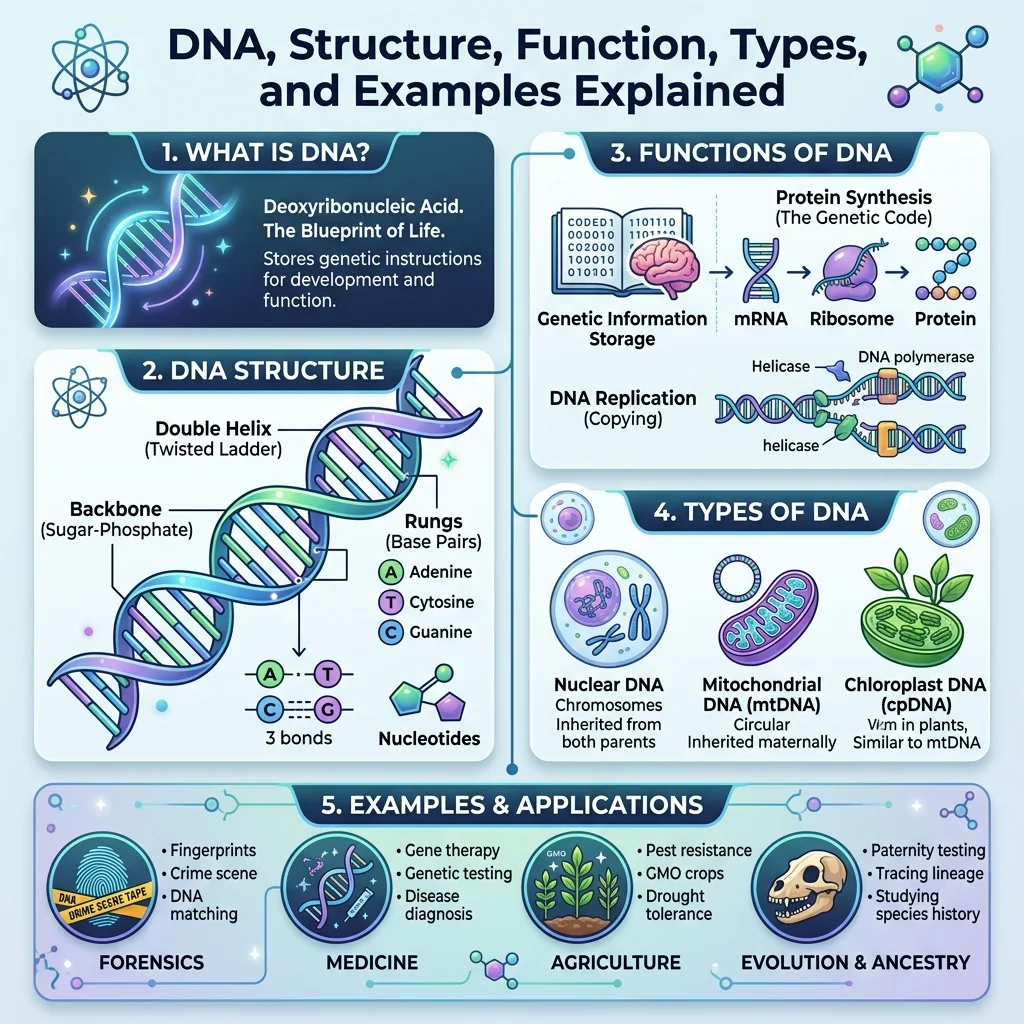
DNA stands for deoxyribonucleic acid. It carries all the genetic instructions that make you who you are. DNA tells your body how to build proteins, how tall you will grow, and even what color your hair will be.
For example, human DNA contains about 20,000 genes. Another example, a single strand of DNA from one cell stretches about six feet long if you unwind it completely.
Simple Explanation of DNA
Imagine a spiral staircase inside every cell of your body. This staircase has millions of steps. Each step contains a pair of chemical letters. These letters spell out instructions for building your entire body.
First, DNA copies itself when cells divide. This ensures every new cell gets the same instructions.
Next, DNA sends messages to the cell. These messages tell the cell which proteins to make.
Then, proteins carry out the work. They build muscles, fight germs, and digest food.
Finally, DNA passes from parents to children. This transfer explains why families share similar traits. Therefore, DNA connects generations through a chain of inherited instructions.
Key Features / Characteristics of DNA
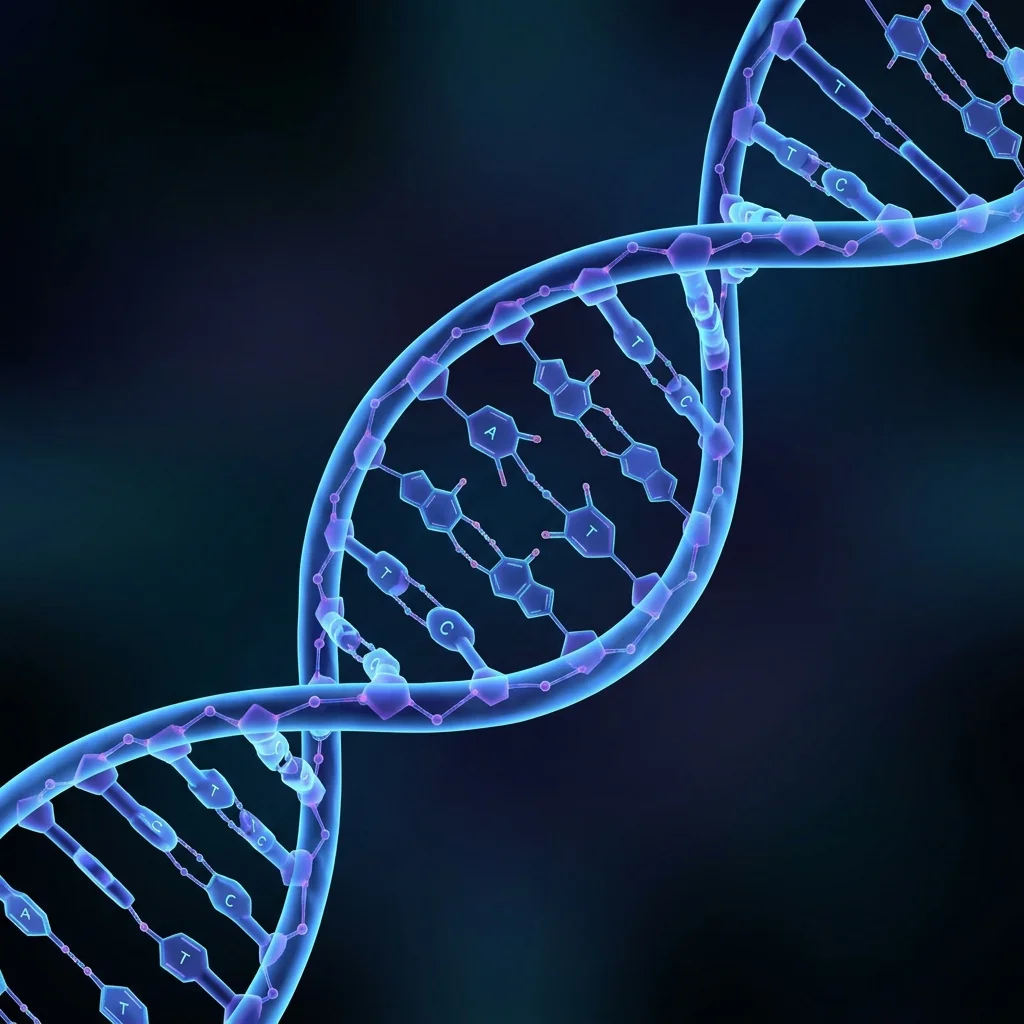
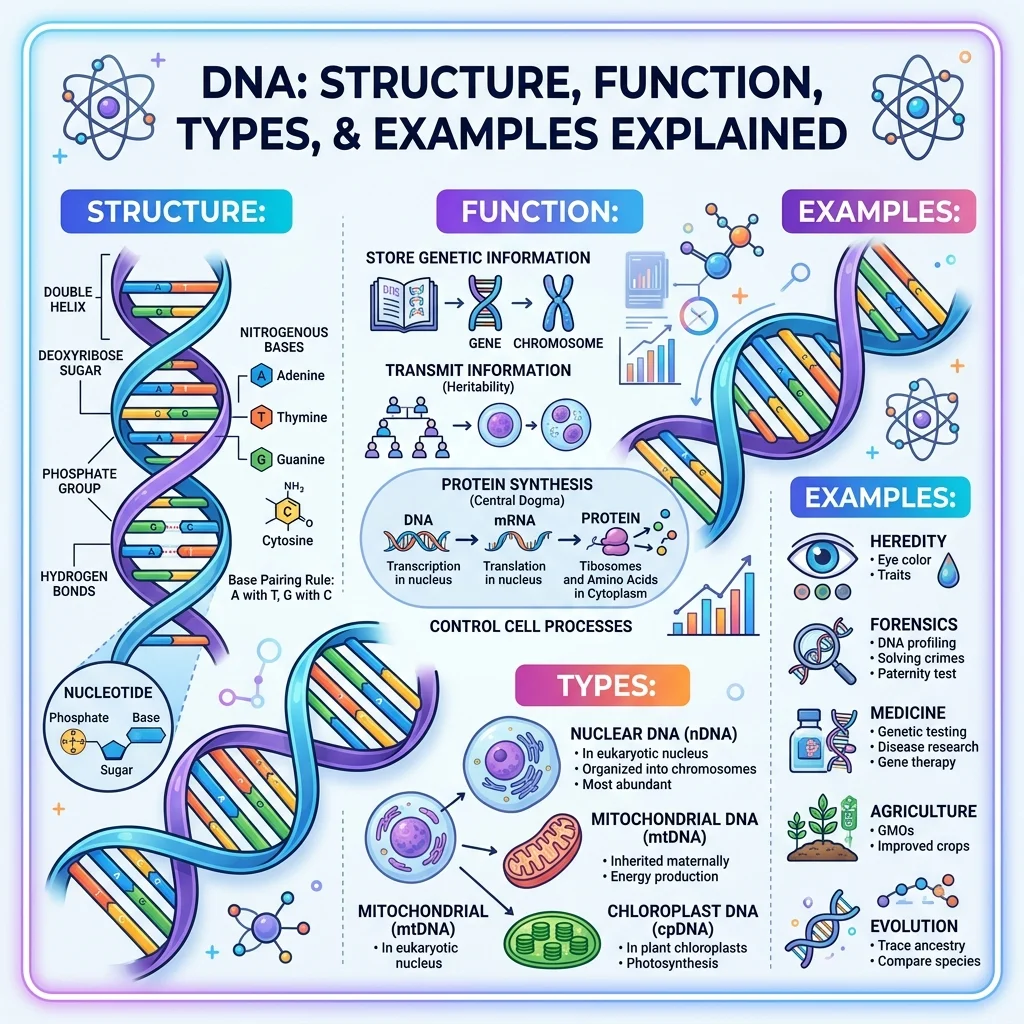
- Double helix shape: DNA looks like a twisted ladder. Scientists call this shape a double helix.
- Nucleotide building blocks: DNA contains four chemical letters called bases. These bases are adenine, thymine, cytosine, and guanine.
- Base pairing rules: Adenine always pairs with thymine. Cytosine always pairs with guanine. This pairing holds the ladder together.
- Self-replication: DNA copies itself exactly before cell division. Therefore, every new cell receives identical instructions.
- Mutation capability: Sometimes DNA changes slightly. These changes create genetic diversity.
- Universal code: All living things use DNA. Humans, trees, bacteria, and butterflies all share this molecule.
Types or Classification of DNA
Scientists classify DNA based on its shape and location.
Nuclear DNA
Nuclear DNA lives inside the nucleus of cells. It contains most of your genetic information. For example, nuclear DNA determines your eye color, height, and blood type.
Mitochondrial DNA
Mitochondrial DNA lives inside mitochondria, the power plants of cells. Mothers pass this DNA to all their children. Therefore, mitochondrial DNA helps scientists trace family lines through generations.
Chloroplast DNA
Chloroplast DNA exists only in plants. It lives inside chloroplasts, the parts of plant cells that perform photosynthesis. This DNA helps plants make food from sunlight.
Circular DNA
Circular DNA forms a ring shape instead of a straight line. Bacteria carry circular DNA. Moreover, some viruses use circular DNA too.
How Does DNA Work?
First, DNA stores genetic information in its chemical sequence. This sequence acts like a written code.
Next, enzymes read the DNA code. These enzymes copy the instructions into a messenger molecule called RNA.
Then, RNA travels to ribosomes, the protein factories of the cell.
After that, ribosomes read the RNA message and assemble amino acids into proteins.
Finally, proteins perform all the jobs in your body. They build structures, speed up reactions, and carry signals. Therefore, DNA controls every biological process through this step-by-step system.
Importance of DNA
Daily Life: DNA testing helps people learn about their ancestry. Moreover, DNA evidence solves criminal cases. Therefore, DNA touches your life in unexpected ways.
Environment: Scientists study DNA to track endangered species. They also use DNA to monitor pollution levels in ecosystems. As a result, DNA helps protect our planet.
Human Health: Doctors use DNA tests to diagnose genetic diseases. They also develop personalized medicines based on your unique DNA. Therefore, DNA saves lives every day.
Examples of DNA in Real Life
- Paternity tests: DNA proves biological relationships between parents and children.
- Forensic science: Police use DNA from hair or blood to identify criminals.
- Genetic counseling: Doctors analyze DNA to predict disease risk in families.
- Agriculture: Scientists modify plant DNA to create pest-resistant crops.
- Evolution research: DNA comparisons show how species relate to one another.
DNA, Structure, Function, Types, and Examples Explained for Different Age Groups
For Kids
Imagine a tiny recipe book inside every cell of your body. This book tells your body how to make your hair, your eyes, and your bones. DNA works just like this recipe book. Your parents give you half of their recipe books. Therefore, you look a little like both of them.
For Students
DNA contains the genetic code for all living organisms. It exists as a double helix made of nucleotides. The four bases pair specifically: A with T, and C with G. DNA replicates before cell division, ensuring genetic continuity. Moreover, DNA transcribes into RNA, which translates into proteins through ribosomes.
For Advanced Learners
DNA represents a polymer of deoxyribonucleotides linked by phosphodiester bonds. The antiparallel double helix exhibits major and minor grooves, facilitating protein binding. Epigenetic modifications, such as methylation and histone acetylation, regulate gene expression without altering the DNA sequence. Moreover, telomeres protect chromosome ends, while repetitive DNA elements influence genome stability. Advanced sequencing technologies now reveal single-nucleotide polymorphisms and structural variations that drive phenotypic diversity. Read about Cells here.
Common Misconceptions About DNA
- Misconception: DNA and genes mean the same thing.
Correction: Genes represent small segments of DNA. DNA includes genes plus regulatory regions and non-coding sequences. - Misconception: All DNA codes for proteins.
Correction: Only about 1-2% of human DNA codes for proteins. The rest plays regulatory, structural, or unknown roles. - Misconception: DNA determines everything about you.
Correction: Environment and lifestyle also shape who you become. DNA provides the blueprint, but experiences modify the final result.
Difference Between DNA and Related Concepts
| Feature | DNA | RNA |
|---|---|---|
| Sugar | Deoxyribose | Ribose |
| Bases | A, T, C, G | A, U, C, G |
| Structure | Double helix | Single strand |
| Location | Nucleus | Nucleus and cytoplasm |
| Function | Stores genetic information | Carries protein-building messages |
| Feature | DNA | Chromosomes |
|---|---|---|
| Composition | Long molecule of nucleotides | Tightly packed DNA with proteins |
| Visibility | Invisible under light microscope | Visible during cell division |
| Number | One long molecule per chromosome | 46 in human body cells |
Applications of DNA
Medicine: Doctors use DNA sequencing to diagnose rare diseases. Moreover, CRISPR technology edits DNA to cure genetic disorders. Gene therapy replaces faulty DNA with healthy copies.
Environment: Scientists use DNA barcoding to identify species in ecosystems. They also engineer bacteria with modified DNA to clean up oil spills.
Technology: DNA computing explores using DNA molecules for data storage. One gram of DNA stores about 215 petabytes of information.
Daily Life: DNA testing kits help people discover ancestry and health risks. Moreover, DNA fingerprinting secures borders and identifies disaster victims.
Interesting Facts About DNA
- If you stretched out all the DNA in your body, it would reach the sun and back about 60 times.
- Humans share about 99.9% of their DNA with every other human.
- You share about 98.7% of your DNA with chimpanzees.
- A single cell contains about two meters of DNA packed into a space smaller than a grain of salt.
- Scientists discovered the DNA double helix structure in 1953. James Watson and Francis Crick won the Nobel Prize for this discovery.
- DNA can survive for thousands of years in fossils. Scientists extracted DNA from mammoths frozen in ice. Read a related article on cell here.
FAQs
Q1: What does DNA do in simple words?
A: DNA stores instructions that tell your body how to grow, function, and repair itself.
Q2: Where does DNA live in the body?
A: DNA lives inside the nucleus of almost every cell. Mitochondria also carry small amounts of DNA.
Q3: Can DNA change during your life?
A: Yes. Mutations change DNA sequences. Moreover, lifestyle factors like smoking can damage DNA.
Q4: Do all living things have DNA?
A: Almost all living things use DNA. However, some viruses use RNA instead of DNA to store genetic information.
Q5: How do scientists read DNA?
A: Scientists use DNA sequencing machines. These machines identify the order of bases in a DNA sample.
How People Search for DNA, Structure, Function, Types, and Examples Explained
- what is DNA structure function types and examples explained
- simple explanation of DNA structure and function
- examples of DNA in real life
- types of DNA nuclear mitochondrial chloroplast
- how does DNA work step by step
- importance of DNA in human health
- DNA vs RNA difference explained
- DNA facts for kids students
- DNA applications in medicine and technology
- DNA double helix structure explained simply
Conclusion
DNA, structure, function, types, and examples explained reveals one of nature’s most elegant systems. This molecule stores the complete instructions for building every living thing on Earth. Moreover, DNA connects all life through a shared genetic language. Therefore, understanding DNA opens doors to medical breakthroughs, environmental protection, and personal discovery. As science advances, our ability to read and edit DNA grows stronger every day. The blueprint of life lies within each of us, waiting to reveal its secrets. Keep exploring, because the story of DNA continues to unfold with every new discovery. Learn more in a video on DNA here.

Hi All! I’m Imran Abbas. I’m a Ph.D (scholar) in Structural Chemistry and I work in a number of domains like Bioinformatics, Literature, politics, sports and I’m a polyglot as well. I respect all irrespective of their ethnicity, locality and color. I’m always ready to learn new ideas and travel to different parts of the world.