
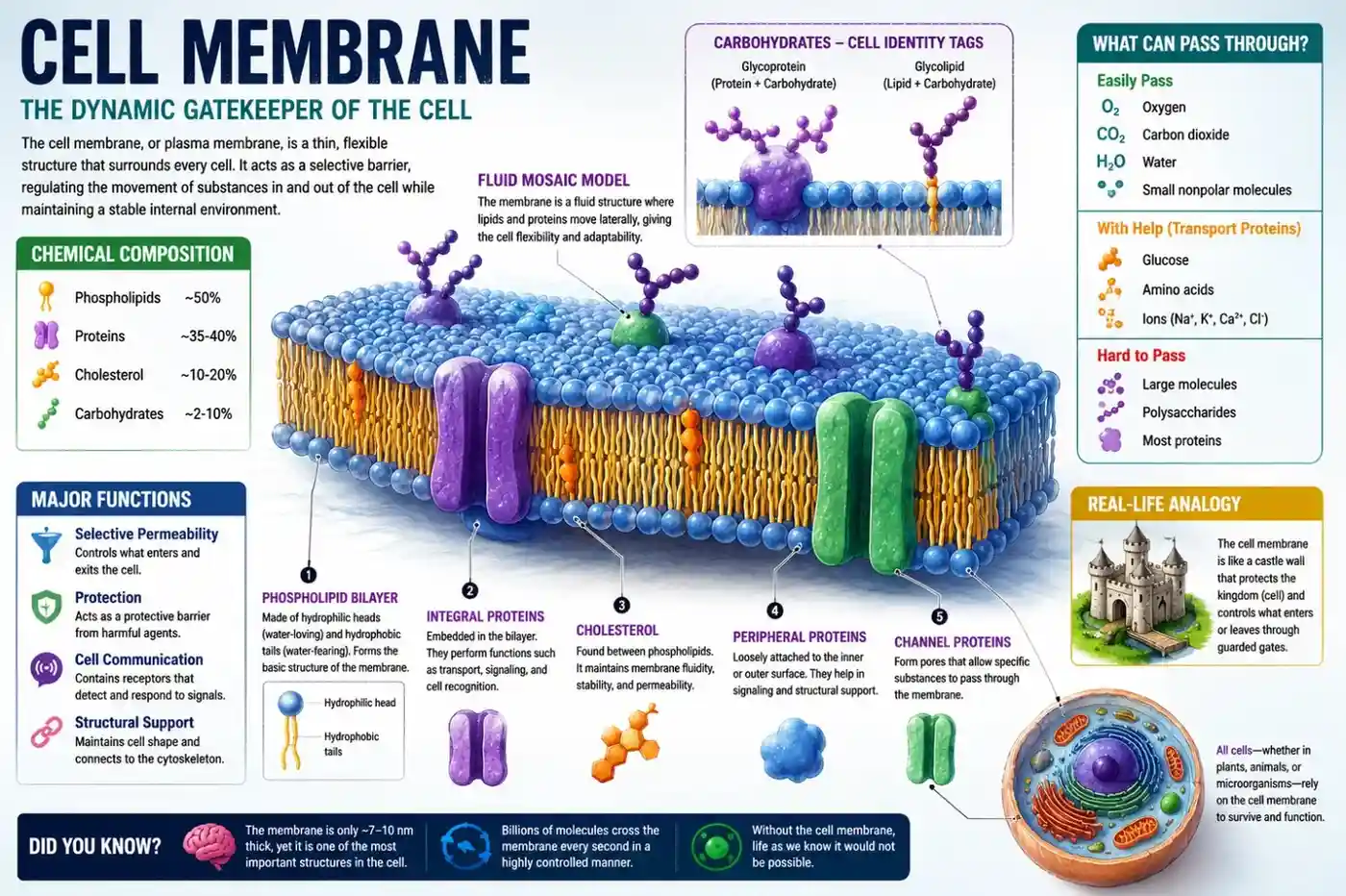
Definition: The cell membrane is a thin, flexible barrier that surrounds every living cell, controlling what enters and exits while protecting the cell’s internal chemistry.
Pronunciation: /sɛl ˈmɛmbreɪn/ (sel MEM-brayn)
Origin: The word “membrane” comes from Latin “membrana,” meaning a thin skin or layer. Swiss scientists Nageli and Cramer coined the term “cell membrane” in 1885 to describe the outer boundary of the protoplast .
Introduction
Cell membrane structure and function shape every moment of your life. Picture yourself slicing an onion in the kitchen. The moment your knife cuts through an onion cell, its membrane ruptures. Chemicals rush out. Your eyes burn. That sting is direct proof the membrane exists. It normally holds those irritants inside. Without this invisible shield, life collapses.
Every cell in your body depends on this gatekeeper. It decides what stays, what leaves, and what never gets inside. Students cramming for exams, curious minds exploring biology, and future doctors building their foundation all need to understand this structure. This guide breaks down the cell membrane completely. You will discover its chemistry, its moving parts, and the revolutionary ideas that changed how scientists see it forever.
What Is the Cell Membrane?
The cell membrane is a selectively permeable barrier that wraps around every living cell. It separates the cell’s interior from the outside world. Scientists also call it the plasma membrane or, in plant cells, the plasmalemma .
Think of it as a smart security checkpoint at a concert. The checkpoint allows ticket holders inside. It blocks intruders. It keeps performers safe. The cell membrane works the same way. Oxygen and nutrients enter. Waste products exit. Toxins stay out.
The Story Behind the Discovery
For decades, scientists got the cell membrane completely wrong.
In 1885, Nageli and Cramer named the structure, but they had no idea what it looked like . In 1935, Hugh Davson and James Danielli proposed a sandwich model. They imagined proteins as bread and lipids as filling . Early electron micrographs seemed to support this “railroad track” appearance.
The 1950s brought a shock. Advanced microscopy revealed the membrane’s core was a double layer, not a sandwich. Then in 1972, Seymour Jonathan Singer and Garth L. Nicolson changed everything. They proposed the fluid mosaic model, describing proteins floating in a sea of lipids .
Here is where the story gets exciting. Modern research has not killed the fluid mosaic model. It has upgraded it. Scientists now view the living membrane as an active membrane composite. Lipid rafts, cytoskeletal fences, and dynamic protein clusters create organized domains within the fluid sea . The membrane is not a passive blanket. It is a living, breathing surface that reshapes itself constantly.
Chemical Composition of the Cell Membrane
The cell membrane is not made of mystery. It contains three major chemical families.
Lipids make up about 40 percent of the dry weight. These include phospholipids, cholesterol, and glycolipids. In a typical animal cell membrane, phospholipids account for roughly 55 percent of lipids, cholesterol for 20 percent, and glycolipids for about 5 percent .
Proteins make up about 60 percent of the dry weight. This high proportion reflects how busy the membrane is. More active cells pack in more proteins .
Carbohydrates contribute only 1 to 10 percent. These sugars attach to proteins and lipids on the outer surface. Together they form the glycocalyx, a sugary coat that acts like a cell’s ID badge .
Structure of the Cell Membrane
The Phospholipid Bilayer
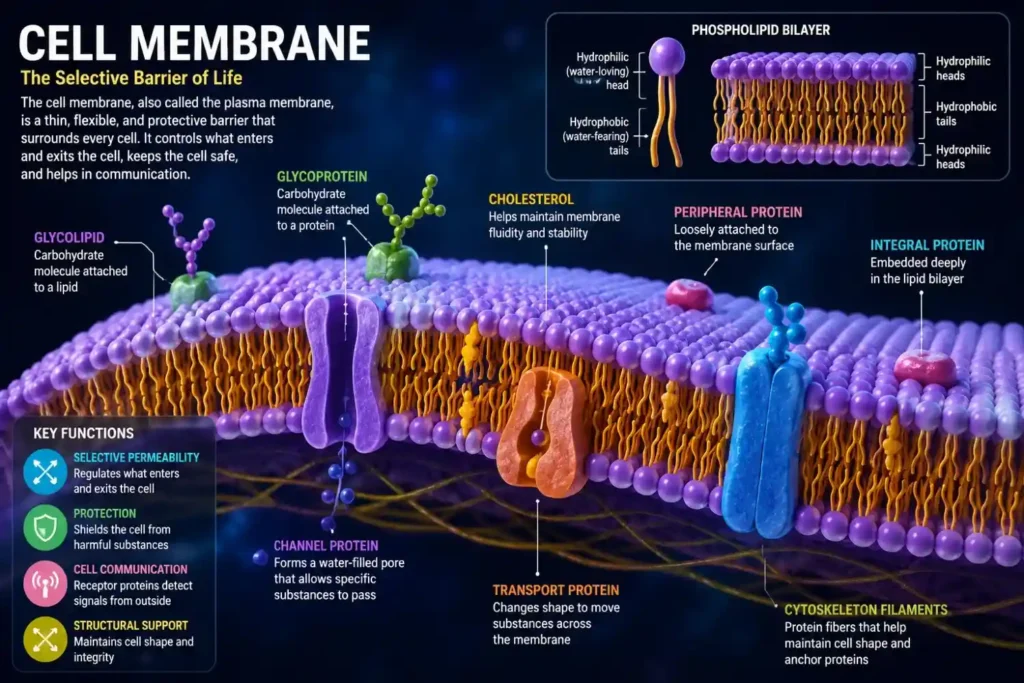
Phospholipid molecules are amphipathic. Each one has a water-loving head and two water-fearing tails. When placed in water, these molecules self-assemble into a double layer. Heads face outward toward the water. Tails hide inside, shielded from contact . This bilayer forms the fundamental framework of every biological membrane.
Cholesterol: The Temperature Buffer
Cholesterol nestles between phospholipids. At low temperatures, it prevents fatty acid tails from packing too tightly. This keeps the membrane fluid. At high temperatures, it restrains movement. This prevents the membrane from becoming too leaky . Without cholesterol, your cells would freeze or melt.
Membrane Proteins: The Workers
Proteins come in two main classes.
Integral proteins embed deeply within the bilayer. Many span the entire membrane. These transmembrane proteins form channels, carriers, and receptors .
Peripheral proteins attach loosely to the inner or outer surface. They often connect to the cytoskeleton or help anchor integral proteins .
Carbohydrates and the Glycocalyx
Sugar chains project from the outer surface. They help cells recognize each other. Your immune system reads these sugar signatures to distinguish friend from foe .
The Fluid Mosaic Model and Beyond
Singer and Nicolson described the membrane as a two-dimensional fluid where proteins drift like icebergs in a lipid sea . Fifty years later, this model remains the foundational framework . However, scientists now recognize that the membrane is more mosaic and dense than originally proposed. Specialized domains, protein-lipid complexes, and cytoskeletal interactions create a structured yet dynamic surface .
Types of Cell Membranes
Not all membranes serve the same master.
Cytoplasmic membranes surround the entire protoplasm. The plasma membrane is the most famous example .
Internal membranes wrap around organelles. The nuclear envelope, endoplasmic reticulum, and mitochondrial membranes all belong to this family .
Plant vs. Animal membranes: Plant cells surround their membrane with a rigid cell wall. Animal cells lack this wall. Their membrane must provide both flexibility and structural support.
Prokaryotic vs. Eukaryotic membranes: Every living cell has a plasma membrane. Only eukaryotes build complex internal membrane systems for organelles.
How Does the Cell Membrane Work?
The cell membrane operates like a busy port with multiple entry systems.
Small nonpolar molecules slip straight through the lipid bilayer. Oxygen and carbon dioxide cross this way.
Water and small polar molecules often need channel proteins. These tunnels allow rapid, selective passage.
Large or charged molecules require carrier proteins or pumps. Active transport uses energy to move substances against their concentration gradient. Endocytosis engulfs bulk cargo. Exocytosis ships waste and hormones outside .
Signal transduction happens when receptor proteins bind hormones or neurotransmitters. This binding triggers chemical cascades inside the cell.
Cell recognition relies on glycoproteins and glycolipids. These surface markers allow immune cells to identify invaders. They also determine blood types .
Functions of the Cell Membrane
The cell membrane performs several vital jobs:
- Barrier and protection: It keeps cellular contents in and harmful substances out .
- Selective transport: It controls the movement of nutrients, ions, and waste.
- Homeostasis: It maintains a stable internal environment.
- Cell recognition: Surface markers identify cells to the immune system.
- Signal transduction: Receptors detect external signals and initiate responses.
- Structural support: Attachment to the cytoskeleton helps cells maintain shape.
- Enzymatic activity: Some membrane proteins catalyze chemical reactions at the surface.
Cell Membrane in Real Life
Science surrounds you every second.
When you cry while chopping an onion, you witness a broken cell membrane releasing irritants. The membrane normally traps those chemicals.
When you wash your hands with soap, the soap disrupts bacterial membranes. It tears their lipid bilayers apart. The bacteria die.
When you drink a sports drink after exercise, you restore the ion balance your membranes maintain. Active transport pumps in your muscle cells work overtime during workouts.
When doctors determine your blood type, they read antigens stuck to your red blood cell membranes .
Common Misconceptions About the Cell Membrane
Myth: The cell membrane is a solid wall.
Truth: It flows like a liquid. Proteins and lipids drift laterally. The surface constantly remodels itself .
Myth: All molecules pass through freely.
Truth: The membrane is selectively permeable. It blocks most large or charged molecules unless they have the right transport pass.
Myth: Only animal cells have a cell membrane.
Truth: Every living cell on Earth has a plasma membrane. Plants, bacteria, fungi, and protists all depend on it.
Myth: The fluid mosaic model is outdated.
Truth: Researchers have added layers of complexity, including lipid domains and cytoskeletal interactions. The core model remains valid and essential . Read about Viruses here.
Cell Membrane vs. Cell Wall
| Feature | Cell Membrane | Cell Wall |
|---|---|---|
| Found in | All living cells | Plants, fungi, bacteria |
| Composition | Lipids, proteins, carbohydrates | Cellulose, chitin, or peptidoglycan |
| Flexibility | Flexible and fluid | Rigid and tough |
| Permeability | Selectively permeable | Fully permeable |
| Metabolic role | Active transport and signaling | Structural support only |
Fascinating Facts About the Cell Membrane
- A single cell membrane measures only 5 to 10 nanometers thick. That is roughly 1,000 times thinner than a human red blood cell is wide .
- The fluid mosaic model has dominated biology education for over fifty years and continues to evolve .
- Phospholipids placed in water spontaneously form bilayers without help. Their chemistry drives this automatic organization .
- Cholesterol makes up about 20 percent of the lipid content in animal cell membranes .
- Your red blood cell membrane contains more than 50 different types of proteins. Read an article on Cells and there types here.
Frequently Asked Questions
What is the cell membrane in simple words?
It is a thin, flexible barrier around every cell that controls what enters and exits.
What is the cell membrane made of?
Mostly lipids and proteins, with small amounts of carbohydrates. Phospholipids form the basic bilayer. Cholesterol stabilizes it. Proteins handle transport and signaling .
Do plant cells have a cell membrane?
Yes. Plant cells have a cell membrane just inside their rigid cell wall .
Why is it called a fluid mosaic?
Because the membrane behaves like a fluid. Proteins and lipids move within it like tiles in a shifting mosaic .
What happens if the cell membrane breaks?
The cell loses control over its internal environment. Contents leak out. Toxins rush in. The cell dies.
How People Search for Cell Membrane
- What is cell membrane
- Cell membrane structure and function
- Cell membrane chemical composition
- Fluid mosaic model explained simply
- Cell membrane vs cell wall
- How does the cell membrane work
- Types of cell membranes
- Cell membrane diagram for students
- Selective permeability meaning
- Cell membrane function in plant cells
Conclusion
The cell membrane is far more than a simple bag. It is a dynamic, intelligent barrier that separates life from chaos. From the self-assembling phospholipid bilayer to the protein channels that guard every entrance, this structure defines what it means to be a cell.
Understanding the cell membrane helps you grasp biology, medicine, and everyday experiences. It explains why soap cleans, why onions burn your eyes, and why your body craves electrolytes after exercise.
Keep exploring. Draw the bilayer. Teach a friend. The more you study this invisible shield, the more you appreciate the elegant chemistry that keeps you alive. See a video here.

Hi All! I’m Imran Abbas. I’m a Ph.D (scholar) in Structural Chemistry and I work in a number of domains like Bioinformatics, Literature, politics, sports and I’m a polyglot as well. I respect all irrespective of their ethnicity, locality and color. I’m always ready to learn new ideas and travel to different parts of the world.