
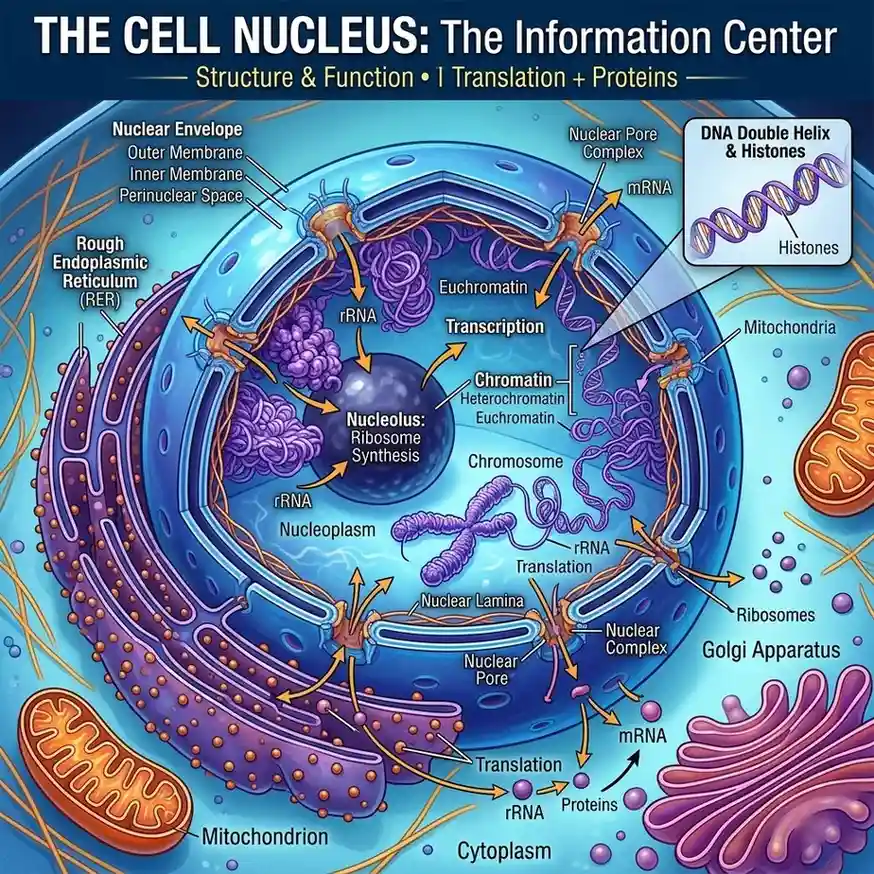
Definition: The nucleus is a membrane-bound organelle found in eukaryotic cells that stores genetic material, controls gene expression, and directs cell growth and reproduction.
Pronunciation: /ˈnjuːkliəs/ (NEW-klee-us)
Origin: The word comes from Latin “nucleus,” meaning kernel or inner part. Robert Brown first used this term in 1831 when he observed a dense spot inside plant cells.
Introduction
Imagine a fortress that guards the most precious blueprint in the universe. Inside this fortress, guards check every visitor at smart gates that reshape themselves in real time. Engineers assemble machinery for building proteins. Archivists organize billions of instruction manuals. This fortress is not science fiction. It lives inside almost every cell in your body right now.
The cell nucleus controls everything that makes you who you are. Your eye color, your height, your ability to heal a cut — all of it starts here. Recent discoveries from Rockefeller University reveal that the nuclear pore complex, the gatekeeper of the nucleus, operates as a dynamic, self-regulating machine that continually remodels itself to control traffic . This organelle is far more active and intelligent than old textbooks suggested.
Understanding the nucleus helps you grasp genetics, disease, and life itself. Whether you are a student preparing for exams, a curious reader, or a future scientist, this guide gives you everything you need. Let us open the gates and explore.
What Is the Nucleus?
The nucleus is a specialized structure that occurs in most cells except bacteria and blue-green algae . It is separated from the rest of the cell by a double membrane called the nuclear envelope. The primary job of the nucleus is to store and protect the cell’s genetic material, or DNA, and to regulate gene expression .
In most eukaryotic cells, only one nucleus exists. However, some cells break this rule. Red blood cells contain no nucleus at all. Muscle fibers and slime molds contain multiple nuclei . The nucleus usually sits near the center of the cell. It accounts for about ten percent of the cell’s total volume .
Think of the nucleus as the command center of a vast city. It holds the master plans, issues orders. It controls when the city grows, repairs itself, or divides into two new cities.
The Story of Discovery
Robert Brown, a Scottish botanist, first described the nucleus in 1831. He observed orchid cells under a microscope and noticed a dense, round structure in each one. He called it the “nucleus,” meaning little nut or kernel.
For nearly two centuries, scientists viewed the nucleus as a passive container. They imagined it as a bag that simply held DNA. Modern research has shattered this view. In 2025, scientists at Rockefeller University used high-speed atomic force microscopy to watch nuclear pore complexes in action. They discovered that these gates fluctuate continuously and reshape themselves in real time . The nucleus is not a static vault. It is a living, breathing command center.
Structure of the Nucleus
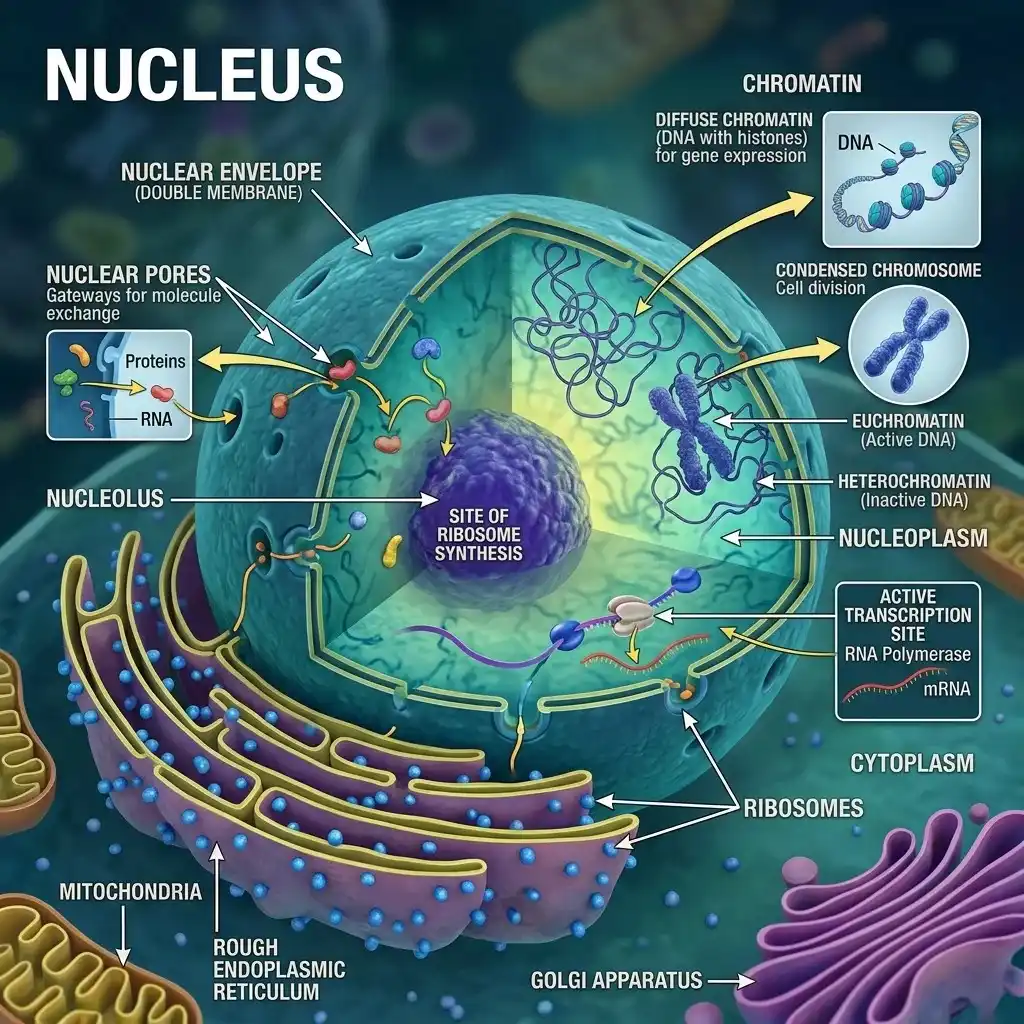
The nucleus contains several distinct parts. Each part performs a specific job. Understanding these parts helps you understand how life works.
Nuclear Envelope
The nuclear envelope is a double membrane that completely surrounds the nucleus . The outer membrane connects directly to the endoplasmic reticulum, a network of membranes inside the cell . The inner membrane faces the nucleoplasm.
Between these two membranes lies a fluid-filled space called the perinuclear space. The envelope maintains the shape of the nucleus. It also separates genetic material from the cytoplasm, creating a protected workspace for DNA .
Nuclear Pore Complexes
The nuclear envelope is not a solid wall. It contains thousands of tiny openings called nuclear pores. Each pore is actually a massive machine called the nuclear pore complex, or NPC .
These pores regulate what enters and exits the nucleus. Large proteins and RNA molecules cannot pass freely. Transport factors must escort them through . Recent research reveals that the NPC’s central barrier is extraordinarily dynamic. Flexible protein threads inside the pore constantly move and reorganize. Transport factors slide between these threads to carry cargo . This discovery overturned older models that imagined the pore as a rigid mechanical gate or a static gel filter .
The NPC acts as a virtual gatekeeper. It protects DNA from harmful molecules while allowing essential materials to pass. Defects in nuclear pore complexes link to cancer, viral infections, and neurodegeneration .
Nucleoplasm
Inside the nuclear envelope lies the nucleoplasm. This gel-like substance is similar to cytoplasm but distinct in composition . It consists mainly of water, dissolved salts, enzymes, and organic molecules.
The nucleoplasm cushions and protects chromosomes and the nucleolus. It also serves as a transport medium. Enzymes and nucleotides move through this fluid to reach their targets .
Chromatin
Chromatin is the complex of DNA and proteins that fills the nucleus . DNA wraps around proteins called histones. Eight histone proteins together with a segment of DNA form a unit called a nucleosome . This wrapping compacts DNA so it can fit inside the tiny nucleus.
Chromatin exists in two main forms. Euchromatin is the active, loosely packed form. Genes in euchromatin can be read and used by the cell . Heterochromatin is the inactive, densely packed form. It sits near the nuclear membrane and remains silent .
When a cell prepares to divide, chromatin condenses further into visible chromosomes. This packaging protects DNA during the splitting process.
Nucleolus
The nucleolus is a dense, membrane-less structure inside the nucleus . It is the factory where ribosomes are born. The nucleolus synthesizes ribosomal RNA, or rRNA. It assembles rRNA with proteins to create ribosome subunits .
Cells can contain up to four nucleoli. During cell division, the nucleolus disappears. It reforms after the new nuclei establish themselves . Recent research also suggests the nucleolus acts as a stress sensor. When cells face danger, the nucleolus triggers protective responses.
Nuclear Lamina
The nuclear lamina is a protein mesh that lines the inner surface of the nuclear envelope . It provides mechanical support for the nucleus, helps maintain nuclear shape. It also anchors chromatin and influences gene activity.
The lamina consists of proteins called lamins. Mutations in lamin genes cause rare diseases called laminopathies. These diseases affect muscles, nerves, and aging processes.
Chemical Composition of the Nucleus
The nucleus is not made of mystery. It contains specific chemicals that work together.
DNA: Deoxyribonucleic acid carries the genetic code. It forms the foundation of chromatin. Human cells contain about two meters of DNA inside a nucleus only five to ten micrometers wide .
RNA: Ribonucleic acid exists in several forms inside the nucleus. Ribosomal RNA is made in the nucleolus. Messenger RNA is transcribed from DNA. Small nuclear RNAs help process other RNA molecules.
Proteins: Histones wrap and compact DNA. Non-histone proteins regulate gene expression. Nucleoporins build the nuclear pore complexes. Lamins form the nuclear lamina. Enzymes such as DNA polymerase and RNA polymerase drive replication and transcription .
Lipids: The nuclear envelope consists of phospholipids arranged in a bilayer, similar to the cell membrane .
Ions and Small Molecules: The nucleoplasm contains water, salts, nucleotides, and signaling molecules. These substances support chemical reactions and transport .
Types of Nucleus
Not all nuclei look or behave the same way. Scientists recognize several types based on cell state and function.
Interphase Nucleus
Most cells spend their lives in interphase, the period between divisions. During this time, the nucleus appears round or oval. It contains a visible nucleolus. Chromatin remains spread out and loosely packed. This arrangement allows genes to remain active .
Dividing Nucleus
When a cell prepares to divide, the nucleus transforms dramatically. The nuclear envelope breaks down. The nucleolus vanishes. Chromatin condenses into thick, visible chromosomes. This breakdown allows spindle fibers to grab and separate chromosomes. After division, new nuclear envelopes form around each set of chromosomes .
Multinucleated Cells
Some cells contain two or more nuclei. Muscle fibers fuse together during development and contain many nuclei. Osteoclasts, the cells that break down bone, also contain multiple nuclei. Slime molds are famous for having many nuclei inside a single giant cell . These extra nuclei allow the cell to produce more proteins and manage larger territories.
Anucleate Cells
Some mature cells eject their nuclei completely. Red blood cells lose their nuclei during development. This sacrifice allows them to carry more oxygen. However, without a nucleus, they cannot divide or repair themselves. Platelets also lack nuclei. Their short lifespans reflect this absence .
Prokaryotic Nucleoid
Bacteria and archaea lack a true nucleus. Instead, they contain a nucleoid region. This area holds a single circular chromosome. It has no membrane. It has no nucleolus. The nucleoid is simply a concentrated zone of DNA floating in the cytoplasm .
How Does the Nucleus Work?
The nucleus performs its duties through a precise sequence of events.
First, DNA stores every instruction the cell needs. These instructions are organized into genes along the chromatin.
Next, when the cell needs a specific protein, the nucleus transcribes the relevant gene. Enzymes create a messenger RNA copy of the gene. This process happens in the nucleoplasm.
Then, the new messenger RNA undergoes processing. The nucleus edits and caps the RNA molecule. This step ensures the message will work properly in the cytoplasm .
After that, transport factors escort the mature mRNA through nuclear pore complexes. The dynamic protein threads inside the pore recognize the transport factors and allow passage .
Finally, ribosomes in the cytoplasm read the mRNA and build the protein. Meanwhile, the nucleolus continuously manufactures new ribosome parts to replace worn-out machinery.
When the cell needs to divide, the nucleus duplicates its DNA. It then packages the DNA into chromosomes. The nuclear envelope dissolves. Spindle fibers pull identical chromosome sets to opposite poles. New nuclei form. The cycle continues.
Functions of the Nucleus
The nucleus performs many vital jobs:
- Stores Hereditary Information: DNA holds the complete set of instructions for building and running the organism .
- Controls Gene Expression: The nucleus decides which genes turn on and off. This control directs cell specialization, metabolism, and response to signals .
- Produces Messenger RNA: Transcription creates mRNA copies of active genes. These copies travel to the cytoplasm for protein synthesis .
- Manufactures Ribosomes: The nucleolus builds ribosomal subunits. These subunits assemble into ribosomes, the protein factories of the cell .
- Regulates Cell Division: The nucleus controls when and how a cell divides. It replicates DNA and ensures each daughter cell receives a complete genome .
- Maintains Genetic Integrity: The nuclear envelope protects DNA from damaging chemicals and enzymes in the cytoplasm .
- Selective Transport: Nuclear pore complexes control the flow of molecules. They allow necessary materials in and keep threats out .
Why the Nucleus Matters in Real Life
Daily Life
Every time you grow taller, heal a cut, or grow new skin, your nucleus directs the process. It tells cells when to multiply and when to stop. It stores the recipe for your hair color, your blood type, and your metabolism.
Human Health
When the nucleus malfunctions, disease follows. Cancer begins when mutations damage DNA inside the nucleus. Laminopathies cause premature aging and muscle wasting. Viruses such as HIV must pass through nuclear pores to infect cells . Understanding nuclear biology helps doctors design better treatments.
Environment
Genetic diversity stored in nuclei allows species to adapt. Crop breeders study plant nuclei to develop stronger, more productive varieties. Conservation biologists analyze nuclear DNA to protect endangered species.
Nucleus in Plant Cells vs Animal Cells
| Feature | Plant Cell Nucleus | Animal Cell Nucleus |
|---|---|---|
| Location | Usually pushed to the side by the large central vacuole | Usually centered in the cell |
| Shape | Often spherical or oval | Typically spherical |
| Number | Usually one per cell | Usually one per cell |
| Nuclear Envelope | Present; connected to endoplasmic reticulum | Present; connected to endoplasmic reticulum |
| Nucleolus | Present; prominent during interphase | Present; prominent during interphase |
| Nuclear Lamina | Less studied but present | Well-studied; mutations cause laminopathies |
| Chromatin Organization | Similar euchromatin and heterochromatin | Similar euchromatin and heterochromatin |
Both plant and animal nuclei perform the same fundamental jobs. They store DNA, control gene expression, and produce ribosomes.
Common Misconceptions About the Nucleus
Misconception 1: All cells have a nucleus.
Truth: Red blood cells and platelets lack nuclei. Bacteria lack true nuclei entirely .
Misconception 2: The nucleus is simply the brain of the cell.
Truth: The nucleus is more like a library and factory combined. It stores information and manufactures tools. It does not “think” like a brain.
Misconception 3: Nuclear pores are just holes in the membrane.
Truth: Nuclear pores are massive, dynamic machines made of hundreds of proteins. They actively select what passes through .
Misconception 4: DNA floats freely inside the nucleus.
Truth: DNA wraps tightly around histone proteins. It organizes into chromatin and chromosomes. This packaging is highly structured .
Misconception 5: The nucleolus is just a blob with no real function.
Truth: The nucleolus is a ribosome factory. It is one of the most important structures inside the nucleus .
Nucleus vs Nucleoid
| Feature | Nucleus (Eukaryotes) | Nucleoid (Prokaryotes) |
|---|---|---|
| Membrane | Double membrane called nuclear envelope | No membrane |
| Shape | Round or oval | Irregular region |
| DNA Type | Linear chromosomes | Single circular chromosome |
| Histone Proteins | Present; DNA wraps around histones | Absent in most bacteria |
| Nucleolus | Present | Absent |
| Nuclear Pores | Present | Absent |
| Size | Large; visible under light microscope | Small; visible only under electron microscope |
| Examples | Human cells, plant cells, fungi, protists | Bacteria, archaea |
Fascinating Facts About the Nucleus
- Your DNA would stretch to the sun and back. If you uncoiled all the DNA in your body, it would extend about 100 trillion meters. The nucleus packs this length into a space smaller than a grain of sand .
- Nuclear pores are gatekeeping machines. Each pore contains about 500 to 1,000 individual protein molecules. These proteins form a ring with eightfold symmetry .
- The nucleolus is a stress sensor. When cells face heat, toxins, or starvation, the nucleolus triggers protective responses. It is not just a factory. It is an alarm system.
- Nuclear pores can constrict and dilate. Recent research shows that the pore diameter changes between 40 and 60 nanometers depending on cellular stress and cargo size .
- Removing one protein can break neural development. Scientists discovered that mouse cells lacking Nup133 develop abnormal nuclear pores. This defect disrupts neuron formation .
- The nuclear envelope connects to your skeleton. Mechanical forces from outside the cell travel through the cytoskeleton to the nucleus. These forces can actually change gene expression by affecting transport through nuclear pores .
Frequently Asked Questions
Q1: What is the nucleus in simple words?
The nucleus is a control center inside eukaryotic cells. It stores DNA, controls gene activity, and makes ribosomes.
Q2: Do all living cells have a nucleus?
No. Prokaryotic cells like bacteria have a nucleoid instead. Some eukaryotic cells, like mature red blood cells, lose their nuclei entirely .
Q3: What is the nucleolus and why does it disappear during division?
The nucleolus makes ribosomes. During cell division, the cell breaks down most internal structures to focus on separating chromosomes. The nucleolus reforms afterward .
Q4: How do molecules enter and exit the nucleus?
They pass through nuclear pore complexes. Small molecules diffuse freely. Large molecules need transport factors to escort them through the dynamic protein barrier .
Q5: Can diseases damage the nucleus?
Yes. Cancer damages DNA inside the nucleus. Laminopathies weaken the nuclear lamina. Viruses hijack nuclear pores to enter and infect cells .
Conclusion
The nucleus is far more than a storage closet for DNA. It is a dynamic command center with self-regulating gates, a ribosome factory, and a protective fortress. From the nuclear envelope that shields your genes to the nuclear pore complexes that reshape themselves in real time, every part works with precision .
Understanding the nucleus helps you understand life itself. It explains why you look like your parents and how your body heals. It points the way toward cures for cancer and genetic diseases.
Keep exploring. Keep asking questions. The more you learn about the nucleus, the more you appreciate the invisible architecture that builds every living thing. Start by reviewing what you learned today. Draw the structure. Teach a friend. Your journey into cell biology has only just begun. Watch a video here.

Hi All! I’m Imran Abbas. I’m a Ph.D (scholar) in Structural Chemistry and I work in a number of domains like Bioinformatics, Literature, politics, sports and I’m a polyglot as well. I respect all irrespective of their ethnicity, locality and color. I’m always ready to learn new ideas and travel to different parts of the world.