
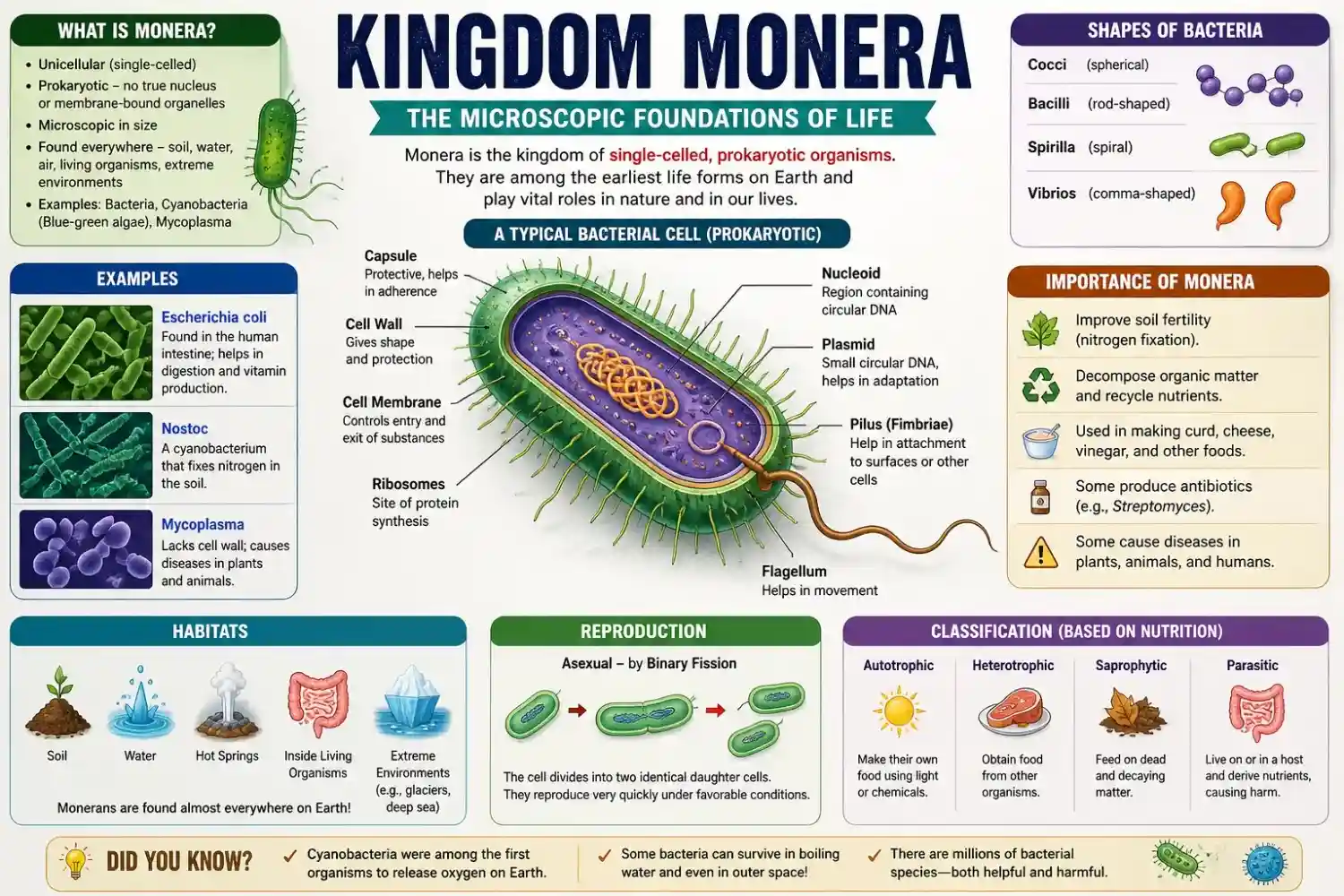
Definition: Kingdom Monera includes all single-celled organisms that lack a true nucleus and membrane-bound organelles. These organisms represent the most basic form of life.
Pronunciation: muh-NEER-uh
Origin: The word “Monera” comes from the Greek word “moneres,” which means “single” or “solitary.” Scientists chose this name because these organisms live as single cells.
Introduction
Have you ever wondered what the smallest living things look like? Moreover, did you know that some tiny organisms live almost everywhere on Earth? Kingdom Monera includes these microscopic life forms. They thrive in soil, water, air, and even inside your body. Therefore, understanding Kingdom Monera matters for everyone. These simple organisms help plants grow, clean the environment, and even keep you healthy. In this article, you will learn everything about Kingdom Monera in simple, clear words. Let us explore this fascinating world together.
What is Kingdom Monera?
Kingdom Monera includes all prokaryotic organisms. Prokaryotic means these organisms lack a true nucleus. Their genetic material floats freely inside the cell. Moreover, they do not have membrane-bound organelles like mitochondria or chloroplasts.
For example, bacteria and cyanobacteria belong to Kingdom Monera. These organisms represent the simplest and oldest forms of life on Earth.
Classification of Kingdom Monera by Shape
Scientists classify Monera based on their cell shape. This system helps everyone identify different types quickly.
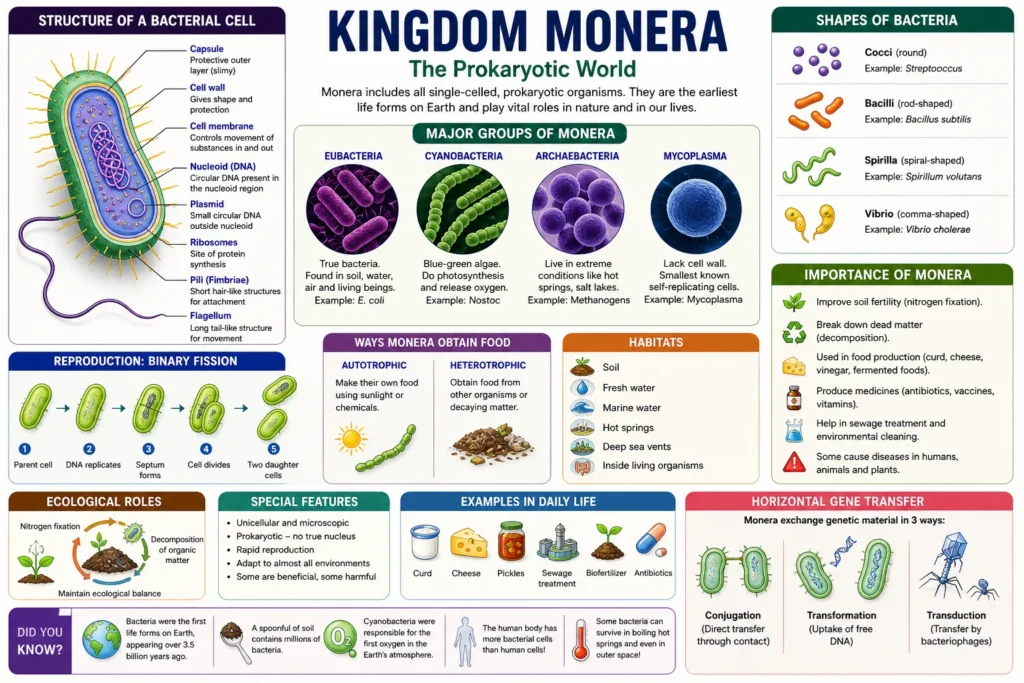
- Coccus (plural: cocci): These organisms look like tiny balls or spheres. For example, Streptococcus causes strep throat.
- Bacillus (plural: bacilli): These organisms look like rods or sticks. For example, Bacillus subtilis lives in soil.
- Spirillum (plural: spirilla): These organisms look like spirals or corkscrews. For example, Spirillum volutans lives in water.
- Vibrio: These organisms look like curved rods or commas. For example, Vibrio cholerae causes cholera.
Classification of Kingdom Monera by Mode of Nutrition
Monera organisms obtain food in different ways. Therefore, scientists group them based on how they eat.
- Autotrophic Monera: These organisms make their own food. They use sunlight or chemicals to produce energy. For example, cyanobacteria perform photosynthesis like plants.
- Heterotrophic Monera: These organisms cannot make their own food. They absorb nutrients from other organisms or decaying matter. For example, E. coli absorbs nutrients from the intestines of animals.
Classification of Kingdom Monera by Presence and Absence of Flagella
Some Monera organisms move, while others stay still. Scientists classify them based on the presence of flagella.
- Monera with Flagella: These organisms have whip-like tails called flagella. The flagella help them swim through liquid. For example, Salmonella uses flagella to move.
- Monera without Flagella: These organisms lack flagella. They cannot move on their own. For example, Staphylococcus remains fixed in one place.
Classification of Kingdom Monera by Type of Cell
All Monera organisms share one common feature. They all have prokaryotic cells.
- Prokaryotic Cells: These cells lack a nucleus. The DNA floats freely in the cytoplasm. Moreover, these cells lack membrane-bound organelles. All Monera organisms have this simple cell type.
Classification of Kingdom Monera by Mode of Attack
Some Monera organisms cause harm, while others help. Scientists classify them based on how they interact with hosts.
- Pathogenic Monera: These organisms attack living hosts and cause disease. For example, Mycobacterium tuberculosis causes tuberculosis.
- Non-pathogenic Monera: These organisms do not cause disease. In fact, many help their hosts. For example, Lactobacillus helps digest food in your gut.
Simple Explanation of Kingdom Monera
Imagine a tiny, single-room house. This house has no separate rooms like a kitchen or bedroom. Everything happens in one open space. Kingdom Monera works exactly like this house.
First, Monera organisms consist of just one cell. Second, this cell has no nucleus. The genetic material floats freely inside. Third, the cell has no complex parts. It only contains basic structures like a cell wall, cell membrane, and ribosomes. Finally, despite this simplicity, Monera organisms perform all life functions. They eat, grow, reproduce, and respond to their environment. Therefore, Monera proves that life does not need complexity to survive.
Key Features / Characteristics of Kingdom Monera
- Single-celled structure: Each organism contains only one cell.
- No true nucleus: The DNA floats freely in the cytoplasm.
- No membrane-bound organelles: Monera lack mitochondria, chloroplasts, and other complex parts.
- Cell wall presence: Most Monera have a rigid cell wall for protection.
- Small size: Monera measure only a few micrometers in length.
- Rapid reproduction: Monera reproduce quickly through binary fission.
- Extreme adaptability: Monera survive in hot springs, deep oceans, and frozen ice.
Types or Classification of Kingdom Monera
Bacteria
Bacteria represent the most common type of Monera. They live everywhere on Earth. Some bacteria cause disease, while others help humans. For example, Rhizobium bacteria help plants absorb nitrogen from the soil.
Cyanobacteria
Cyanobacteria perform photosynthesis. They use sunlight to make food. Moreover, they release oxygen into the air. Therefore, scientists call them “blue-green algae.” For example, Nostoc lives in water and moist soil.
Archaebacteria
Archaebacteria live in extreme environments. They thrive in hot springs, salty lakes, and deep-sea vents. For example, Methanogens live in the stomachs of cows and help break down food.
Eubacteria
Eubacteria represent the “true bacteria.” They live in normal environments like soil, water, and the human body. For example, E. coli lives in human intestines and aids digestion.
Additional Structural Components of Monera Cells
Although you mentioned basic structures, the article does not fully explain detailed cell architecture. This section is essential for scientific completeness.
- Capsule (Glycocalyx):
Some bacteria possess an outer protective layer. This capsule helps in adhesion and protects against host immune responses. - Pili (Fimbriae):
These are short hair-like structures. They help bacteria attach to surfaces and exchange genetic material. - Plasmids:
Small circular DNA molecules exist outside the main chromosome. They carry genes for antibiotic resistance and adaptation. - Flagella Arrangement Types:
- Monotrichous (single flagellum)
- Lophotrichous (tuft at one end)
- Amphitrichous (both ends)
- Peritrichous (all over the surface)
Advanced Classification Based on Cell Wall Composition
Your article misses Gram staining classification, which is fundamental in microbiology.
- Gram-positive bacteria:
- Thick peptidoglycan layer
- Retain crystal violet stain
- Example: Staphylococcus
- Gram-negative bacteria:
- Thin peptidoglycan layer
- Possess outer membrane
- Do not retain primary stain
- Example: E. coli
This classification directly relates to antibiotic effectiveness and pathogenicity.
Modes of Reproduction Beyond Binary Fission
Binary fission is explained well. However, genetic variation mechanisms are missing.
- Conjugation:
Transfer of DNA through direct cell-to-cell contact - Transformation:
Uptake of free DNA from the environment - Transduction:
DNA transfer mediated by bacteriophages
These processes explain rapid evolution and antibiotic resistance.
Metabolic Diversity and Energy Pathways
The article introduces nutrition types but lacks biochemical depth.
- Photoautotrophs: Use light energy (cyanobacteria)
- Chemoautotrophs: Use inorganic chemicals (nitrifying bacteria)
- Photoheterotrophs: Use light but depend on organic carbon
- Chemoheterotrophs: Depend entirely on organic compounds
Also include:
- Aerobic respiration (requires oxygen)
- Anaerobic respiration (occurs without oxygen)
- Facultative anaerobes (adapt to both conditions)
Growth Curve of Bacteria
A key microbiological concept missing from your article.
- Lag Phase: Cells prepare for division
- Log Phase: Rapid exponential growth
- Stationary Phase: Growth equals death rate
- Death Phase: Decline in population
This concept is crucial in medicine, food microbiology, and research.
Role in Biogeochemical Cycles
You mentioned importance, but not system-level ecological cycles.
- Nitrogen Cycle: Nitrogen fixation, nitrification, denitrification
- Carbon Cycle: Decomposition and CO₂ release
- Sulfur Cycle: Sulfur oxidation and reduction
These processes maintain global ecosystem balance.
Antibiotic Resistance and Public Health Concern
This is a major modern scientific gap in the article.
- Overuse of antibiotics leads to resistant strains
- Resistant bacteria evolve through plasmids and gene transfer
- Example: MRSA (Methicillin-resistant Staphylococcus aureus)
This section connects Monera to real-world medical challenges.
Symbiotic Relationships
The article briefly mentions benefits but lacks classification of interactions.
- Mutualism: Both organisms benefit (Rhizobium + plants)
- Commensalism: One benefits, other unaffected
- Parasitism: One benefits, host is harmed
This strengthens understanding of ecological interactions.
Industrial and Biotechnological Applications (Advanced Level)
You included applications, but deeper scientific uses are missing.
- Recombinant DNA technology: Gene cloning using bacteria
- CRISPR-Cas systems: Gene editing tools derived from bacteria
- Bioreactors: Large-scale microbial production systems
- Biofertilizers: Sustainable agriculture solutions
Evolutionary Significance and Origin of Life
A crucial conceptual gap for advanced learners.
- Monera represent the earliest life forms (~3.5 billion years ago)
- Likely evolved in anaerobic environments
- Gave rise to eukaryotic cells through endosymbiotic theory
This connects Monera to the origin of complex life.
Visual Learning Elements
- Labeled diagram of bacterial cell
- Infographic of classification
- Flowchart of reproduction
- Table of differences (Gram + vs Gram -)
First, Monera organisms absorb nutrients from their surroundings. Autotrophic Monera make food using sunlight or chemicals. Heterotrophic Monera absorb food from other sources.
Next, Monera process these nutrients to produce energy. They use this energy to grow and repair their cells.
Then, Monera reproduce through binary fission. The cell copies its DNA and splits into two identical cells. This process happens very quickly. Some Monera double their numbers every 20 minutes.
Finally, Monera respond to changes in their environment. They move toward food, away from danger, or adapt to new conditions. Therefore, Monera maintain life through these simple but effective steps.
Importance of Kingdom Monera
Daily Life
Monera help produce yogurt, cheese, and pickles. Bacteria ferment milk and vegetables to create these foods. Therefore, Monera play a vital role in your kitchen.
Environment
Monera break down dead plants and animals. This process recycles nutrients back into the soil. Moreover, cyanobacteria add oxygen to the air. As a result, Monera keep ecosystems healthy.
Human Health
Good bacteria in your gut help digest food and fight bad germs. Moreover, scientists use bacteria to create antibiotics and vaccines. Therefore, Monera protect and improve human health every day.
Examples of Kingdom Monera in Real Life
- E. coli: Lives in human intestines and helps digest food.
- Lactobacillus: Turns milk into yogurt and cheese.
- Rhizobium: Helps plants grow by fixing nitrogen in soil.
- Streptococcus: Causes strep throat in humans.
- Cyanobacteria: Grows in ponds and produces oxygen.
Kingdom Monera for Different Age Groups
A First Glimpse into the Microscopic World (For Kids)
- Tiny living things exist all around you, even though you cannot see them without a microscope .
- These organisms belong to Kingdom Monera, one of the simplest forms of life.
- They appear in different shapes, such as:
- ⚪ Cocci (round like balls)
- 🟩 Bacilli (rod-shaped)
- 🌀 Spirilla (spiral-shaped)
- Moreover, many of them help in everyday life:
- They turn milk into tasty foods like yogurt 🥛
- They help plants grow by improving soil nutrients 🌱
- In addition, they live almost everywhere: soil, water, air, and even inside your body.
- Therefore, although they are tiny, they quietly keep nature balanced and active.
Foundational Biological Perspective (For Students)
- Kingdom Monera includes all prokaryotic organisms, meaning:
- They lack a true nucleus
- They do not contain membrane-bound organelles such as mitochondria or Golgi apparatus
- Structurally, these organisms consist of:
- A cell membrane
- A cell wall (often made of peptidoglycan in bacteria)
- A nucleoid region containing circular DNA
- Major groups within Monera include:
- Eubacteria (true bacteria)
- Cyanobacteria (photosynthetic, oxygen-producing)
- Archaebacteria (extremophiles living in harsh conditions)
- Furthermore, reproduction primarily occurs through:
- Binary fission (asexual, rapid cell division)
- Functionally, Monera play essential ecological roles:
- 🌿 Nitrogen fixation (conversion of atmospheric nitrogen into usable forms)
- ♻️ Decomposition (breaking down organic matter)
- 🧀 Food production (fermentation processes)
- However, some members can also act as pathogens, causing diseases in plants, animals, and humans.
Advanced Microbiological Insights (For Higher Learning)
- Kingdom Monera represents organisms within the broader framework of prokaryotic life, now classified under domains Bacteria and Archaea.
- These organisms exhibit extensive metabolic diversity, allowing survival in varied environments:
- 🌞 Photoautotrophs perform oxygenic photosynthesis (e.g., cyanobacteria)
- ⚗️ Chemoautotrophs derive energy from inorganic compounds (e.g., sulfur-oxidizing bacteria)
- 🌑 Anaerobes thrive in oxygen-deficient environments
- Genetically, Monerans possess:
- Circular chromosomes
- Additional genetic elements such as plasmids
- Importantly, horizontal gene transfer (HGT) accelerates evolution through:
- Transformation (uptake of free DNA)
- Transduction (virus-mediated transfer)
- Conjugation (direct cell-to-cell transfer)
- As a result, Monera adapt rapidly to environmental stress, including antibiotic exposure.
- Ecologically and evolutionarily, they:
- Represent some of the earliest life forms on Earth
- Contribute to biogeochemical cycles at a global scale
- Biotechnological applications include:
- 🧪 Production of antibiotics and enzymes
- 🧬 Genetic engineering and recombinant DNA technology
- 🌍 Environmental bioremediation (pollution cleanup)
Common Misconceptions About Kingdom Monera
- Misconception: All bacteria cause disease.
Correction: Most bacteria help humans and the environment. Only a small number cause illness. - Misconception: Monera are plants because some perform photosynthesis.
Correction: Cyanobacteria perform photosynthesis, but they lack plant structures like roots and leaves. Therefore, they belong to Monera, not Plantae. - Misconception: Antibiotics kill all types of Monera.
Correction: Antibiotics target specific bacteria. Moreover, antibiotics do not affect archaebacteria.
Difference Between Kingdom Monera and Related Concepts
| Feature | Kingdom Monera | Kingdom Protista |
|---|---|---|
| Cell type | Prokaryotic | Eukaryotic |
| Nucleus | Absent | Present |
| Organelles | None | Many |
| Examples | Bacteria, cyanobacteria | Amoeba, paramecium |
| Feature | Kingdom Monera | Viruses |
|---|---|---|
| Cell structure | Complete cell | No cell structure |
| Reproduction | Binary fission | Requires host cell |
| Living status | Living organism | Debated among scientists |
Applications of Kingdom Monera
Medicine
Scientists use bacteria to produce antibiotics, insulin, and vaccines. Moreover, probiotics containing good bacteria improve digestive health.
Environment
Monera clean oil spills, break down plastics, and treat sewage. Therefore, they serve as natural cleaners for the planet.
Technology
Biotechnologists use bacteria in genetic engineering. For example, E. coli produces human insulin in laboratories.
Daily Life
Monera help make bread, yogurt, cheese, and vinegar. Moreover, they preserve foods through fermentation.
Interesting Facts About Kingdom Monera
- Monera represent the oldest life forms on Earth. They appeared over 3.5 billion years ago.
- A single spoonful of soil contains millions of Monera organisms.
- Cyanobacteria produced the first oxygen on Earth. Therefore, they made complex life possible.
- Some Monera survive in boiling water near underwater volcanoes.
- The human body contains more bacterial cells than human cells.
- Monera communicate with each other using chemical signals.
FAQs
Q1: What makes Kingdom Monera different from other kingdoms?
A: Kingdom Monera includes only prokaryotic organisms. These organisms lack a nucleus and membrane-bound organelles. All other kingdoms contain eukaryotic organisms.
Q2: Can Monera organisms live in extreme environments?
A: Yes. Archaebacteria thrive in hot springs, salty lakes, and acidic environments. Therefore, Monera show extreme adaptability.
Q3: How do Monera organisms reproduce?
A: Monera reproduce through binary fission. The cell copies its DNA and splits into two identical cells.
Q4: Are all Monera harmful to humans?
A: No. Most Monera help humans and the environment. Only a small percentage cause disease.
Q5: Why do scientists study Kingdom Monera?
A: Scientists study Monera to understand early life, develop medicines, and solve environmental problems.
How People Search for Kingdom Monera
- what is Kingdom Monera
- simple explanation of Kingdom Monera
- examples of Kingdom Monera
- characteristics of Kingdom Monera
- types of Kingdom Monera
- importance of Kingdom Monera
- Kingdom Monera vs Protista
- Kingdom Monera classification
- Kingdom Monera facts for kids
- Kingdom Monera in daily life
Conclusion
Kingdom Monera includes the simplest yet most important organisms on Earth. These tiny, single-celled life forms lack a nucleus but perform vital functions. Moreover, they help produce food, clean the environment, and keep humans healthy. Therefore, understanding Kingdom Monera opens a window into the foundation of all life. As you continue learning biology, remember that complexity does not always mean importance. Sometimes, the smallest things make the biggest difference. Keep exploring, and you will discover even more wonders in the microscopic world. For more information click here.

Hi All! I’m Imran Abbas. I’m a Ph.D (scholar) in Structural Chemistry and I work in a number of domains like Bioinformatics, Literature, politics, sports and I’m a polyglot as well. I respect all irrespective of their ethnicity, locality and color. I’m always ready to learn new ideas and travel to different parts of the world.